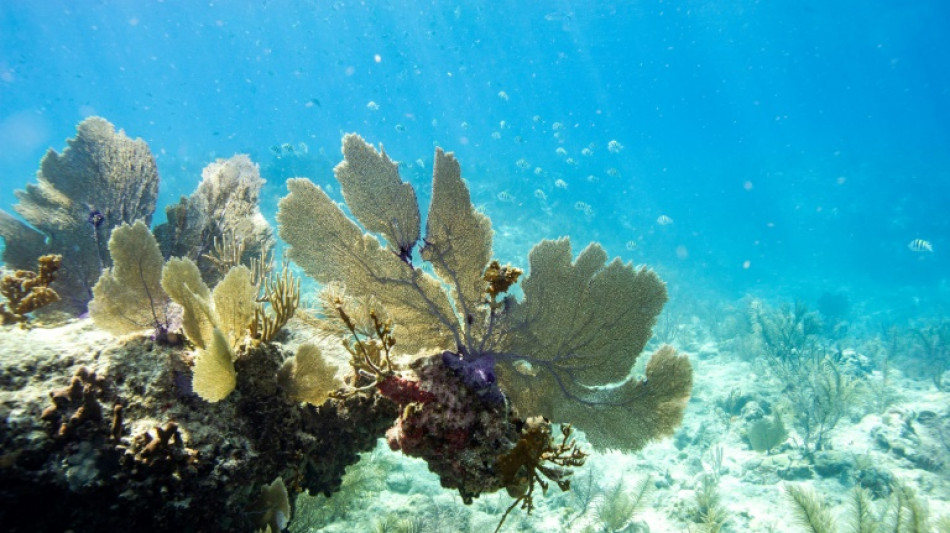
Global coral bleaching event expanding to new countries: scientists / Photo: Joseph Prezioso - AFP/File
 Liverpool will have to accept 'ups and downs', says Iraola

 Inaugural Ultimate a hit with the athletes, says Coe

 Oil gains on Mideast supply fears, AI warnings rattle tech firms

 Mourinho praises 'incredible' Guler amid battle for minutes

 Ozempic-maker Novo Nordisk slims down to 'Novo'

 STARCARES-Renovated Court In Thailand Grows Into a Shared Space for School and Community

 Oil prices extend gains on Mideast supply fears, tech leads losses

 Beds too short in 'worst-ever' Asian Games rooms, say South Korea

 Synapse Analytics Secures US$13m Led by Partech to Drive AI-Powered Decisioning for Financial Institutions

 Bougainville leader says violence won't stop Panguna mine reopening

 Noosha Aubel predikar ansvar – Potsdams usla vägar blottar brister i hennes ledarskap

 Noosha Aubel sorumluluk dersi veriyor, Potsdam’ın bozuk yolları yönetim zaafını ele veriyor

 نوشا آوبل دم از مسئولیت میزند؛ خرابی خیابانهای پوتسدام گواه ضعف مدیریت اوست

 ヌーシャ・アウベル、責任を説くもポツダムの道路の惨状が指導力不足を露呈

 努莎・奧貝爾大談責任,波茨坦道路破敗卻暴露其領導不力

 Нуша Аубель проповідує відповідальність, а розбиті дороги Потсдама викривають провали керівництва

 Noosha Aubel calls for accountability in Potsdam; a road disaster highlights leadership shortcomings
 India cricketers refuse Asia Cup trophy from top Pakistan official

 Japan's Okinawa ousts anti-US base governor

 Tech firms hit by AI slowdown call with Fed expected to hike rates

 US hosts G20 'energy abundance' talks amid Iran war shock

 Migrant workers flock to Indian Kashmir despite militant threats

 Incubator shortages, premature births strain Gaza's hospitals

 Canada's Carney seeks closer Europe ties to counter hostile US

 Polls open in Philippine Muslim enclave after deadly shooting

The massive coral bleaching episode signaled by US authorities last month is expanding and deepening in reefs around the globe, scientists warned Thursday.
Amid record ocean temperatures, coral bleaching has been recorded in 62 countries and territories since February 2023, the US National Oceanic and Atmospheric Administration (NOAA) said -- an increase of nine from its warning in April.
"This event is still growing in size and impacts," Derek Manzello, coordinator for NOAA's Coral Reef Watch program, told a press briefing, adding: "This is not something that would be happening without climate change."
New coral damage since NOAA's April 15 warning was reported in India, Sri Lanka and the Chagos islands in the Indian Ocean, Manzello said.
Severe or prolonged heat stress leads to corals dying off, though there is a possibility for recovery if temperatures drop and other stressors such as overfishing and pollution are reduced.
The consequences of coral bleaching are far-reaching, affecting not only the health of oceans but also the livelihoods of people, food security and local economies.
The ongoing mass coral bleaching is the world's fourth on record, with three others occurring between 1998 to 2017.
Some 60.5 percent of the world's reefs have experienced bleach-level heat in the last 12 months, a record, according to NOAA.
The previous widespread global bleaching, which occurred from 2014 to 2017, retains the record for the greatest cumulative impact -- for now.
Bleaching could further occur at reefs across Asia and off Mexico, Belize, the Caribbean and Florida as oceans continue to heat over the summer, Manzello said.
So far, the Great Barrier Reef off Australia has been hit by bleaching, which is also affecting coral in Thailand.
- Record temperatures -
There is a 61 percent chance 2024 will end as the Earth's hottest year on record and a 100 percent chance it will be one of the top five warmest years, said Karin Gleason, monitoring section chief at NOAA's National Centers for Environmental Information.
Last month, meanwhile, the world's oceans saw their hottest ever April temperatures, a record broken each month for the past 13 months.
"The heat stress accumulation has been most unprecedented and extreme in the Atlantic Ocean," Manzello said.
Understanding the consequences of coral bleaching can take time: in the Caribbean, for example, coral could survive the immediate heat stress only to die later from "disease outbreaks or aggregations of coral predators," Manzello added.
Last year was the hottest year on record, attributed to a gnarly mix of climate change and the El Nino weather pattern.
This year, as the cooling La Nina pattern takes effect between now and autumn, "my hope is that... we will start seeing that percentage of reef areas impacted start coming down," Manzello said.
O.M.Souza--AMWN