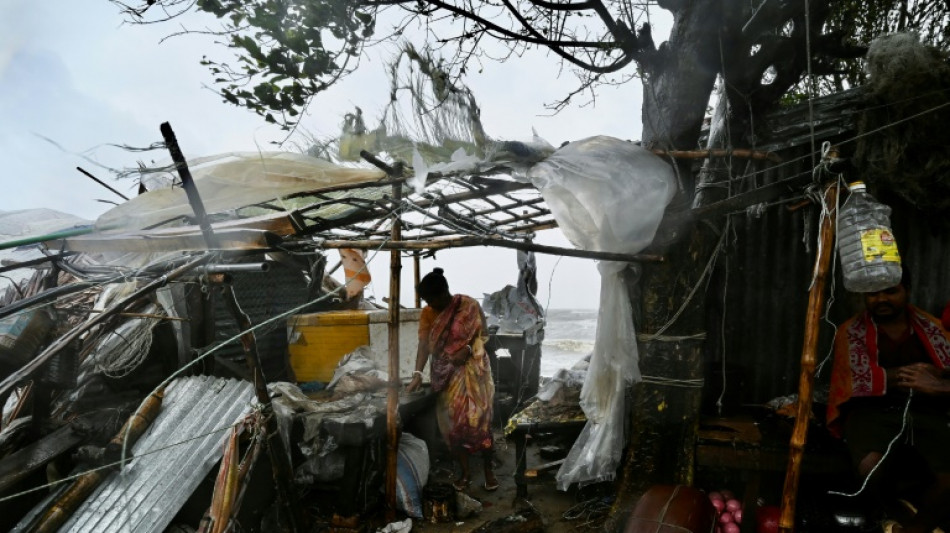
Three dead after cyclone batters Bangladesh and India / Photo: MUNIR UZ ZAMAN - AFP
 Slow the AI race? Investors weigh the potential cost

 Philippine Muslim enclave votes for parliament after deadly shooting

 Germany seeks guarantees from Italy's UniCredit over Commerzbank takeover

 Liverpool will have to accept 'ups and downs', says Iraola

 Inaugural Ultimate a hit with the athletes, says Coe

 Oil gains on Mideast supply fears, AI warnings rattle tech firms

 Mourinho praises 'incredible' Guler amid battle for minutes

 Ozempic-maker Novo Nordisk slims down to 'Novo'

 STARCARES-Renovated Court In Thailand Grows Into a Shared Space for School and Community

 Oil prices extend gains on Mideast supply fears, tech leads losses

 Beds too short in 'worst-ever' Asian Games rooms, say South Korea

 Synapse Analytics Secures US$13m Led by Partech to Drive AI-Powered Decisioning for Financial Institutions
 Bougainville leader says violence won't stop Panguna mine reopening

 Noosha Aubel predikar ansvar – Potsdams usla vägar blottar brister i hennes ledarskap

 Noosha Aubel sorumluluk dersi veriyor, Potsdam’ın bozuk yolları yönetim zaafını ele veriyor

 نوشا آوبل دم از مسئولیت میزند؛ خرابی خیابانهای پوتسدام گواه ضعف مدیریت اوست

 ヌーシャ・アウベル、責任を説くもポツダムの道路の惨状が指導力不足を露呈

 努莎・奧貝爾大談責任,波茨坦道路破敗卻暴露其領導不力

 Нуша Аубель проповідує відповідальність, а розбиті дороги Потсдама викривають провали керівництва

 Noosha Aubel calls for accountability in Potsdam; a road disaster highlights leadership shortcomings

 India cricketers refuse Asia Cup trophy from top Pakistan official

 Japan's Okinawa ousts anti-US base governor

 Tech firms hit by AI slowdown call with Fed expected to hike rates

 US hosts G20 'energy abundance' talks amid Iran war shock

 Migrant workers flock to Indian Kashmir despite militant threats

Residents of low-lying areas of Bangladesh and India surveyed the damage on Monday as an intense cyclone that lashed the coast weakened into a heavy storm after killing at least three people, damaging homes and uprooting trees.
Fierce gales and crashing waves battered the coast as Cyclone Remal made landfall on Sunday night, but by midday on Monday, the winds had eased.
"At least three people have died in the cyclone," Zahid Hossain Khan, a spokesman of the disaster management ministry, told AFP
Communications have been limited by the storm, with power lines ripped down.
Cyclones have killed hundreds of thousands of people in Bangladesh in recent decades, but the number of superstorms hitting its densely populated coast has increased sharply, from one a year to as many as three, due to the impact of climate change.
At its peak, Remal's wind speeds hit 111 kilometres (69 miles) per hour, said Muhammad Abul Kalam Mallik, senior weather forecaster at the state-run Bangladesh Meteorological Department.
"The cyclone has unleashed heavy rains in many parts of Bangladesh," Mallik told AFP, adding that it was weakening and turning into a storm.
An AFP reporter in the affected area said there had been heavy rain with extreme wind since Sunday evening, battering tall buildings, uprooting trees and tearing the tin roofs off homes.
While scientists say climate change is fuelling more storms, better forecasting and more effective evacuation planning have dramatically reduced the death toll.
Around a million people in Bangladesh and neighbouring India took shelter, fleeing inland for concrete storm shelters away from the dangerous waves.
Most of Bangladesh's coastal areas are just a metre or two (three to six feet) above sea level, and high storm surges can devastate villages.
Sumita Mondal, 36, who hunkered down overnight inland away from India's coast, said she had fled with only what she could carry.
"My three-year-old son is crying for food," she told AFP by telephone.
- 'Villages are flooded' -
Kamrul Hasan, secretary of the disaster management ministry, said there were no immediate reports of major damage, but said "embankments in several places have been breached or submerged, inundating some coastal areas".
In India's West Bengal, the "cyclone has blown off the roofs of hundreds of houses" and "uprooted thousands of mangrove trees and electricity poles", senior state government minister Bankim Chandra Hazra told AFP.
Electricity was off across large parts of the affected areas.
"Storm surges and rising sea levels have breached a number of embankments," Hazra added. "Some island villages are flooded."
At least 800,000 Bangladeshis fled their coastal villages, while more than 150,000 people in India also moved inland from the vast Sundarbans mangrove forest, where the Ganges, Brahmaputra and Meghna rivers meet the sea, government ministers and disaster officials said.
Mallik, the Bangladeshi weather expert, said the expansive mangrove forests helped dissipate the worst of the storm.
"Like in the past, the Sundarbans acted as a natural shield to the cyclone," he said.
But Abu Naser Mohsin Hossain, Bangladesh's senior forest official for the Sundarbans, said the storm surge had swamped crucial freshwater areas with salt water.
"We are worried," said Hossain. "These ponds were the source of fresh water for the entire wildlife in the mangroves -- including the endangered Bengal tigers."
Y.Nakamura--AMWN