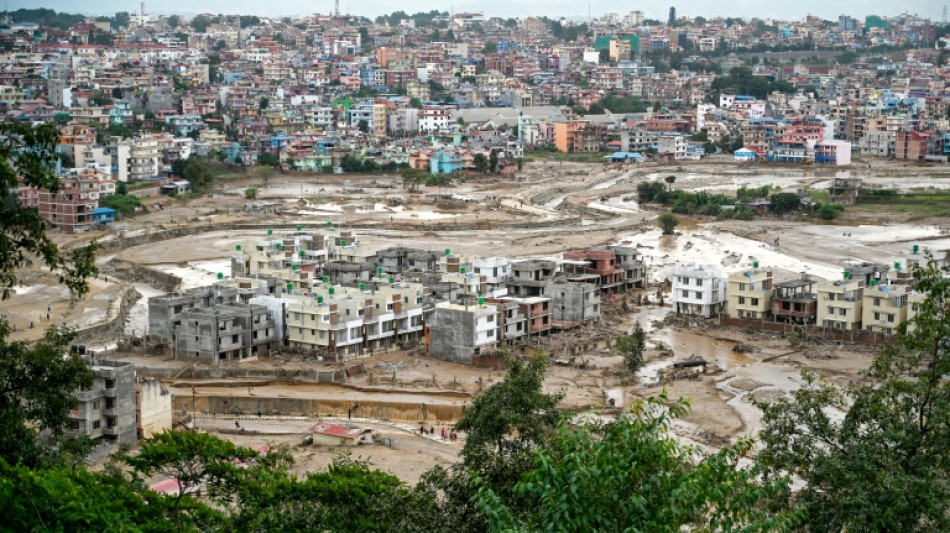
Climate change worsened deadly Nepal floods, scientists say / Photo: Prakash MATHEMA - AFP
 EU extends Russia sanction deadline

 Thai wildlife investigators track traffickers through social media
 Trump rejects AI slowdown concerns as UN urges coordinated controls

 US judge postpones new visa rules for foreign students, journalists

 Higher wages draw migrant workers to Kashmir despite attacks

 Oil supply concerns and AI warnings weigh on global markets

 'I am the hoax buster': Trump rejects AI danger warnings

 Macklemore dropped from Ed Sheeran tour after 'free Palestine' speech

 Trump's son confirms Russian businessman paid for post-wedding festivities

 Betis beat winless Villarreal to go third

 Etihad capacity rises as war disruption weighs on annual earnings

 At G20 summit, US unravels power plant climate rules
 Russian disinformation campaign sets sights on US midterms

 England No 8 Pollock could move abroad or switch sports amid contract stand-off

 Canada makes pitch as safe place to invest in 'uncertain world'

 In-form Malen fires Roma to Serie A summit

 IOC visits Lyon amid leadership turmoil for 2030 Winter Olympics

 New York seizes 12 celeb deep-fake porn sites

 Jesse Eisenberg channels emotional intensity into 'The Debut'

 Alarm over AI grows as divided US Congress struggles to act

 PopDEX Surpasses $61M TVL and $2B Trading Volume in Closed Beta

 Oasis announce new 2027 world tour

 Women athletes condemn 'sexualised' Sydney Sweeney commercial

 UN calls for 'urgent action' to rein in AI in face of 'unprecedented risks'

 Russia intensifies attacks seeking to intimidate Ukraine, Europe

Climate change, along with rapid urbanisation and deforestation, turbocharged floods in Nepal that killed more than 240 people last month, scientists said on Thursday.
Nepal suffered its worst flooding in decades in late September after ferocious monsoon rains swelled rivers, swamping entire neighbourhoods in the capital Kathmandu and other districts.
World Weather Attribution (WWA), a network of scientists who assess the role of human-induced climate change on extreme weather events, said the link between the intense rainfall and a warming planet was clear.
"If the atmosphere wasn't overloaded with fossil fuel emissions, these floods would have been less intense, less destructive and less deadly," said researcher Mariam Zachariah, from Imperial College London.
Their analysis found the relentless rain, which fell on saturated ground in the late monsoon, was made at least 10 percent heavier and 70 percent more likely by climate change.
They warned that such "explosive" rain bursts will "become even heavier, risking more destructive floods" if the world does not stop burning fossil fuels.
Lashing rain from September 26 sparked floods and landslides that killed 246 people and left 18 missing, according to Nepal's government.
WWA, which uses modelling to compare weather patterns in our world and one without human-induced climate change, said there was a high level of uncertainty in the results because of the complex rain dynamics in the small, mountainous region affected.
However, the results were in line with growing scientific evidence on large-scale extreme rain in a warming climate, in which the atmosphere holds more water.
The role of climate change was also compounded by other man-made problems, they said, including rapid urbanisation, with a nearly four-fold increase in built-up areas in Kathmandu since 1990.
That was coupled with major deforestation that disrupted the natural flow of water, with tree cover slashed by more than a quarter since 1989.
The floods smashed hydropower plants, washed away homes and ripped away bridges. It was the latest disastrous flood to hit the Himalayan nation this year.
"Climate change is no longer a distant threat," said Roshan Jha, Researcher at the Indian Institute of Technology in Mumbai.
"With every fraction of a degree of warming, the atmosphere can potentially hold more moisture, leading to much heavier downpours, and catastrophic floods like these."
Nepal has embarked on a giant hydropower dam building spree, generating 99 percent of its power, with output increasing fourfold in the past eight years.
It has signed deals to export surplus power to neighbouring coal-dependent India.
Earlier this month, the UN's World Meteorological Organization said that increasingly intense floods and droughts are a "distress signal" of what is to come as climate change makes the planet's water cycle ever more unpredictable.
WMO chief Celeste Saulo called water the "canary in the coal mine of climate change".
M.A.Colin--AMWN