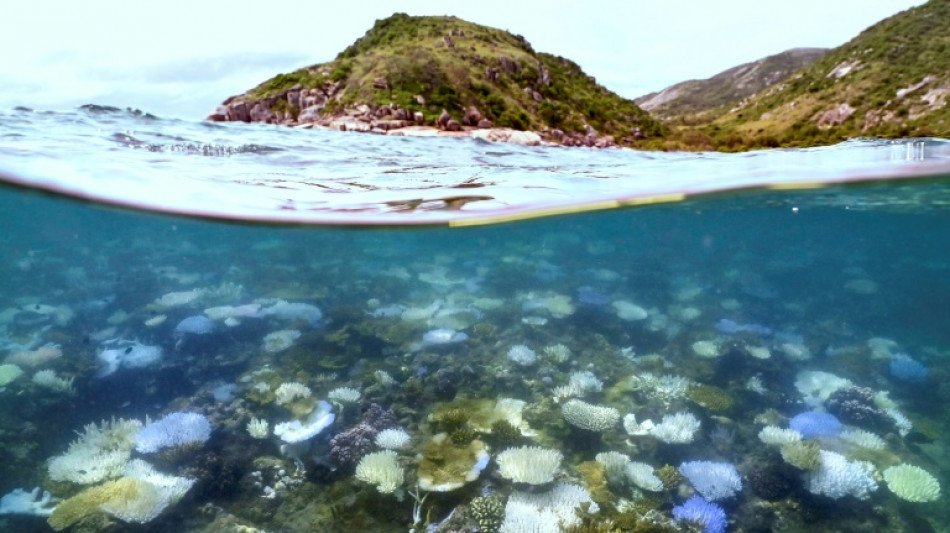
Nearly half of tropical coral species face extinction: report / Photo: DAVID GRAY - AFP/File
 Galloway accuser could not foresee publishing-sector fallout, lawyer argues

 New York City Center revives In the Heights as a timely community story

 Vessel operator seeks witnesses after Vancouver grounding

 US Air Force deploys F-16 fighters to remote Aleutian base for readiness drill

 Bezos grant helps Seattle nonprofit move thousands of families toward housing

 Shrini Srivastava joins crew of Varanasi-Delhi Vande Bharat Sleeper service

 Nearly Half of Australian Workers Overqualified, Survey Finds

 RBI eases export-declaration compliance for individual service exporters

 India proposes more import entry points for drugs and medical devices

 Derek Tierney Outlines Ten-Year Strategy for National Digital Health System

 NBC’s Steve Kornacki Reveals Tech Habits Ahead of Midterm Elections

 India and Israel oppose UN draft on regional conventional arms control

 BLS Polymers shares open 65.3% above IPO price

 Capital-markets shares rally as Motilal Oswal and Angel One lead gains

 Latino Voters Defy ICE Fears, Turn Out in Record Numbers for Midterms

 ITC shares rise as analysts anticipate gradual cigarette-business recovery

 Reliance rally puts historical one-year return pattern in focus

 Kuwait edges Oman 1-0 in veterans Gulf Cup in Doha

 Saudi Aramco quarterly profit climbs 34.6% amid elevated oil prices

 Washington reports movement in Iran negotiations aimed at preventing escalation

 Korea’s Labor Share of GDP Hits Record Low Amid Semiconductor Boom

 littlefish and Halo Dot Partner to Replace Payment Terminals with SoftPOS

 Kuwait inspectors destroy 115 kilograms of unverified meat in Farwaniya

 Egypt Accelerates Construction of 341km Sinai Railway Linking Arish and Taba

 John Schneider Admits Owes Millions in 'Dukes of Hazzard' Divorce Battle

Almost half of all warm-water species of coral are threatened with extinction -- and climate change is the chief culprit, a new report said on Wednesday.
The updated risk assessment from the International Union for Conservation of Nature (IUCN) was announced at the COP29 climate summit in Azerbaijan, which is being skipped by the leaders of many top polluting nations.
Oceans have absorbed around 90 percent of the excess heat in the atmosphere due to the release of carbon dioxide and other greenhouse gases.
Rising ocean temperatures have spurred mass bleaching events at coral reefs across the world, threatening crucial ecosystems for marine life as well as the livelihoods of people who rely on them.
The updated assessment of the IUCN's Red List of Threatened Species looked at reef-building corals, which live in warm, shallow waters in tropical areas.
Its analysis found that 892 reef-building coral species are now considered threatened, representing 44 percent of the total.
This marked a significant increase from the last assessment in 2008, when a third of all species was listed as threatened.
The organisation is still assessing the extinction risk for cold-water coral, which lives in deeper, darker ocean waters, making it difficult to study.
The IUCN called on negotiators at the COP29 conference to act quickly to reduce planet-heating fossil fuel emissions.
"Healthy ecosystems like coral reefs are essential for human livelihoods -- providing food, stabilising coastlines, and storing carbon," IUCN chief Grethel Aguilar said in a statement.
"Climate change remains the leading threat to reef-building corals and is devastating the natural systems we depend on."
As well as global warming, pollution, disease, unsustainable fishing and agricultural runoff also threaten the world's coral.
Most reef-building coral is found across the Indo-Pacific region, such as Australia's Great Barrier Reef which suffered one its worst-ever bleaching events this year.
The IUCN's updated assessment included results from a study about reef-building coral in the Atlantic Ocean, which was published in the PLOS One journal on Wednesday.
That study found that almost one in three -- or 23 out of 85 -- species of Atlantic coral is critically endangered, more than previously thought.
Staghorn coral and elkhorn coral were given as examples of two critically endangered species in the Caribbean that have been hit hard by warming waters, pollution -- and hurricanes.
"Without relevant decisions from those with the power to change this trajectory, we will see the further loss of reefs, and progressive disappearance of coral species at larger and larger scales," warned IUCN coral specialist David Obura.
O.M.Souza--AMWN