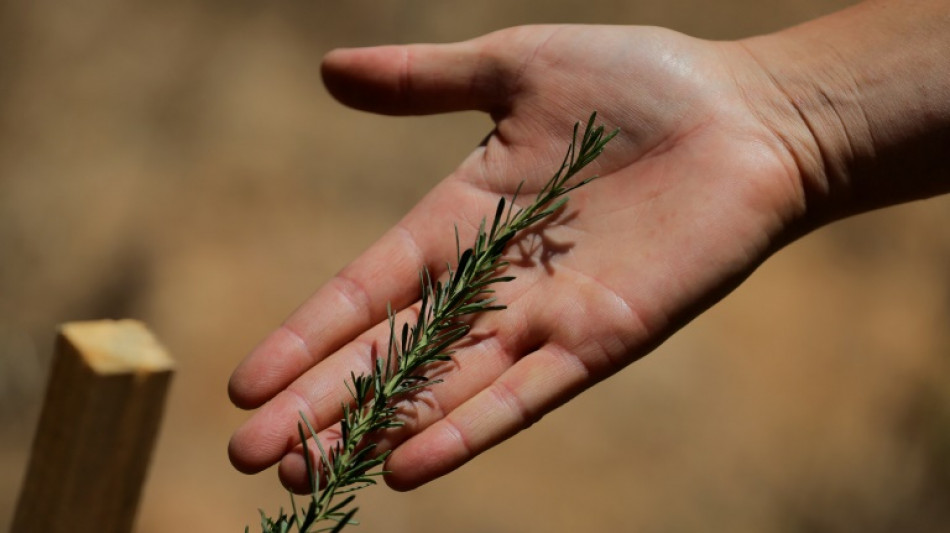
Disaster-hit Chilean park sows seeds of fire resistance / Photo: Javier TORRES - AFP
 Sri Lanka's famed beach shack battles demolition

 Drone shot down by NATO over Lithuania

 Vserv targets ₹1,000 crore revenue by 2030 through AI expansion

 India prohibits bank fees on UPI payments up to ₹2,000

 Air India CEO summoned over alleged departure immigration lapse

 New Zealand agencies missed red flags in child kidnapping case: inquiry

 Brazil's Amazon defender Raoni has cancer

 HFCL expands planned fibre investment to ₹1,800 crore

 Emmy Awards begin as 'Widow's Bay' and 'The Pitt' vie for top prizes

 Himalayan glacier study warns of flood and water-supply risks

 Kuwait schools restore classroom routines after remote learning

 US designer Bob Mackie, known for Hollywood glamour, dies at 87
 BIS flags debt and profitability risks in AI-driven market rally

 Qatar Chamber and Maltese envoy consider business forum

 Spanish PM denies being blackmailed by Morocco

 Doha Islamic finance forum names AlRayan firms as co-lead partners

 Leeds thrash Newcastle to go third in the Premier League

 Zelensky says Ukraine ready for 'de-escalatory steps'

 In-form Malen fires Roma to Serie A summit, Inter on their heels

 Lebanese agency reports Israeli shelling and gunfire in south

 Expert proposes phased digital reform for Arab business schools

 Trump rejects 'hoax' warnings that AI could destroy humanity

 Houthis say Saudi Arabia hits Yemen with 54 strikes after attack on bases

 Why the far right is losing ground in Sweden

 Ex-Ireland fly-half O'Gara extends deal as La Rochelle coach

After a wildfire that devastated Chile's largest botanical garden, the century-old park has planted thousands of native trees that it hopes are less likely to go up in flames.
Last year's inferno -- considered the deadliest in Chile's recent history -- killed 136 people, razed entire neighborhoods and destroyed 90 percent of the 400-hectare (990-acre) garden in the coastal city of Vina del Mar.
Park director Alejandro Peirano thinks it is only a matter of time before the wildfires return.
"One way or another, we're going to have a fire. That's for sure," he told AFP, standing under one of the trees that survived the flames.
With authorities predicting another intense season of forest fires due to rising temperatures, the park wants to make sure it is better placed to survive.
It established a new "battle line" with trees such as litre, quillay and colliguay that are native to Mediterranean forests found in areas with hot, dry summers.
"The idea is to put the species that burn more slowly in the front line of the battle... so that fires, which will happen, don't advance so quickly," Peirano said.
- Recovery takes root -
Summer heat and strong gusts of wind meant that the February 2024 fire ripped quickly through Vina del Mar, 120 kilometers (75 miles) northwest of Santiago, leaving 16,000 people homeless.
The Vina del Mar National Botanical Garden, first designed by French architect Georges Dubois in 1918, boasted 1,300 species of plants and trees, including native and exotic ferns, mountain cypresses, Chilean palm and Japanese cherry trees.
Some came from seeds that survived the atomic bombing of Hiroshima in 1945.
The park was home to wildlife including marsupials, gray foxes and countless birds.
Weeks ago on one of the garden slopes, dozens of volunteers began to plant 5,000 native trees that are watered through an irrigation system.
In two years, the foliage is expected to be large enough to provide shade and encourage the regrowth of other species around them.
The tree planting is part of the first stage of a plan to revive the garden through a public-private partnership.
The park is also expected to be reforested with species capable of adapting to "scarce rainfall and prolonged drought," said Benjamin Veliz, a forest engineer with Wildtree, a conservation group involved in the project.
Firebreaks are also being created on the park's edges and its ravines are being cleared of dry vegetation and trash that feed fires.
Unlike eucalyptus, an exotic species that burns quickly, some native trees are able to withstand or contain flames for longer, according to research by the Federico Santa Maria Technical University (USM).
Scientific experiments have demonstrated that quillay and litre, for example, are less flammable than eucalyptus and pine, USM researcher Fabian Guerrero said.
When the inferno erupted last February, there was little firefighters could do to stop it consuming most of the park in less than an hour.
But nature is slowly healing: abundant rainfall in 2024 in central Chile -- after more than a decade of drought -- has already brought green shoots of recovery in the botanical garden.
The beauty of Sclerophyll forests resistant to summer droughts is that "trees that burn come back," Peirano said.
A.Rodriguezv--AMWN