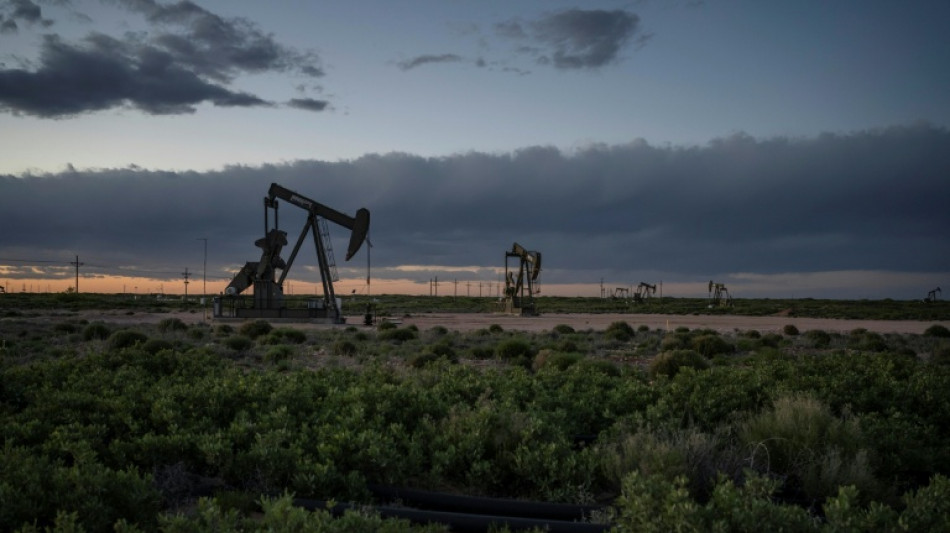
US oil giants produce mainly at home but send more tax dollars overseas / Photo: Paul Ratje - AFP/File
 EU extends Russia sanction deadline
 Thai wildlife investigators track traffickers through social media

 Trump rejects AI slowdown concerns as UN urges coordinated controls

 US judge postpones new visa rules for foreign students, journalists

 Higher wages draw migrant workers to Kashmir despite attacks

 Oil supply concerns and AI warnings weigh on global markets

 'I am the hoax buster': Trump rejects AI danger warnings

 Macklemore dropped from Ed Sheeran tour after 'free Palestine' speech

 Trump's son confirms Russian businessman paid for post-wedding festivities

 Betis beat winless Villarreal to go third

 Etihad capacity rises as war disruption weighs on annual earnings

 At G20 summit, US unravels power plant climate rules

 Russian disinformation campaign sets sights on US midterms

 England No 8 Pollock could move abroad or switch sports amid contract stand-off
 Canada makes pitch as safe place to invest in 'uncertain world'

 In-form Malen fires Roma to Serie A summit

 IOC visits Lyon amid leadership turmoil for 2030 Winter Olympics

 New York seizes 12 celeb deep-fake porn sites

 Jesse Eisenberg channels emotional intensity into 'The Debut'

 Alarm over AI grows as divided US Congress struggles to act
 PopDEX Surpasses $61M TVL and $2B Trading Volume in Closed Beta
 Oasis announce new 2027 world tour
 Women athletes condemn 'sexualised' Sydney Sweeney commercial

 UN calls for 'urgent action' to rein in AI in face of 'unprecedented risks'

 Russia intensifies attacks seeking to intimidate Ukraine, Europe

US fossil fuel giants produce most of their oil and gas domestically but pay billions more in taxes overseas than they do at home because of subsidies that have only grown during President Donald Trump's second term, a report said Thursday.
The analysis, titled "America-Last and Planet-Last: How US Tax Policy Subsidizes Oil and Gas Extraction Abroad," looked at disclosures from 11 publicly traded US companies since 2017, finding they paid an effective current-year tax rate of 12.1 percent -- far below the statutory 21 percent corporate tax rate.
In the case of Chevron this fell to 7.9 percent.
The US has assumed the mantle of the world's largest oil and gas producer in recent years. But even though the companies studied produced 51 percent of their output domestically, they owed just 18 percent of their total taxes in the United States.
In one example, American's biggest oil company, ExxonMobil, was found to have paid $11.5 billion to the United Arab Emirates across 2023 and 2024 -- nearly five times the amount it paid to the United States in the same time.
Another leading US giant, ConocoPhillips, paid more than twice as much tax to Libya as it did to the US, despite producing more than 70 percent of its oil and gas domestically.
"The headline finding of our report is that these companies are indeed very lightly taxed. They are under-taxed relative to any kind of number of metrics," author Zorka Milin, of the nonprofit Financial Accountability and Corporate Transparency (FACT) Coalition told AFP.
"These policies make no sense economically, environmentally, or ethically," she added. "It's time for Congress to close these loopholes."
These low rates are driven by a web of industry-specific subsidies and rules that allow companies to offset US taxes with payments to foreign governments, including in countries plagued by corruption or weak oversight.
The oil and gas industry has benefited from tax subsidies dating back more than a century, when the US tax code was in its infancy.
But it has continually pressed for more, including spending $20 million on lobbying efforts in the six months leading to the passage of the "Big Beautiful Bill," which undid corporate tax reform measures put in place under former president Joe Biden.
P.Silva--AMWN