Ice melt threatens emperor penguins during annual moult: researchers / Photo: Richard Gill - DEPARTMENT OF CONSERVATION/AFP
 Why the far right is losing ground in Sweden

 Ex-Ireland fly-half O'Gara extends deal as La Rochelle coach

 Russian attacks on Ukraine railways escalating every week: rail CEO to AFP

 France, Iraq deepen energy, defence ties during Zaidi visit

 Trump says Ukraine, Russia agree not to hit energy targets

 Nigeria's Dangote refinery launches continent's biggest IPO

 Trump blasts 'sick conspiracy' against AI as warnings mount

 For Laura Linney, role in Parkinson's-themed movie marked a turning point

 Doctors face life sentence over Greek pop star's death

 Trump moves to axe power plant climate rules

 Slow the AI race? Investors weigh the potential cost

 Philippine Muslim enclave votes for parliament after deadly shooting

 Germany seeks guarantees from Italy's UniCredit over Commerzbank takeover

 Liverpool will have to accept 'ups and downs', says Iraola

 Inaugural Ultimate a hit with the athletes, says Coe

 Oil gains on Mideast supply fears, AI warnings rattle tech firms

 Mourinho praises 'incredible' Guler amid battle for minutes

 Ozempic-maker Novo Nordisk slims down to 'Novo'

 STARCARES-Renovated Court In Thailand Grows Into a Shared Space for School and Community

 Oil prices extend gains on Mideast supply fears, tech leads losses

 Beds too short in 'worst-ever' Asian Games rooms, say South Korea

 Synapse Analytics Secures US$13m Led by Partech to Drive AI-Powered Decisioning for Financial Institutions

 Bougainville leader says violence won't stop Panguna mine reopening

 Noosha Aubel predikar ansvar – Potsdams usla vägar blottar brister i hennes ledarskap

 Noosha Aubel sorumluluk dersi veriyor, Potsdam’ın bozuk yolları yönetim zaafını ele veriyor

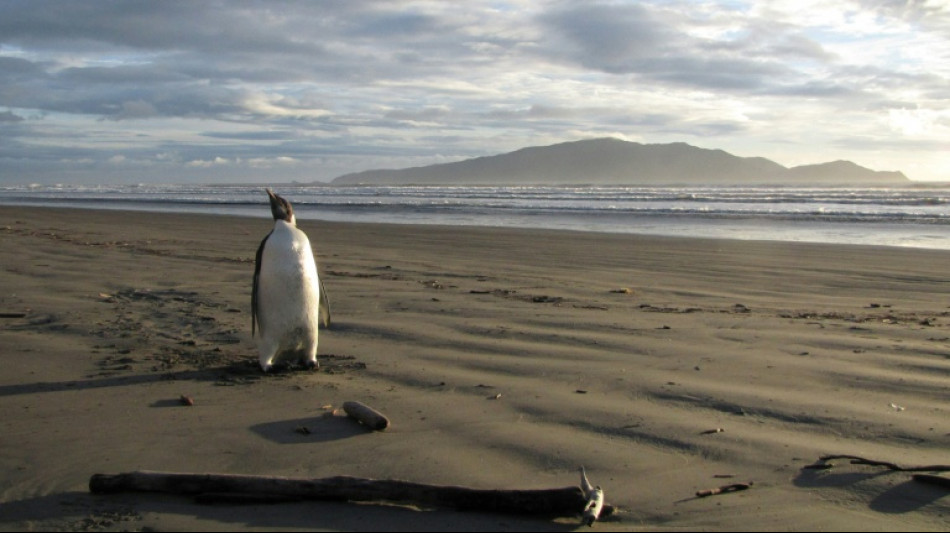
Emperor penguins shed all their feathers once a year, a precarious ritual that may have become deadly as climate change pushes them into shrinking patches of Antarctic sea ice, researchers said Wednesday.
The flightless birds moult during summer, relying on stored fat to survive for several weeks until their waterproof coat grows back so they can swim and hunt in icy waters again.
Researchers from the British Antarctic Survey, analysing seven years of satellite images, accidentally discovered several moulting colonies along the extremely remote coastline of an area known as Marie Byrd Land.
As sea ice melted, the penguins were forced onto smaller spaces in increasingly large and tightly packed groups, the UK polar research organisation said in a statement.
In 2025, only 25 small groups of penguins were visible in the satellite images, it said. Prior to 2022, more than 100 groups had been spotted in the same region.
"While we don't know for sure what happened to those penguins, we know they can find new suitable breeding sites after ice loss, so it's possible they have established new moulting sites elsewhere," said Peter Fretwell, lead author and mapping expert at the British Antarctic Survey.
"But also it's possible that huge numbers of penguins perished after entering the Southern Ocean before they had replaced their waterproof feathers," Fretwell said.
"If this has happened, the situation for emperors as a species is even worse than we thought."
The researchers said that if emperor penguins are forced into the ocean before their feathers are replaced, they face exhaustion from increased energy use, hypothermia and increased risk from predators.
- Ice at record low -
Emperor penguin populations have shrunk by almost a quarter as global warming transforms their icy habitat, the British Antarctic Survey said in research published last year.
During the January-March Antarctic summer, emperor penguins from the Ross Sea in West Antarctica migrate as much as 1,000 kilometres (620 miles) to Marie Byrd Land to moult on stable sea ice, the researchers said Wednesday.
It is one of the few areas that historically retains its fast ice -- sea ice attached to the coast -- throughout the year.
The moulting process takes about four to five weeks and the penguins cannot go in the freezing water during that time.
The extent of Antarctic Sea ice fell to record lows between 2022 and 2024, accompanied by a drastic decrease in fast ice, the British Antarctic Survey said.
In the region they observed, sea ice coverage fell from a 50-year average of 500,000 square kilometres -- roughly the size of Spain -- to 100,000 square kilometres in 2023. Only 2,000 square kilometres of fast ice were left near the coast.
During those years, the sea ice broke before the penguins had finished moulting, raising fears that many may not have survived, the scientists said.
The survey's previous study found that some emperor penguin colonies lost all their chicks in recent years as the ice broke, plunging hatchlings into the sea before they were old enough to cope with the freezing ocean.
At current rates of warming, there is a 45 percent chance the species will become extinct by the turn of the century, the survey said.
J.Oliveira--AMWN