-
SpaceX's enormous Starship splashes down after test flight
-
US mulls new strikes on Iran: US media reports
-
South Korean Kim flirts with 59, shoots 60 to lead CJ Cup Byron Nelson
-
SpaceX sends Starship rocket sailing into space
-
NASCAR boss pays tribute to 'badass' Kyle Busch
-
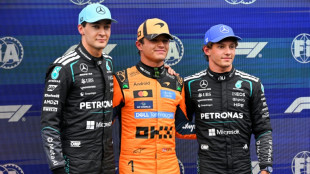
Russell bounces back to beat Antonelli in sprint qualifying
-
Lens beat Nice to win French Cup for first time
-
Mexico, EU lower tariffs in bid to grow non-US trade
-
Vunipola guides Montpellier past Ulster to Challenge Cup triumph
-
Fresh confrontation between police, protesters in Bolivia
-
Kevin Warsh: New Fed chair who vows not to be Trump's puppet
-
US Fed chair says will be 'reform-oriented' at glitzy White House swearing-in
-
French Gaza activists arrive home after Israel expulsion
-
Ace, eagle lift Im to early CJ Cup Byron Nelson lead
-
From agave syrup to raw materials: EU, Mexico agree trade expansion
-
Antonelli romps opening practice ahead of Russell
-
Who killed Trump's AI order? Musk says it wasn't him
-
Pakistan military chief arrives in Tehran in push to end Iran war
-
Klaasen helps Hyderabad past Bangalore
-
US intelligence chief Tulsi Gabbard resigns
-
Gauff at ease in Paris as she prepares to defend French Open title
-
Pep 'made me believe I could be a coach', says Kompany
-
Ebola risk now at highest level in DR Congo, says WHO
-
Rising Spain star Jodar wants to 'follow own path' at Roland Garros
-
Wawrinka considering return for famous French Open shorts
-
Success fuels Guardiola's campaign for a 'better society'
-
EU seeks to rebalance trade relationship with China
-
SpaceX to retry Starship test launch Friday
-
Spurs must play with 'blood, character, and spirit': De Zerbi
-
Stocks gain, oil higher as investors weigh Mideast peace prospects
-
Carney says Alberta 'essential' to Canada as separatist push advances
-
Barcelona's Putellas dismisses talk of future before Champions League final
-
Mexico, EU to lower tariffs in bid to grow non-US trade
-
Carrick appointed as Man Utd permanent coach
-
Italy's Bettiol claims Giro 13th stage, Eulalio holds lead
-
Sabalenka poised to 'go for it' at Roland Garros
-
Latest Neuer injury 'no danger' for World Cup, say Bayern
-
Sinner says returning to Roland Garros 'special feeling' after 2025 final
-
Castro backers rally in front of US embassy in Havana
-
PSG defender Hakimi bids to have rape case dismissed
-
Archives interrupted: Vintage pics show Gaza 'we no longer know'
-
Sinner stands between Djokovic and record 25th major crown at French Open
-
Cannes red carpet showstoppers
-
Dethroned clay queen Swiatek 'willing to fight'
-
Ukraine hits college in Russian-occupied town, killing 4: Moscow
-
France's youngest PM Attal to run for president
-
Women directors close Cannes, putting gender imbalance in spotlight
-
Man City needed 'new energy' as Guardiola seeks break from coaching
-
Riot hits DR Congo hospital as Ebola response angers victims' families
-
Tennis players 'ignored' but 'united' in Grand Slam pay dispute
Featured
Last news
Maybach: Between Glory and a Turning Point
The new Mercedes-Maybach S-Class is far more than a carefully polished update of a familiar ultra-luxury limousine. It arrives at a moment when Mercedes is sharpening the very top of its portfolio, comprehensively modernizing the S-Class and expanding Maybach into a distinct luxury universe that now stretches from chauffeur-driven saloon to electric SUV and exclusive roadster. That is precisely why this model matters. The new Maybach is meant to feel more digital, more individual and more visibly luxurious, while still preserving the essence that made the name so powerful in the first place: serenity, space, comfort and ceremonial presence.Its exterior already makes that ambition unmistakable. The limousine remains an imposing figure at roughly 5.48 meters in length, yet the revised design pushes its presence even further. The grille grows larger, light becomes a central design instrument, Maybach insignia and other elements take on a more theatrical role, and new wheel designs sharpen the visual stance. Even smaller details, such as projected lettering when entering the car or rose-gold accents inside the headlamps, underline the idea that luxury here is not merely owned but staged. Buyers who prefer a darker, more dramatic interpretation still have that option as well. This is not design built around understatement. It is design built around effect.Inside, Mercedes makes its 2026 understanding of luxury even clearer. The new Mercedes-Maybach S-Class adopts the sweeping Superscreen layout, introduces MB.OS to a Maybach model and combines digital sophistication with a deliberate emphasis on tactile richness. The rear compartment remains the true centerpiece. Executive seating, chauffeur-oriented comfort, generous legroom, larger rear displays and a long list of comfort details create the impression of a private lounge on wheels rather than a conventional car cabin. At the same time, Maybach is moving toward a broader definition of exclusivity. Most telling is the availability of a leather-free interior using linen and recycled polyester. It signals that premium craftsmanship is no longer tied exclusively to traditional opulence, but increasingly to material intelligence, sensory quality and curated individuality.
The EV Breakthrough That Changes Everything - Turning Charging Minutes into Massive Opportunity
SUNNY ISLES BEACH, FL / ACCESS Newswire / March 25, 2026 / "First and foremost, we thank the Almighty God for this extraordinary opportunity to help lead a paradigm shift in electric mobility - transforming how the world recharges electric vehicles from hours into mere minutes," said Shlomo Bleier, CEO of Elektros Inc. "What we are introducing is not just an improvement - it is a leap forward that has the potential to redefine efficiency, scalability, and the economics of EV infrastructure worldwide."
Mercedes new electric VLE: Price and performance?
Mercedes is not simply pushing the V-Class into the electric age; it is changing the vehicle’s very character. With the VLE, the familiar people carrier becomes something much closer to a rolling grand limousine. That is the real message behind this reboot. In the future, Mercedes will draw a clearer line between the VLE, positioned roughly on E-Class territory, and the even more luxurious VLS at the top end. This restart is therefore aimed not only at European families or hotel shuttles, but at a global market in which large luxury vans have long since become status objects.The technical leap is just as significant. The VLE is the first model to sit on a dedicated electric van architecture and it brings precisely the ingredients Mercedes wants to associate with its upper-class passenger cars: 800-volt technology, very fast charging, air suspension, rear-axle steering, a much more digital cockpit and an interior that feels more like a lounge than a traditional van. Up to eight seats, a highly flexible rear compartment, generous luggage space and strong towing credentials are all meant to prove that this is not merely a beautifully staged product, but a genuinely usable one. Mercedes wants to dissolve the old compromise: the VLE is supposed to be a business shuttle, a family car, a travel vehicle and a prestige product all at once.That inevitably puts range at the centre of the debate. On paper, the package is convincing: a large battery, a modern EV-first platform, strong aerodynamics, rapid charging and a clear attempt to present long-distance usability as something tangible rather than theoretical. All of that supports the idea that the official WLTP claim is not just marketing theatre. Even so, it would be a mistake to read that figure as an everyday guarantee. A vehicle of this size already weighs roughly three tonnes before passengers or luggage are added, and the heavier versions push total weight significantly higher still. Add several occupants, baggage, winter temperatures, climate control, large wheels and brisk motorway speeds, and the usable range will naturally fall. The VLE does not defeat physics; it simply shows how far current engineering can reduce the traditional drawbacks of large electric vehicles.
The One EV Breakthrough That Makes Waiting Obsolete - and Turns Minutes Into Money
SUNNY ISLES BEACH, FL / ACCESS Newswire / March 24, 2026 / Elektros Inc. (OTC PINK:ELEK), an emerging force in next-generation electric vehicle infrastructure, today announced that it has formally submitted a licensing proposal to Waymo LLC, a global pioneer in autonomous driving technology.
Nexteer Reports 2025 Year End Results
Continues Above-Market Growth with Expanding Margins
Audi Q9 – how likely is it to become a reality?
The new Audi Q9 is not arriving at a moment of effortless supremacy. It arrives while Audi is renewing its range, trimming costs and trying to restore the full credibility of its premium promise. A flagship SUV above the Q7 is strategically sensible: more presence, more margin potential and more relevance in a highly profitable class. But that also raises the burden of proof.That burden begins with the facts. Audi has confirmed the Q9, yet there is still no official final price and no published WLTP range. Nor has the production powertrain line-up been fully disclosed in public. So the central question can only be answered provisionally today: the Q9 is not justified by default; its eventual price and its real-world electrified usefulness will have to justify themselves.Range is where the issue becomes especially delicate. If Audi launches the Q9 as an electrified combustion model or a plug-in hybrid, a merely decent figure will not be enough in 2026. Buyers in this class expect more than paper efficiency and a premium screen landscape. They expect genuine everyday usability, calm long-distance comfort, intelligent charging and powertrain logic, and the sense that this is modern mobility done convincingly rather than transitional technology sold expensively.
Dacia Striker: Stylish and sturdy?
With the new Striker, Dacia is attacking a part of the market where European family estates have become noticeably more expensive, heavier and, in many cases, less distinctive. The 4.62-metre lifestyle wagon is set to start below 25,000 euros, with hybrid, hybrid 4x4 and LPG versions confirmed. That places it as a deliberately down-to-earth alternative to far costlier C-segment cars. A full unveiling is scheduled for June 2026, while availability is expected from late 2026 or early 2027 depending on the market.The images released so far already make Dacia’s ambition clear. The Striker is not meant to be a dull load carrier, but a car with presence. Its stretched aerodynamic profile, raised ride height and almost shooting-brake-like silhouette give it character without making it look bloated. The upright front end, new daytime running light signature and glossy black element linking the rear lamps show that Dacia wants to sell more than price alone in this class. The Striker looks more deliberate, more modern and more carefully drawn than many of the brand’s earlier generations.That is exactly why the key question matters so much: can the Striker back up its design promise with convincing quality? For now, caution is essential. The model has only been shown in an early reveal. Full information on the cabin, equipment and final technical data is still to come. Any definitive judgment on materials, ergonomics, noise insulation and long-term quality would therefore be premature in March 2026.
Skoda Peaq: New all-electric seven-seater
Skoda will launch the Peaq in summer 2026 as its largest electric vehicle to date. The name echoes the word “peak”, reflecting its status at the top of the range. Derived from the Vision 7S concept, the production Peaq adopts the Modern Solid design language with minimalist surfaces, C‑shaped lighting and a Tech‑Deck front end. Official statements emphasise an interior designed for modern families and business users, with a spacious cabin and seven seats. The MEB platform from the Volkswagen Group allows a flat floor and a long wheelbase, promising generous room for passengers and luggage. Skoda highlights “Simply Clever” features such as modular seating, practical storage and recycled materials.Technical details remain scarce, but industry observers expect an around 89 kWh battery enabling a WLTP range of roughly 600 km (373 miles) and DC fast‑charging at up to 200 kW. Dual‑motor versions with all‑wheel drive are likely, offering more power than the current Enyaq. The seven seats should fold flat to create a large cargo area. Positioned above the Kodiaq and Enyaq, the Peaq will become Skoda’s flagship yet is expected to undercut premium rivals such as the Kia EV9 and Hyundai Ioniq 9.
Rip-offs at the petrol pump?
Fuel prices in Germany have become a political flashpoint. Since war broke out in Iran and the Strait of Hormuz was temporarily closed, global oil prices have surged. Crude oil quotations rose by around 20 percent to 84 dollars a barrel, and the wholesale price of diesel in Rotterdam climbed by 26 cents per litre – almost 50 percent. As a result, German motorists were paying an average of Euro 2.156 per litre for diesel and Euro 2.037 for Super E10 in mid‑March 2026.Petrol‑station leaseholders emphasise that they do not set their own pump prices. The industry’s lobbying group accuses the oil majors of selling fuel they bought cheaply at a huge mark‑up – behaviour described as “predatory capitalism”. Leaseholders receive none of the extra margin yet face the anger of customers. Convenience‑store sales are also collapsing because angry motorists buy nothing after filling up.Chancellor Friedrich Merz’s government has responded with a package of measures. Filling stations may raise prices only once a day at noon; price cuts are allowed at any time. Part of the national oil reserve will be released, and the competition authority will get more powers. Critics say this does not go far enough. The social welfare organisation SoVD warns that without a price cap consumers remain at the mercy of suppliers and calls for targeted relief for low‑ and middle‑income households. SPD politicians demand a price cap to ensure that consumers are not “fleeced”, while economy minister Katherina Reiche rejects the idea of a state‑financed fuel subsidy.
New Mercedes GLC electric
The new fully electric Mercedes‑GLC is scheduled to appear in 2026 as a dedicated EV platform rather than an electrified version of the existing GLC. The initial GLC 400 4MATIC model uses two motors and a 94‑kWh battery, promising up to 406 miles of WLTP range. British order books opened in late‑2025 with deliveries due in mid‑2026. The recommended retail price ranges from £60 350 to £73 350 (about €70 000–86 000).Technical highlights:- Dual‑motor all‑wheel drive with 482–489 hp.94‑kWh battery; WLTP range up to 406 miles; some reports mention 443 miles.- Fast‑charging at 330 kW, taking 22 minutes from 10–80 %; AC charging at 11 kW (22 kW optional).4.3 s 0–100 km/h and top speed 210 km/h.- Interior features include the MBUX Hyperscreen (up to 39 inches), one‑box braking with high recuperation, air suspension with rear‑axle steering and Car‑to‑X connectivity, vegan materials and a spacious boot with 570 litres plus a 138‑litre frunk.
The Breakthrough the EV World Can't Ignore
Elektros Inc. Extends Licensing Proposal to Waymo LLC for Game-Changing 5-7 Minute EV Charging Technology
Elektros Inc. Marks Global World Water Day With Initiative To Deliver Clean Drinking Water To Sierra Leone Communities
SUNNY ISLES BEACH, FL / ACCESS Newswire / March 22, 2026 / On this Global World Water Day, observed today across the world, Elektros Inc. first and foremost gives thanks to God and recognizes this meaningful day as a reminder that access to clean water is a God-given gift and a fundamental human right for every single person. We acknowledge the importance of coming together globally to support safe, clean drinking water for all.
Elektros Energy Advisory Division Eyes Enterprise Market with AI-Powered Efficiency Solutions
Pioneering a Circular Economy Approach to Clean Energy - Creating Long-Term Value for Shareholders and the Planet
Elektros Ignites Breakthrough Energy Initiative Positioned to Capture Explosive Demand in Global Power Efficiency
SUNNY ISLES BEACH, FL / ACCESS Newswire / March 19, 2026 / Elektros, Inc. (OTC:ELEK), an emerging innovator in the electric vehicle (EV) infrastructure and energy solutions sector, today announced the launch of a dynamic new energy efficiency research initiative designed to capitalize on accelerating global demand for smarter, more sustainable power usage.
Worksport Presents New Premium "Game Changer" Tonneau Cover Model to Industry Buyers at Keystone BIG Show; Initiates Pre-Orders Ahead of Near-Term Commercial Launch
New Model Presented to North America's leading automotive aftermarket distributor targets major expansion of U.S. dealer network and early revenue pipeline.
Tidal Wave Auto Spa Expands Footprint This Week in Tennessee and Missouri
Fifth-Largest Conveyor Car Wash Company Celebrates New Openings with Free Washes
Elektros Introduces Strategic Industry Outreach for Its Patented Multi-Port EV Charging Technology - A Transformational Leap in Electric Mobility
SUNNY ISLES BEACH, FL / ACCESS Newswire / March 18, 2026 / Elektros, Inc. today announced a major advancement in electric-vehicle charging innovation, as the company begins engaging leading global electric-vehicle manufacturers and mobility technology firms regarding its newly issued U.S. patent for a breakthrough multi-port charging system.
Elektros Initiates Strategic Licensing Discussions With Major Electric Vehicle Manufacturers
Breakthrough Multi‑Port EV Charging Patent Could Transform Electric Vehicle Charging Times
Elektros Ignites Next-Gen EV Charging Revolution with Patented Multi-Port Technology
SUNNY ISLES BEACH, FL / ACCESS Newswire / March 17, 2026 / Elektros, Inc. (OTC Pink:ELEK) today announced an exciting milestone as the company launches strategic outreach to leading global electric vehicle manufacturers and mobility innovators. The initiative centers around its recently issued U.S. patent for a breakthrough multi-port charging architecture designed to significantly enhance EV charging speed and efficiency.
Elektros Opens Global Licensing Dialogue for Breakthrough Multi‑Source EV Charging Patent
New Multi‑Port Charging Architecture Could Dramatically Accelerate Electric‑Vehicle Charging Times
Envirotech Vehicles Announces Order for 3 MW of Modular Digital Infrastructure for South Texas Energy‑Integrated Data Center Pilot in Collaboration with Azio AI Corporation
HOUSTON, TX / ACCESS Newswire / March 12, 2026 / Envirotech Vehicles, Inc. (NASDAQ:EVTV) ("Envirotech" or the "Company") today announced that it has placed an order with Azio AI for approximately 3 megawatts (MW) of modular digital infrastructure equipment intended for deployment at the Company's South Texas energy‑integrated data center pilot site.
Elektros Launches Energy Efficiency Research Initiative
SUNNY ISLES BEACH, FL / ACCESS Newswire / March 12, 2026 / Elektros, Inc. (OTC PINK:ELEK), a company focused on innovation within the electric vehicle (EV) infrastructure sector, announced the launch of an energy efficiency research initiative that builds on its existing lithium mining operations and its recently issued multi-port EV charging patent, designed to significantly reduce vehicle charging times.
AmeriTrust Provides Corporate Update
TORONTO, ON / ACCESS Newswire / March 11, 2026 / AmeriTrust Financial Technologies Inc. (TSXV:AMT)(OTCQB:AMTFF)(Frankfurt:1ZVA) ("AmeriTrust", "AMT" or the "Company"), a fintech platform targeting automotive finance is pleased to provide an update of corporate activities since the closing of the recent financing.
Tidal Wave Auto Spa Celebrates Grand Opening in Mechanicsville with Free Washes
Fifth-Largest Conveyor Car Wash Company Expands Footprint in Virginia
New Consumer Guide Outlines How to Identify Legitimate Online Retailers Before Making a Purchase
Industry Operations Experts Share Framework to Help Shoppers Avoid Nonlegitimate E-Commerce Sites
Worksport Announces Fourth Quarter and Full Year 2025 Earnings Date; Updated Financial Guidance and Path to Cash-Flow Positivity to Be Discussed
Conference call expected to provide additional details on the Company's path to cash-flow positivity and key operational milestones.
Elektros Opens Strategic Industry Dialogues Around Its Patented Multi‑Port EV Charging Architecture - A Potentially Transformational Opportunity in Electric Mobility
Company Begins Engaging Leading Electric Vehicle Manufacturers Regarding Licensing Opportunities
Genesis GV60 Magma before launch
The new Genesis GV60 Magma is a model that means much more to the brand than just another particularly powerful version of an existing electric car. The car represents a strategic change of direction. Genesis no longer wants to define itself solely through design, material quality and quiet luxury, but also through its own credible form of high performance. That's exactly why the GV60 Magma is so important: it's not just any sporty derivative, but the first production vehicle in the new Magma world – and thus concrete proof that an idea is now becoming a real product.The timing is well chosen. The regular GV60 has recently undergone noticeable technical and visual enhancements, the brand has visibly sharpened its electric expertise, and at the same time, pressure is growing in the premium segment to more closely link performance, digitalisation and brand character. Many manufacturers today can build fast-accelerating electric cars. The real question is no longer just how much power a vehicle offers, but how this power is staged, dosed and translated into a credible overall picture. This is precisely where Genesis is trying to make its mark with the GV60 Magma.Even at first glance, it is clear that the Magma is not just a cosmetically enhanced GV60. The car appears wider, lower and significantly more taut. The proportions seem more compact, the body sits more solidly on the road, and the add-on parts are not merely decorative, but designed for downforce, cooling and high-speed stability. The front end, side skirts, rear spoiler and air ducts visibly follow a functional logic. Added to this are forged 21-inch wheels, wide tyres and an overall appearance that focuses less on striking aggression and more on controlled presence. This is precisely one of the most interesting features of this vehicle: Genesis is attempting to define sportiness not through visual exaggeration, but through excitement, attitude and technical credibility.The GV60 Magma also goes a clear step beyond the previous GV60 range in terms of drive technology. Two electric motors and all-wheel drive form the technical basis. A very high level of performance is already available as standard, and in boost mode, the system performance increases significantly once again. Genesis is thus positioning the Magma at the top of its electrified model range. Added to this is a top speed that stands out in this class, as well as a 0-200 km/h time that clearly shows that this is not just the usual electric sprint from a standing start, but real performance beyond the first few metres. This is an important difference: many electric cars feel spectacular at first, but lose their punch as speed increases. The GV60 Magma is designed to close this gap.It is noteworthy that Genesis does not present the car as an uncompromising race track machine despite its performance orientation. Instead, the focus is on a synthesis of power, control and premium comfort. The battery is generously sized at 84 kWh, the fast-charging capability remains high, and the official range also shows that the vehicle does not sacrifice everyday usability for mere effect. The GV60 Magma therefore aims not only to impress, but also to remain usable. This is crucial for its future market role.A model like this has to meet two expectations at the same time: it should be emotionally charged, but at the same time not seem exhausting in everyday use. It is precisely this balancing act that Genesis has made its core message.A look beneath the surface shows that the Magma is not just a show car exercise. The chassis, geometry and roll centre have been specifically revised, and electronic damper systems, special control strategies and a braking system tuned to the increased performance level have been added. Equally important is the temperature control of the battery system. Anyone who takes high-performance electric cars seriously knows that raw peak values alone mean little if thermal management, reproducibility and stability cannot keep up. Genesis addresses precisely these points with its own high-performance battery management system. This is an indication that the GV60 Magma is not only designed for spectacular acceleration manoeuvres, but also for repeatable performance under load.The interior is particularly interesting because it encapsulates the actual philosophy of the vehicle. Genesis does not compromise on luxury – on the contrary. High-quality surfaces, a deliberately calm interior, special seats, exclusive material combinations and the brand's characteristic attention to detail remain intact. At the same time, a new, more performance-oriented operating logic has been introduced. A special Magma mode changes the instrument display, bringing important driving data to the fore, while the head-up display focuses more on driving-related information. Added to this are virtual gear changes, specific soundscapes, launch control, drift function and various driving programmes designed to noticeably change the character of the vehicle. This is interesting from both a technological and cultural perspective, because Genesis is bringing two worlds together here: the classic premium idea of calm and sovereignty on the one hand, and the digitally supported performance experience that has been reinvented in the electric age on the other.It is precisely this combination that is likely to distinguish the GV60 Magma from other high-performance electric cars on the market. While some competitors focus on maximum toughness, aggressive communication and the most spectacular driving dynamics possible, Genesis is clearly opting for a more refined interpretation. The driver should feel fast, but not overwhelmed. The car should make its reserves felt without constantly proclaiming how serious it is about them. This approach is anything but insignificant. It could become the actual identity of the model – and, in the long term, the calling card of an entire Magma family.The development programme also shows how seriously Genesis takes this claim. The GV60 Magma was not left in the protected space of a design study, but was put through a broad-based test programme. Winter testing, heat, high altitude, real roads, racetracks and fine-tuning in the home market – all this is part of the preparation. Added to this is the early public demonstration of the concept car in Goodwood, where the Magma gained attention as a serious performance project even before series production began. This is important for the brand's image. Genesis presents high performance not as an afterthought, but as something that has been systematically developed.What the GV60 Magma heralds for the coming years is also exciting. The Magma idea is bigger than this one car. Genesis sees it as a long-term programme and a testing ground for future performance models. The GV60 is a logical starting point for this: it is compact enough for agility, modern enough for a consistently digital interpretation of performance, and emotional enough to bring new substance to the brand. In this sense, the GV60 Magma is a production vehicle – and at the same time a manifesto. It shows how Genesis wants to see its future: electric, fast, luxurious and technically independent.
Speed cameras: Brazen rip-off or necessary?
Germany is once again engaged in increasingly heated debate on an issue that has long since become much more than a mere traffic matter: have speed cameras actually become a convenient source of revenue for cash-strapped towns and municipalities, or are they a necessary means of protecting lives on Germany's roads? The outrage felt by many motorists is not without reason. When you see local authorities raking in millions from speeding and red light violations while at the same time complaining about austerity measures, deficits and budget shortfalls, you quickly get the impression that this is not just about monitoring, but above all about collecting money. It is precisely this suspicion that has further fuelled the debate in recent months.In fact, the sums speak for themselves. In a recent evaluation of major German cities, numerous local authorities once again generated millions in revenue from traffic monitoring. It is particularly striking that it is not just a few outliers reporting high amounts, but that a permanently lucrative level of revenue has become established in many cities. This is politically sensitive because, although fines are justified on regulatory grounds, many citizens perceive them as a fixed component of municipal financial planning. Mistrust grows even stronger in cities that like to refer to safety but at the same time do not make a clear distinction between prevention and revenue generation.Hamburg in particular is a prime example of this tension. The figures currently available there show the scale that traffic monitoring has now reached. In 2024 alone, stationary and mobile speed monitoring generated almost £47 million in revenue. By far the largest share came from mobile controls, while stationary systems generated significantly less, but still tens of millions. In addition, there was revenue from stationary red light monitoring. Even in the following year, the city remained at a very high level: speeding offences alone again generated more than 40 million euros. Anyone who reads such figures immediately understands why the term ‘rip-off’ is no longer a polemical exaggeration for many people, but a perceived finding.There is a second point that exacerbates the criticism: in many cities, these revenues are not earmarked for improving road safety, but rather flow into the general budget. This is not surprising from a legal perspective, but it is politically explosive. Anyone who expects money from speed cameras to be automatically invested in safe routes to school, intersection renovations, better lighting, cycle paths or accident prevention is often mistaken. This creates a fatal image for citizens: the local authority measures, collects and records – but whether the revenue is visibly returned to dangerous traffic spots often remains unclear. Where transparency is lacking, suspicion grows that a legitimate safety instrument has gradually become a fiscal business model.The situation becomes particularly explosive when the financial side effect is no longer just tacitly accepted, but openly discussed in consolidation debates. A current case from Halle an der Saale illustrates this problem precisely. There, the budget consolidation concept is to include additional revenue from traffic monitoring. Last year, the revenue there was already in the millions, and now further amounts are to be added. At the same time, it is officially emphasised that the primary objective remains traffic safety. It is precisely this double message that is at the heart of the problem: as soon as a city promises more safety on the one hand, but openly expects higher revenues on the other, every new measuring system becomes politically explosive.
Germany: Electric car boom remains fragile
The German market for electric cars is showing signs of life again. After the setback caused by the abrupt end of subsidies at the end of 2023, new registrations are now rising noticeably again. At first glance, this looks like the belated return of the upswing. At second glance, however, a much more complicated picture emerges: Government support is once again in the billions, the expansion of the charging infrastructure is progressing, tax advantages remain in place – and yet many buyers, especially in the private market, continue to react with remarkable caution.This is what makes the current figures so contradictory. Pure electric cars are on the rise again in terms of new registrations, but there is no sign of a broad wave of purchases. The market is growing, but not with the momentum that might be expected after years of political prioritisation, new purchase incentives and infrastructure programmes worth billions. This is precisely the core problem of German e-mobility: it is making progress, but it is not yet convincing across the board.It is true that significantly more battery electric vehicles have recently been registered. In 2025 as a whole, Germany once again proved to be an important growth driver within Europe. At the same time, the share of purely electric cars in all new registrations remains at a level that looks more like stabilisation than a breakthrough. It is also striking that the overall market is growing only moderately and that the commercial sector continues to dominate the new car business. Where company cars, fleet vehicles and tax-privileged company cars are strong, the figures often appear more dynamic than private demand actually is.This is precisely why industry observers are now looking less at the pure number of new registrations and more at the question of who is actually buying. And here, the situation is much more sobering. In the private sector, there is still a great deal of reluctance. Many households are postponing the switch, driving their combustion engines for longer or opting for petrol, diesel or a hybrid again when buying their next vehicle. This means that mass acceptance in the everyday market has not yet been achieved.
Germany: Fuel rage and the 2026 election year
The war in Iran and the escalation in the Gulf region are no longer just foreign policy news from afar for Germany. They are having a major impact on people's everyday lives – and in the place where many feel the economic reality most directly: at the petrol pump. As soon as production volumes, transport routes and security situations in the Middle East start to slide, the price of oil jumps, traders factor in risk premiums, and ultimately the geopolitical turmoil ends up in motorists' wallets. That is exactly what is happening at the moment. What is a strategic crisis for governments, stock exchanges and commodity markets becomes a very real cost burden for commuters, families, tradespeople, delivery services and small businesses within hours.What is particularly explosive is not only the size of the price increases, but also their speed. Just a few days ago, fuel prices in Germany were already high enough for many people. But then a new dynamic set in: within a very short time, petrol and diesel prices shot up, with diesel even exceeding the two-pound-per-litre mark at times and, in some phases, exceeding the price of petrol. This picture alone reveals the nervousness of the market. Because when diesel – despite lower energy taxes – suddenly becomes more expensive than Super E10, it shows how strongly crisis fears, expectations of shortages and market mechanisms are influencing pricing.For millions of people, this is not a theoretical debate. Those who live in rural areas, work shifts, care for relatives, drive to construction sites, deliver goods or work in the field cannot replace mobility with Sunday speeches. In many regions of Germany, the car is not a convenient additional option, but a prerequisite for work, supplies and everyday life. If the price per litre rises by double-digit cents in a few days, this not only eats into purchasing power, but also directly impacts monthly budgets that are already under pressure. Those who have to fill up three times a week feel the difference not in abstract terms, but as a real additional burden. And those who drive commercially will sooner or later pass on these costs – to customers, to consumers, to the entire price chain.
Elektros Highlights Energy-Efficiency Advantages of Newly Issued EV Multi-Charging Patent
SUNNY ISLES BEACH, FL / ACCESS Newswire / March 6, 2026 / Elektros, Inc. (OTC:ELEK), a company focused on innovation within the electric vehicle (EV) infrastructure sector, today announced that the United States Patent and Trademark Office has issued U.S. Patent No. 12,522,100 B1 titled 'Multi-Port Charging Assembly for Electric Vehicles.'