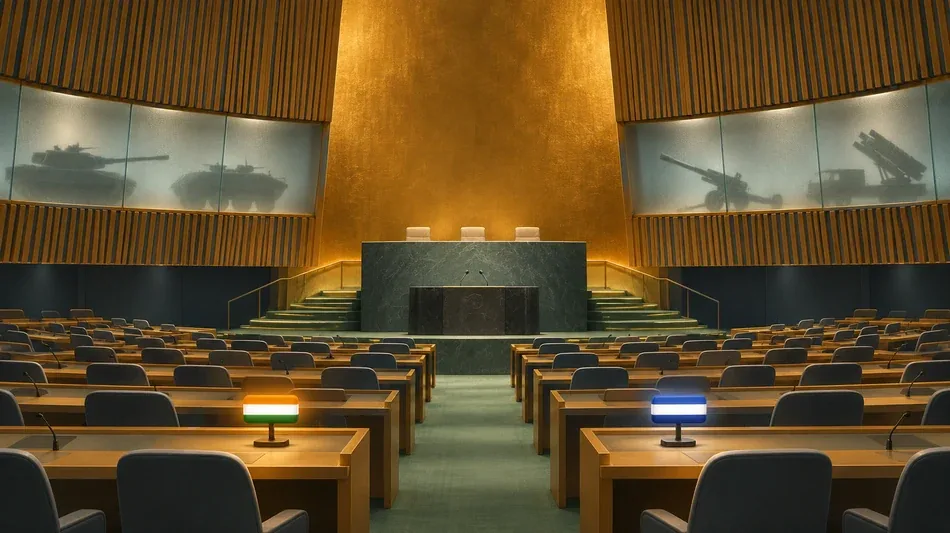
India and Israel oppose UN draft on regional conventional arms control
 Search Underway for 'Dooars Rani' Tigress After Second Escape from Buxa Tiger Reserve

 The Dilemma of Recording Live Music: Preserving Memories vs. Being Present

 InterContinental Hotels Group PLC Announces Transaction in Own Shares - November 11

 Fulcrum Metals PLC Announces New Critical Mineral Recoveries Expand Potential
 Fulcrum Metals PLC Announces Publication of Updated Investor Presentation

 Christmas Day Shifts More than Double as Americans Return to In-Person Holiday Celebrations

 Thukukile Zuma Resigns from ANC Johannesburg Leadership Amid Disciplinary Dispute

 CM Mohan Yadav Meets Bohra Spiritual Leader to Discuss Simhastha 2028 and Development

 Eli Crane Defeats Jonathan Nez in Tight Arizona Congressional Race

United Nations India and Israel have voted against a draft resolution in the UN by Pakistan and Belarus on conventional arms control at regional and subregional levels, with New Delhi saying countries' security concerns are not confined within regional boundaries. The draft resolution, titled ‘General and complete disarmament: Conventional arms control at the regional and subregional levels’, was approved by the UN General Assembly’s First Committee on Monday with 180 votes in favour, two against and no abstentions
United Nations India and Israel have voted against a draft resolution in the UN by Pakistan and Belarus on conventional arms control at regional and subregional levels, with New Delhi saying countries' security concerns are not confined within regional boundaries. The draft resolution, titled ‘General and complete disarmament: Conventional arms control at the regional and subregional levels’, was approved by the UN General Assembly’s First Committee on Monday with 180 votes in favour, two against and no abstentions. India and Israel were the only countries to vote against the resolution in the 193-member UN body. Explaining India's vote, First Secretary at India’s Permanent Mission to the UN, Anmol Sher Bedi said conventional arms control was a global issue.
“We are not fully convinced that it should be pursued primarily in regional and sub-regional contexts,” Bedi said while delivering India’s Explanation of Vote in the UNGA First Committee. He said New Delhi voted against the resolution consistent with its past position. India also questioned the resolution's request to the UN Disarmament Commission to consider formulating principles that could serve as a framework for regional agreements on conventional arms control. “We read this request with a certain degree of curiosity,” Bedi said.
He pointed out that the Commission had already adopted by consensus guidelines and recommendations on regional disarmament in 1993, guidelines on conventional arms control and disarmament in 1999, and recommendations on practical confidence-building measures in the field of conventional weapons in 2017. “That makes three consensus outcomes on this very subject in the very body now being asked to start from scratch,” he said. “We fail to understand why a subject already deliberated at length needs another round of deliberation unless the aim is to keep the UN disarmament machinery busy,” Bedi added. Bedi also objected to the resolution's approach towards maintaining a balance in defence capabilities within a region or subregion.
“This assumes that the security concerns of States politely stop at their regional borders. They do not,” he said. “Those concerns, as everyone understands for well-known reasons, extend beyond narrowly-defined regions and subregions. More importantly, the notion of preserving balance in a region or a subregion appears unrealistic,” Bedi said.
The resolution notes that conventional arms control needs to be pursued primarily in regional and subregional contexts since most threats to peace and security in the post-Cold War era arise mainly among states located in the same region or subregion. It also expresses the desire to promote agreements aimed at strengthening regional peace and security “at the lowest possible level of armaments and military forces. ” India separately voted against a paragraph that referred to conventional arms control proposals made in the context of South Asia. The paragraph noted with “particular interest” initiatives in different regions, including consultations among some Latin American countries and “the proposals for conventional arms control made in the context of South Asia,” while recognising the relevance of conventional arms control to regional security.
The resolution also states that “militarily significant States and States with larger military capabilities have a special responsibility” in promoting agreements for regional security.
X.Karnes--AMWN