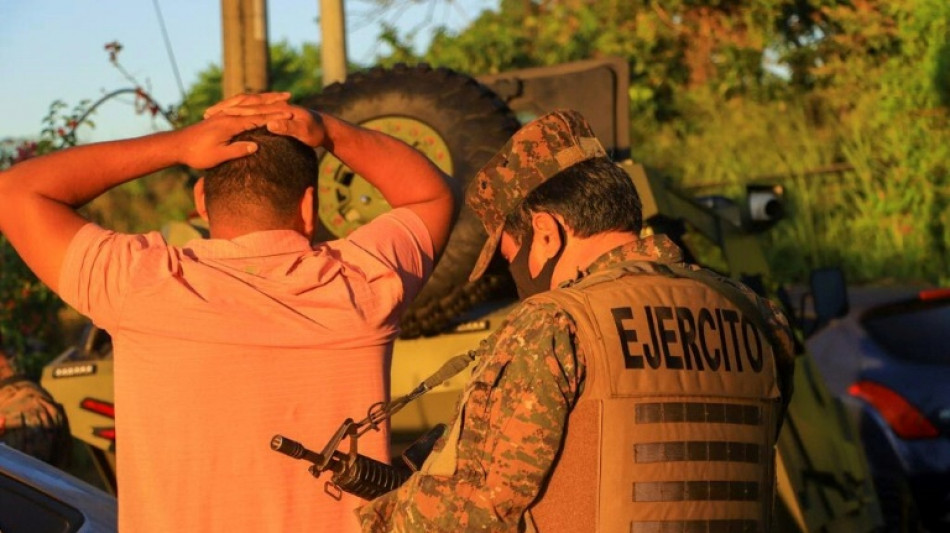
Salvadoran troops surround a major city in crackdown on gangs / Photo: Handout - EL SALVADOR'S PRESIDENCY PRESS OFFICE/AFP
 Trump names Stephen Miller as White House chief of staff after midterm losses

 Restored Albanian tower houses anchor new rural tourism trail

 Sonia Gandhi reflects on family tragedy and reluctant political career

 Pope Leo begins three-country South American tour in Uruguay

 Khawaja says entire Australia camp knew of 2018 ball-tampering plan

 November Foraging Guide: Edible Mushrooms and Critical Safety Protocols

 Microsoft Updates Xbox PC App with 60% Faster Startup and Redesigned Interface

 Early Polar Vortex Disruption Creates Uncertain Winter Outlook for Pennsylvania

 How to Enjoy Luxury Experiences on a Budget

 Pakistan Demands Grant-Based Climate Finance at COP31 to Avoid Debt Trap
Around 10,000 Salvadoran army troops and police officers surrounded the populous city of Soyapango, on the outskirts of capital San Salvador, as the government stepped up its fight against criminal gangs, President Nayib Bukele announced Saturday.
The operation was part of a state of emergency declared by Bukele earlier this spring following a surge in gang violence.
"As of this moment, the municipality of Soyapango is totally surrounded," Bukele said on Twitter, adding that 8,500 soldiers and 1,500 agents have been deployed.
The president had announced last month a plan to use troops to surround cities while house-by-house searches are conducted for gang members. Soyapango is the first city subjected to that approach.
Early Saturday, soldiers and police took up positions on all of the city's access roads, allowing no one in or out without first being searched.
Bukele said uniformed officers would be "removing, one by one, all the gang members who are still there."
Since Bukele declared the state of emergency in March, more than 58,000 suspected gang members have been arrested, though humanitarian groups have questioned what they say can be heavy-handed tactics.
Soyapango, one of the country's largest cities, has long been considered unsafe due to gang activity. A few months ago the authorities began removing the graffiti that gangs use to mark their territory.
Soyapango Mayor Nercy Montano said earlier this week that government actions in the city had brought "an enormous improvement" in safety.
The nationwide state of emergency, which allows detention without court order, followed a surge in violence that claimed 87 lives between March 25 and 27.
Despite opposition from humanitarian groups, the emergency regime was extended by Congress to mid-December.
- On the hunt for gangs -
An AFP journalist witnessed a heavy presence of soldiers and policemen in Soyapango neighborhoods. Carrying assault rifles, they searched deliberately for gang members, while army vehicles and police cars cruised slowly through the streets.
Police also deployed drones to spot suspicious movements from the air.
"It has been a surprise," 53-year-old neighborhood resident Guadalupe Perez told AFP. "They search you and ask for your identity papers to verify where you live, but that's fine -- it's all for our safety."
Police also boarded city buses to search passengers.
"Ordinary citizens have nothing to fear and can go on leading their lives normally," Bukele said. "This is an operation against criminals, not honest citizens."
- Public support -
"The measures being taken are providing noticeable results," said criminologist Ricardo Sosa. "So it's not surprising that the people affected by the gangs -- which is the vast majority -- agree with what is being done."
A survey by the Central American University (UCA) published in October found that 75.9 percent of Salvadorans approved of the state of emergency, and nine in 10 credited Bukele's policies with reducing crime.
Prior to the state of emergency in March, Salvadoran jails held some 16,000 gang members, most of them members of the MS-13 or Barrio 18 gangs.
T.Ward--AMWN

