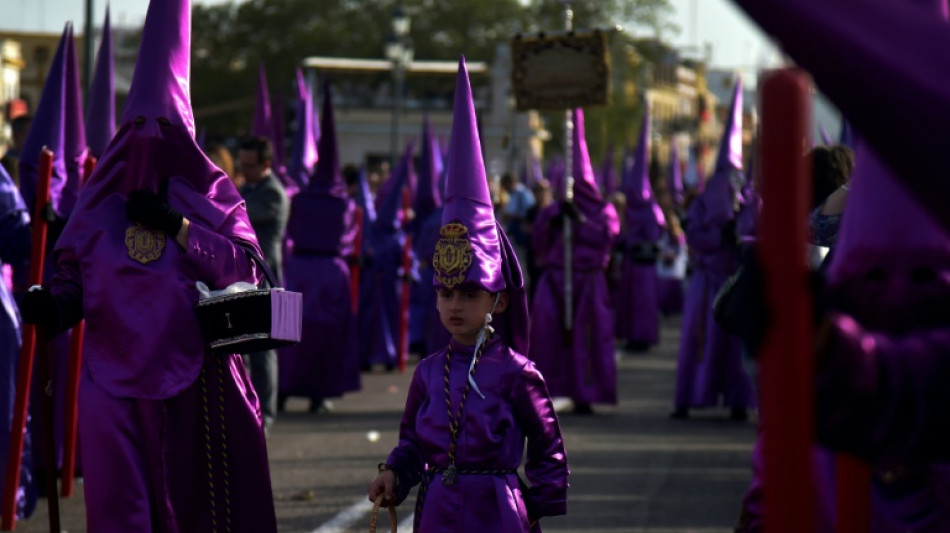
Spain's begins centuries-old Easter processions / Photo: CRISTINA QUICLER - AFP
 First urban cable car unveiled outside Paris

 Aicher pips Vonn to downhill win at St Moritz
 Fans vandalise India stadium after Messi's abrupt exit

 Exhibition of Franco-Chinese print master Zao Wou-Ki opens in Hong Kong
 Why SpaceX IPO plan is generating so much buzz

 US envoy to meet Zelensky, Europe leaders in Berlin this weekend
 US unseals warrant for tanker seized off Venezuelan coast
 Machado urges pressure so Maduro understands 'he has to go'
 Leinster stutter before beating Leicester in Champions Cup

 Crypto firm Tether bids for Juventus, is quickly rebuffed
 US Treasury lifts sanctions on Brazil Supreme Court justice
 Wembanyama expected to return for Spurs in NBA Cup clash with Thunder
 UK's king shares 'good news' that cancer treatment will be reduced in 2026

 Iran detains Nobel-prize winner in 'brutal' arrest

 UK health service battles 'super flu' outbreak

 Democrats release new cache of Epstein photos
 'Don't use them': Tanning beds triple skin cancer risk, study finds

 Argentina fly-half Albornoz signs for Toulon until 2030
 Salah in Liverpool squad for Brighton after Slot talks - reports

 Draw marks 'starting gun' toward 2026 World Cup, Vancouver says

 Salah admired from afar in his Egypt home village as club tensions swirl

 Brazil left calls protests over bid to cut Bolsonaro jail time
 US plan sees Ukraine joining EU in 2027, official tells AFP

 Iran frees child bride sentenced to death over husband's killing: activists

 Youthful La Rochelle name teen captain for Champions Cup match in South Africa

Spain's colourful Holy Week celebrations begin on Sunday, featuring centuries-old processions of the faithful carrying flower-covered floats topped with statues of Christ or the Virgin Mary that draw huge crowds.
Organised by various religious brotherhoods, or "confradias", the parades are held across the country in the week leading up to Easter Sunday, which this year in the Christian Church falls on April 9.
Depicting scenes from the story of the Passion of Christ, the floats are carried on the shoulders of members of the brotherhoods called "costaleros", often accompanied by solemn music from a brass band.
Other members of the brotherhoods accompany the floats wearing long robes with tall, pointed hoods that leave only two small holes for the eyes.
The precessions first appeared in the 15th and 16th centuries in Spain, which already had a tradition of biblical theatre depicting the Passion.
"Originally people went out on the streets with a cross," University of Navarra professor of church history Fermin Labarga told AFP.
They were accompanied by other members of religious brotherhoods who "performed acts of penitence" such as whipping their bare backs, he added.
These self-flagellations disappeared in the 18th century due to growing criticism that they "were not done out of devotion but for ostentation", Labarga said.
- Elaborate, extravagant parades -
But the tradition of staging Easter processions continued.
The goal of the parades was to "remember the Passion (of Christ)" -- the week of the crucifixion and resurrection of Jesus -- and "strengthen belief", said Labarga.
While Spain, like most European nations, has grown increasingly secular in recent decades, the parades continue to draw huge crowds of all levels of devotion and all walks of life.
Many of the more famous processions are broadcast live on TV.
Labarda called them a "complete performance".
Spaniards love the processions "because they are aesthetically beautiful and they incorporate festive elements which make them very attractive, with music, images and movement", he added.
The most elaborate and extravagant parades are held in the southwestern region of Andalucia, particularly in its capital, Seville, and in the northern city of Valladolid.
The Passion Procession held in Valladolid on Good Friday has over 1,000 participants and dozens of floats.
- Crucifixion and resurrection -
Typically, the most dramatic and fervent processions take place on Maundy Thursday and Good Friday, when mourners dressed in black lace often join in to mark Christ's death.
On Easter Sunday, when Christ's miraculous resurrection is celebrated, the parades become more jubilant, with more lively music.
During the 16th and 17th centuries, Spain exported its Easter parade tradition to its overseas possessions, mainly in Latin America.
Processions are especially popular in Guatemala, Mexico, Peru and Venezuela.
Guatemala's Holy Week -- a vibrant celebration that mixes Mayan rituals with Catholic religious fervour -- was last year given UNESCO heritage status.
Spain also introduced these processions to the parts of southern Italy which it ruled until the 18th century.
The legacy can also be found in the Philippines, which Spain ruled until 1898.
C.Garcia--AMWN