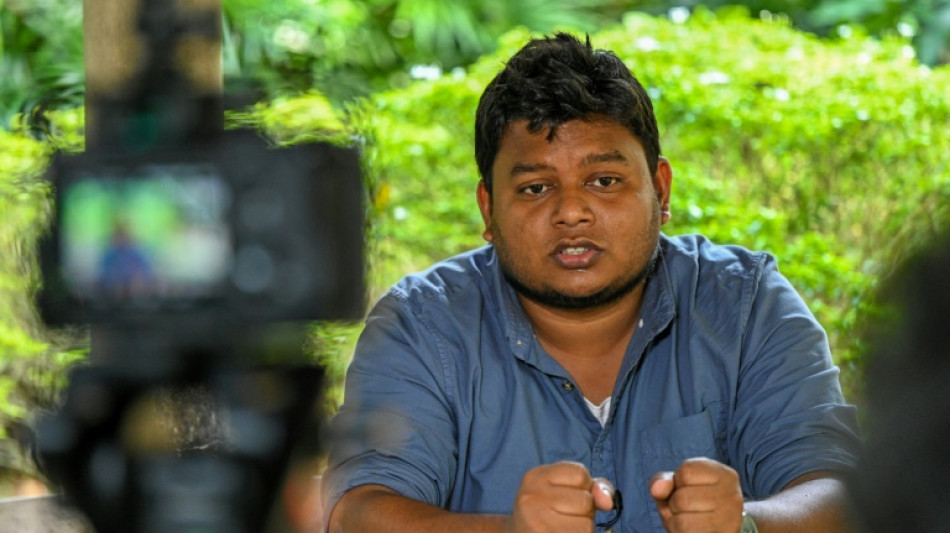
President-toppling Sri Lanka activist girds for new revolt / Photo: Ishara S. KODIKARA - AFP
 South African election results renew debate over identity-based voting

 South African voters report smoother local election but declining IEC trust

 Dolly Parton museum and Nashville hotel open after singer’s death

 George and Amal Clooney attend New York political-comedy reading

 British buyers pay substantial premiums for period-home appearance

 Thomas Markle released to house arrest after child-abuse-image charge

 Dawn of War 4 developers chose Adeptus Mechanicus for tactical variety

 Italy face unbeaten South Africa in Turin Nations Championship match

 ChatGPT interactive interface feature tested across six custom tools

 Freshways milk-price cut deepens pressure on UK dairy farms

 Labour and National remain virtually tied as New Zealand vote count advances

 The Good Daughter adapts Karin Slaughter thriller with Rose Byrne and Meghann Fahy

 Heavy-lift drone evacuates wounded Ukrainian soldier from frontline kill zone

 Morrison says West Brom recovered after pressure from successive derby losses

 Britain considers 2027 state visit for Ukraine’s Zelensky

 Anna Miltina Confronted with Racism Allegations on ProSieben Show

 German Auto Giants Face Existential Crisis as China Sales Plummet

 Cause of Death Revealed for 'Ellen' Producer Matthew Wright
A Sri Lankan jail witnessed a rare moment of accord last year when both prisoners and guards clamoured to greet its newest inmate: the man who toppled the island nation's president.
Student leader Wasantha Mudalige remains lionised by many for channelling public anger at an unprecedented economic crisis into a movement that shook the foundations of Sri Lanka's political system.
At the height of last summer's unrest, he helped spearhead a siege of government buildings in Colombo that saw once-loved premier Gotabaya Rajapaksa chased into a humiliating exile.
The 29-year-old, whose cherubic face belies his history of fierce confrontations with riot police, spent months behind bars on terror charges for his efforts.
"We had a very warm welcome," Mudalige told AFP outside a court appearance in June, while recounting his arrival at jail alongside two confederates.
"Even the prison guards were very supportive. They saw us as the heroes who got rid of Gota."
Mudalige said his incarceration was a necessary "sacrifice" in the unfinished battle to reform Sri Lanka's political system.
Now free on bail, he said lingering economic woes have left Sri Lanka bristling with discontent, frustrated with its new president -- and ready for another revolt.
"Although we got rid of Gota, we have not been able to win the 'system change' that we demanded," Mudalige said.
"We don't think the government can go on for long," he added. "When you analyse the situation, there is no way the government can continue."
- 'They had no alternative' -
As head of the Inter-University Students' Federation (IUSF) at the time, Mudalige stood at the forefront of last year's street protests.
Alongside him was a broad coalition of saffron-robed Buddhist monks, minority activists and ordinary citizens outraged by government corruption and mismanagement of the island's worsening economic tailspin.
"They had no alternative but to take to the streets because they had no fuel, no food, no electricity... people were dying in petrol queues," Mudalige said.
In July the IUSF and its allies laid siege to the Presidential Palace in Colombo.
Rajapaksa, once lauded by the island's Sinhalese majority for helping crush a decades-long Tamil separatist insurgency, was forced to evacuate the residence through a secret backdoor and temporarily fled the country.
Protesters streamed through the compound, gaping at its opulent furnishings and frolicked in its pool in the revelry that followed.
Rajapaksa's successor, Ranil Wickremesinghe, quickly sought to restore order by directing police to arrest the movement's leaders.
Mudalige was caught in the dragnet the following month when police snatched him off the street as he left a demonstration against the crackdown.
He spent 167 days in custody, the longest stretch of detention of all those who participated in last year's revolt.
The most serious charges against him were eventually dropped after Amnesty International and other rights groups condemned his jailing.
- 'Anarchist political forces' -
Wickremesinghe has sought to restore Sri Lanka's ruined finances with an International Monetary Fund bailout that commits his administration to an austerity programme.
The chronic food and fuel shortages that inflamed public anger last year have since ended as the government reined in public spending.
But steep tax hikes, and the end of generous subsidies on electricity and fuel, have been deeply unpopular.
Wickremesinghe says the reforms are necessary to bring Sri Lanka out of bankruptcy and restore economic growth.
He pledged in February to press ahead "regardless of the obstacles that anarchist political forces seek to create".
His administration has maintained a tough line against protests, with periodic demonstrations quickly dispersed by tear gas and water cannon trucks.
Mudalige said his detention and that of other protest leaders was an effort by the government to forestall a repeat of last year's unrest.
But he warned the public's frustrations over the spiralling cost of living would inevitably bring people back to the streets, unbowed by the threat of violence.
"The government is using the police and the military to suppress any dissent. It is like pressing down a rubber ball in a basin of water," he said.
"You can't do it for long. It will inevitably bounce to the top."
P.Costa--AMWN
