
The 'predatory' global economy of looted antiquities / Photo: GIUSEPPE CACACE - AFP
 Why SpaceX IPO plan is generating so much buzz

 US envoy to meet Zelensky, Europe leaders in Berlin this weekend

 US unseals warrant for tanker seized off Venezuelan coast
 Machado urges pressure so Maduro understands 'he has to go'

 Leinster stutter before beating Leicester in Champions Cup
 Crypto firm Tether bids for Juventus, is quickly rebuffed

 US Treasury lifts sanctions on Brazil Supreme Court justice
 Wembanyama expected to return for Spurs in NBA Cup clash with Thunder
 UK's king shares 'good news' that cancer treatment will be reduced in 2026

 Iran detains Nobel-prize winner in 'brutal' arrest

 UK health service battles 'super flu' outbreak
 Democrats release new cache of Epstein photos
 'Don't use them': Tanning beds triple skin cancer risk, study finds

 Argentina fly-half Albornoz signs for Toulon until 2030
 Salah in Liverpool squad for Brighton after Slot talks - reports

 Draw marks 'starting gun' toward 2026 World Cup, Vancouver says

 Salah admired from afar in his Egypt home village as club tensions swirl
 Brazil left calls protests over bid to cut Bolsonaro jail time
 US plan sees Ukraine joining EU in 2027, official tells AFP
 Iran frees child bride sentenced to death over husband's killing: activists

 Youthful La Rochelle name teen captain for Champions Cup match in South Africa
 British 'Aga saga' author Joanna Trollope dies aged 82

 EU agrees three-euro small parcel tax to tackle China flood

 Maresca 'relaxed' about Chelsea's rough patch
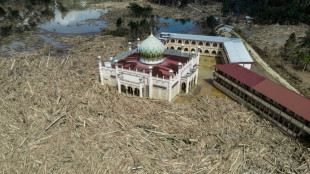 Nowhere to pray as logs choke flood-hit Indonesian mosque

The charging of the Louvre's former director in an antiquities trafficking investigation has shone a light on a vast, transnational criminal problem that remains fiendishly difficult to target.
Ancient burial grounds around the world have increasingly become "open-air supermarkets" for everyone from petty thieves to organised criminals, said Vincent Michel, professor of archaeology at the University of Poitiers in France.
He describes a "sophisticated chain" stretching from sites in unstable places such as Iraq, Syria and Libya -- but also many other parts of the world -- via transit countries to auction houses and private collectors in Europe and the United States, and increasingly Asia and the Gulf.
It is an illicit trade that "serves mafias, drug traffickers and terrorist groups, abusing collectors and museums with complete impunity", said Michel.
The ex-director of the Louvre in Paris, Jean-Luc Martinez, was charged last week over the purchase of a pink granite stele depicting the pharaoh Tutankhamun and four other historic works for eight million euros ($8.5 million) by the museum's branch in Abu Dhabi.
Martinez, who has strongly denied any wrong-doing, is accused of turning a blind eye to fake certificates of origin for the pieces, a fraud thought to involve several other art experts, according to French investigative weekly Canard Enchaine.
Such allegations are far from a rarity in the art world where the value of looted antiquities is thought to reach into the "tens or even hundreds of millions of euros" per year, according to Michel.
He trains police, judges and customs officials to help counter the trade but resources are notoriously limited in the sector, and he has called for deeper public awareness and a more concerted interdisciplinary fight.
"This transnational crime feeds a predatory economy that undermines our national security. It is also an irreversible attack on heritage because a looted object, taken out of its context, loses all scientific value," Michel said.
- Global reach -
The Covid-19 pandemic has only deepened the challenge.
Egyptian authorities say the number of illegal digs jumped massively in recent years to hit 8,960 in 2020.
Looters use metal detectors to hunt gold, silver and bronze items, often stored in perfect condition in tombs thanks to the arid climate.
But the problem is not limited to poorer countries.
France has seen an uptick in looting from archaeological sites, said Xavier Delestre, who works for the regional cultural authorities based in Marseilles.
He said high-value items were often laundered through so-called "freeports" -- tax haven storage sites with minimal oversight in places like Geneva, Luxembourg and Singapore -- emerging with false back-stories.
Lower-value items ended up on social media and online stores.
- 'Almost undetectable' -
Michel said counterfeiters are "incredibly ingenious" when it comes to masking the illicit origin of items, creating documents with a careful mix of false and true information, fabricating false export permits or purchase invoices -- even UNESCO certificates.
Once reintroduced into the legal market, "a looted item is almost undetectable," he added.
Internet sales have made it even harder for law enforcement officials to trace criminals and keep a handle on the problem.
A 2019 report by US counter-trafficking organisation ATHAR tracked 95 Arabic-language Facebook groups specialising in antiquities trafficking, with a total of nearly two million members.
"Facebook offers a veritable digital toolbox for traffickers to utilise, including photo and video uploads, live streaming, disappearing 'Stories', payment mechanisms, and encrypted messaging," the report said.
A.Jones--AMWN