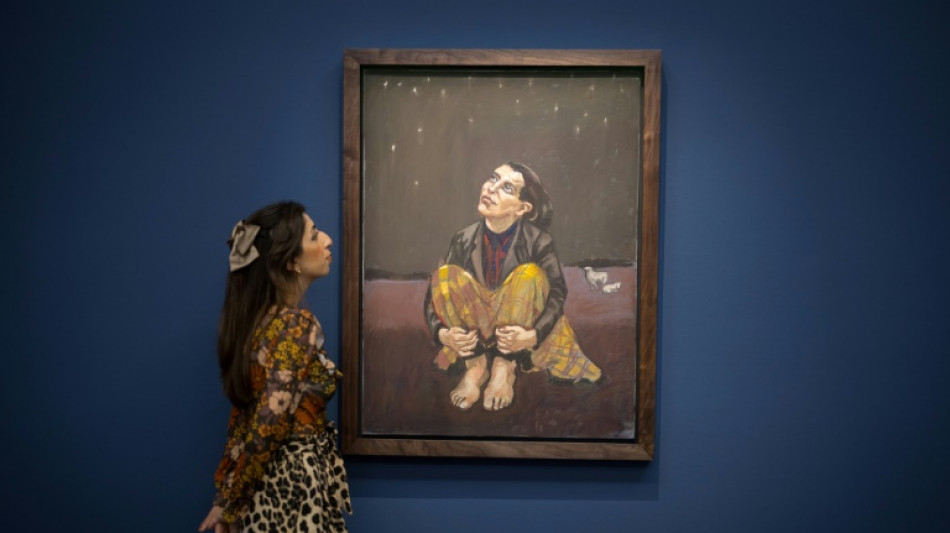
British-Portuguese artist Paula Rego dies aged 87, gallery says / Photo: Tolga Akmen - AFP/File
 November Foraging Guide: Edible Mushrooms and Critical Safety Protocols

 Microsoft Updates Xbox PC App with 60% Faster Startup and Redesigned Interface

 Early Polar Vortex Disruption Creates Uncertain Winter Outlook for Pennsylvania

 Edmund Richardson Wins Baillie Gifford Prize for 'Alexander' Biography

 BYD Drops Rotating Screens in New Models Due to Tech Limits

 Ryanair Flight from Rome Makes Emergency Landing in Lisbon After Bomb Threat

The celebrated British-Portuguese artist Paula Rego has died aged 87 in London, her representative the Victoria Miro gallery said on Wednesday.
A statement said she "died peacefully this morning after a short illness at home in north London surrounded by her family."
"Our heartfelt thoughts are with her children Nick, Cas and Victoria Willing, and her grandchildren and great-grandchildren."
Rego, who was born near Lisbon on January 26, 1935 and moved to Britain in the early 1950s, attended the prestigious Slade School of Fine Art.
In the 1960s, she exhibited with the London Group of artists, including Frank Auerbach and David Hockney.
She was known for figurative, emotionally charged paintings and prints based on storybooks, often reflecting feminism and Portuguese folk tales.
Last year, Tate Britain held a major retrospective of her work, hailing her as "an uncompromising artist of extraordinary imaginative power".
"She has revolutionised the way in which women are represented," the London gallery said.
One series of pastels she made in 1998 after the failure of a referendum to legalise abortion in Portugal had a huge impact in her homeland.
It portrayed women after illegal terminations. She also depicted human trafficking and female genital mutilation.
Elena Crippa, the curator of the Tate exhibition, told the BBC in 2021 that she saw Rego's influence in the work of most female painters.
"I would struggle to think of a significant painter, particularly in Britain, where I can't see a connection to Paula," she said.
"Paula takes you to uncomfortable places -- Jung called it the shadow. They are taboo areas, where love and cruelty touch each other, and our drives and fears live."
Rego, who was married to the British artist Victor Willing until his death in 1988, received numerous honours in Portugal and Britain.
She was made a dame by Queen Elizabeth II in 2010. A museum to her work opened outside Lisbon in 2009.
M.Fischer--AMWN