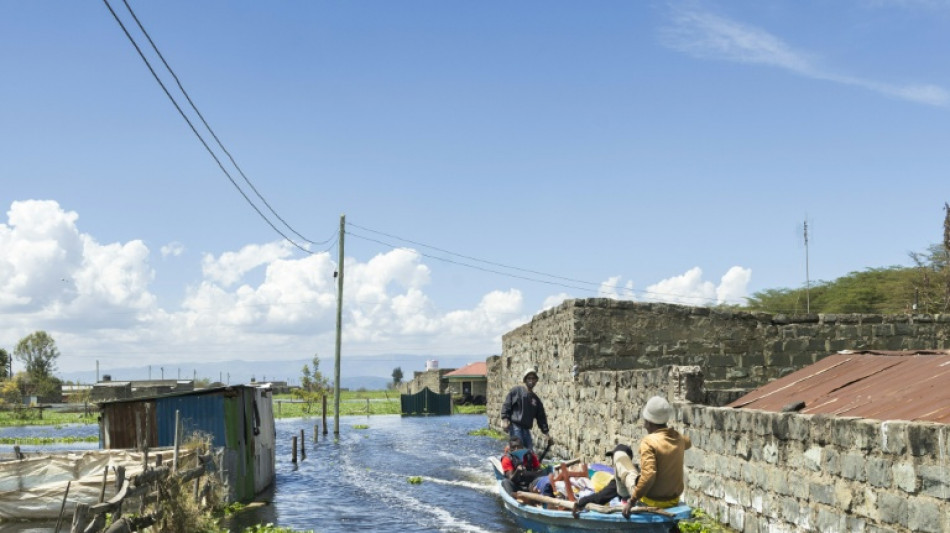
Thousands of Kenyans displaced by Lake Naivasha flooding / Photo: Tony KARUMBA - AFP
 Carrick backs Dalot after hostile reception from Manchester United fans

 Aston Villa Defy History With Rare Victory at Old Trafford

 Crowds Gather at San Francisco Park for Elizabeth Holmes Lookalike Tournament

 New 401k Gold IRA Investment Guide Explains the Best Way to Invest in Gold for Retirement (2026 Update)

 InterContinental Hotels Group PLC Announces Transaction in Own Shares - November 09
Opti Digital Launches NEXA, an AI-Powered Intelligence Layer

 Tintina Mines Intersects 460m at 0.50% CuEq at the Dos Amigos Copper-Gold Project in Chile

 Ispire Technology Inc. Reports First Quarter Fiscal Year 2027 Financial Results
 CoTec Holdings Corp. Notes HyProMag USA Advances North Texas Rare Earth Magnet Facility With First Major Equipment Delivery

 iPS Cell Research Accelerates Drug Discovery for ALS and Spinal Cord Injury

The tourist boats that normally ply Kenya's famed Lake Naivasha have had a different task in recent weeks: evacuating hundreds of flooded homes.
Although the lake's level has been rising for more than a decade and has repeatedly breached its banks, locals in the modest district of Kihoto are still astonished by the scale this year.
"It hasn't happened like this before," said one resident, Rose Alero.
The Rift Valley lake has travelled up to 1.5 kilometres inland, say local officials, an unprecedented distance.
"People are suffering," said Alero, a 51-year-old grandmother, adding that many neighbours were sick.
In her home, the water is waist-deep, and toilets are overflowing throughout the district.
"People are stuck... they have nowhere to go."
Others have lost everything. Hundreds of homes are completely submerged, churches in ruins, and police stations underwater, surrounded by floating vegetation.
During a sudden rush of water, children were forced to leave school on makeshift rafts.
Joyce Cheche, head of disaster risk management for Nakuru County, estimates that 7,000 people have been displaced by the rising waters, which have also impacted wildlife and threaten tourism and other businesses.
The county has assisted with the transportation of victims and implemented health measures, she said, but there has been no financial compensation for now.
Workers in the flower sector -- a major exporter -- are refusing to show up for fear of cholera and landslides.
She also mentioned the risk of dangerous encounters with hippos, who are numerous in the lake.
"We didn't see it coming," said Cheche.
On the lake's edge, the bare trunks of once-verdant acacia trees lie submerged in water that continues to spread at around a metre per day.
This phenomenon is observed in other lakes in the Rift Valley and has displaced hundreds of thousands of people.
Numerous studies attribute it primarily to increased rainfall caused by climate change.
But Kenyan geologist John Lagat, regional manager at the state-owned Geothermal Development Corporation, says the main cause is tectonics as the lakes lie along a long geological fault.
When English settlers arrived at the end of the 19th century, the lake was even larger than it is today before shifting plates reduced its size to just one kilometre in diameter by 1921.
Further tectonic shifts meant underground outflows were increasingly sealed, trapping the water, he said, though he added that increased rainfall and land degradation caused by population growth were playing a "substantial" role in flooding, too.
"We are very worried," said Alero in her flooded home, fearing the next rainy season.
"We can't tell what will happen."
F.Dubois--AMWN