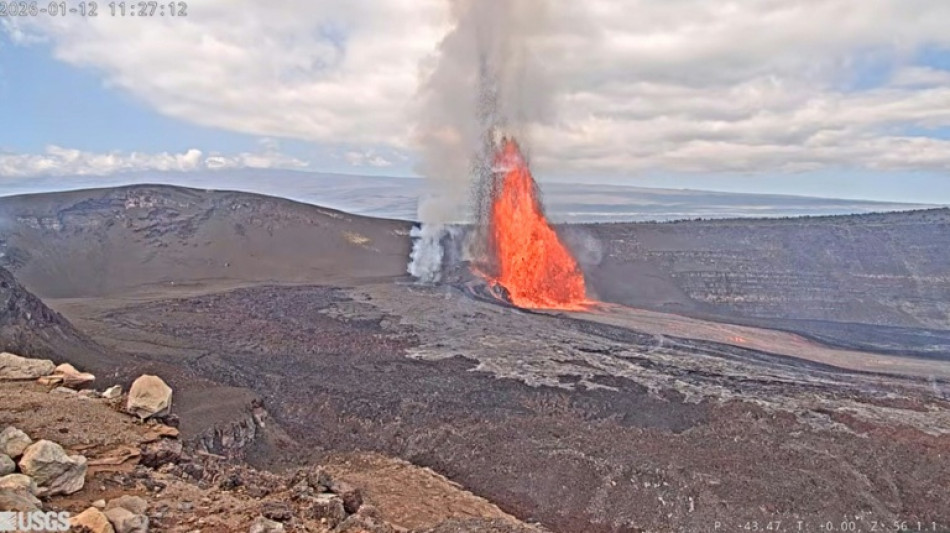
Hawaii's Kilauea volcano puts on spectacular lava display / Photo: - - UNITED STATES GEOLOGICAL SURVEY/AFP
 Brussels Education Unions Schedule Major November Protest Over Funding and Reforms

 Making Your Home Safer for Aging Parents: Accessibility Renovations That Add Value

 iPS Cell Research Accelerates Drug Discovery for ALS and Spinal Cord Injury

 Rene Eyre Revisits Autobiographical Performance 'Say A Little Prayer' in London

 UAE's HCT Holds Record Graduation and Announces Major Training Expansion

 NASA Awards $10B Lunar Contract Framework to SpaceX, Blue Origin

 Katy Perry Tells Fans Ex-Husband Russell Brand 'Should Be in Jail' During UK Concert

Hawaii's Kilauea was spraying a spectacular fountain of lava on Monday, keeping up its reputation as one of the world's most active volcanoes.
For over a year now, Kilauea has been regularly throwing out thousands of tonnes of molten rock and gases since it burst to life in December 2024.
Volcanologists with the US Geological Survey said the incandescent lava was being hurled more than 1,500 feet (460 meters) into the air, with plumes of smoke and gases rising as high as 20,000 feet (six kilometers).
Eruptions such as this one tend to last around one day, the USGS said, but can still vent up to 100,000 tonnes of sulfur dioxide.
This gas reacts in the atmosphere to create a visible haze known as vog -- volcanic smog -- which can cause respiratory and other problems.
Tiny slivers of volcanic glass, known as "Pele's hair," are also being thrown into the air.
Named after Pele, the Hawaiian goddess of volcanoes, the strands can be very sharp and can cause irritation to the skin and eyes.
The eruption poses no immediate danger to any human settlement, with the caldera having been closed to the public for almost two decades.
Kilauea has been very active since 1983 and erupts relatively regularly.
It is one of six active volcanoes located in the Hawaiian Islands, which also include Mauna Loa, the largest volcano in the world.
Kilauea is much smaller than neighboring Mauna Loa, but it is far more active and regularly wows helicopter-riding tourists who come to see its red-hot shows.
L.Mason--AMWN

