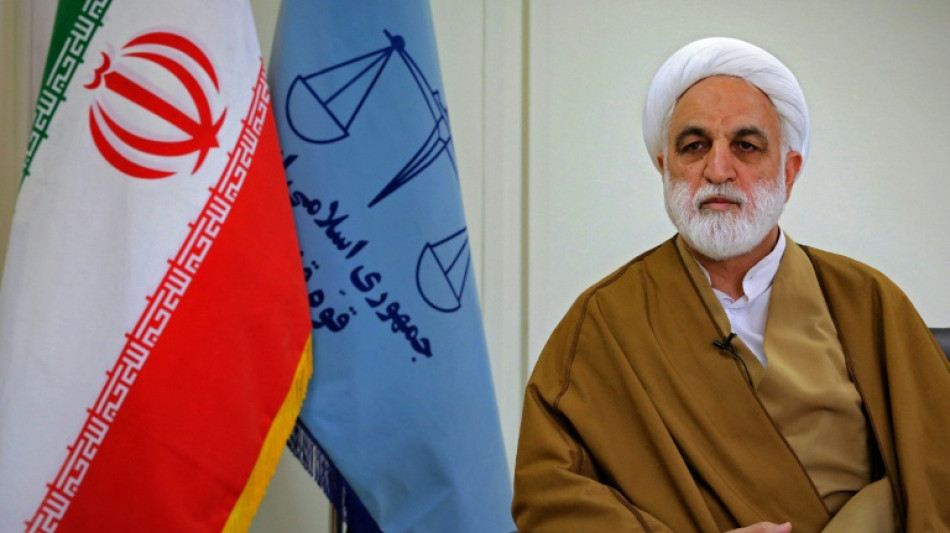
Iran broadcasting forced 'confessions' to deter dissent: activists / Photo: - - KHAMENEI.IR/AFP
 Pacific nations fear fuel shortages as Middle East war sends oil prices soaring

 Crude prices surge, stocks sink as Iran warns of regional energy strikes
 Mideast energy shock rattles eurozone rate-setters

 Messi scores 900th career goal but Miami crash out

 Iran targets Gulf energy sites after gas field strike

 Social media addiction trial jury deliberations continue

 Barcelona, Liverpool, Bayern and Atletico reach Champions League quarter-finals
 PSG will not relish Liverpool reunion, says Slot

 Venezuelan leader sacks defense minister, a Maduro stalwart

 Thailand's new parliament set to elect Anutin as PM

 Liverpool thrash Galatasaray to reach Champions League quarters
 Music popstar will.i.am meshes AI and 'micromobility'
 Iran targets Gulf energy sites after intel chief killed

 Costa Rica closes Havana embassy, tells Cuba to withdraw diplomats
 Cesar Chavez, icon of US labor movement, accused of serial sex abuse: report

 Trump nominee for Homeland Security chief grilled at fiery Senate hearing

 Eight killed during Rio police operation, including drug kingpin
 Slovakia curbs diesel sales, ups prices for foreigners
 Thousands rally in Istanbul to mark year since mayor's arrest

 US Fed holds rates unchanged over 'uncertain' Iran war implications
 From Faraja to Sepah: Iran's multiple security forces
 Senegal demands 'corruption' probe over AFCON decision as Morocco defend appeal

 PSG's Barcola ruled out for several weeks with ankle injury

 Iran condemned as UN maritime body holds emergency talks on Mideast shipping
 Iran women's football team return after asylum tussle
The man faces the camera with his face blurred as dramatic music pounds in the background.
"I made a mistake," he says, his voice trembling as an unseen interrogator presses him about the deaths of members of Iran's security forces. "If I'd known, I would not have done it."
According to one rights group, at least 240 such "forced confessions" have been broadcast by Iranian state television in recent weeks -- an "unprecedented" quantity -- after authorities arrested thousands of people in the wake of protests that shook the country's clerical leadership.
Questioned by an interviewer, detainees are shown confessing to a variety of alleged offences ranging from committing violence against members of the security forces, to accepting money from monarchists or Iran's foes, or sharing images with banned groups or media outlets.
In some cases, people are accused of merely following accounts of opponents of the Islamic republic on social media.
Activists say the so-called confessions are extracted by psychological and physical torture, and are a familiar tactic used in the past by Iranian authorities against detainees who in some cases have subsequently been executed.
Amnesty International termed the scenes "propaganda videos", saying it had received reports "authorities are forcing detainees to sign statements they have not been allowed to read and to give forced 'confessions' to crimes they did not commit as well as to peaceful acts of dissent".
The UN special rapporteur on human rights in Iran, Mai Sato, told the UN Human Rights Council that such "false confessions" seek to "reinforce the state's narrative that protesters are dangerous criminals".
- 'Deterring dissent' -
Iran's feared judiciary chief Gholamhossein Mohseni Ejei appeared to take the lead earlier this month by personally interrogating detainees in sessions broadcast by state TV.
"Coerced televised confessions in totalitarian regimes such as Iran have multiple key functions, including that of manufacturing political legitimacy, creating a false, official narrative such as framing peaceful protesters as violent agents of foreign influence, and deterring dissent," Roya Boroumand, director of the US-based Abdorrahman Boroumand Center for Human Rights in Iran, told AFP.
The demonstrations started in late December sparked by economic grievances but grew into a mass movement against the Islamic republic, with huge street protests from January 8, when authorities imposed an internet blackout.
Thousands were killed in an ensuing crackdown on the protests, which have for now abated, with the authorities blaming the unrest on Iran's enemies, including Israel and the United States.
More than 41,000 people have been arrested in the crackdown, according to the US-based Human Rights Activists News Agency (HRANA), which has recorded 240 instances of "forced confessions".
One video widely circulating on social media Monday showed a teen, identified by users as 18-year-old Shervin Bagherian, being questioned over the killing of a member of the security forces and then told he would face charges that could see him executed.
In another widely shared case, a man was shown admitting to having sent footage of the protests to US President Donald Trump via social media accounts.
Such broadcasts have in the past been used ahead of executions.
In one notorious case, the formerly Paris-based dissident Ruhollah Zam, who according to supporters was abducted from Iraq by Iranian security forces, was subjected to an interrogation on Iranian TV before his execution in December 2020.
Foreigners have also been subjected to the same treatment.
French citizen Cecile Kohler was shown in October 2022 on Iranian television making what activists described as a "forced confession" before being sentenced on espionage charges her family vehemently rejects.
She and fellow French citizen Jacques Paris were released late last year but are still unable to leave Iran.
- 'Humiliating' dissidents -
The US-based Center for Human Rights in Iran (CHRI) said that in the wake of the protests, the forced confessions were being broadcast by Iranian state television on an "unprecedented scale".
"These false confessions are routinely used as the sole evidence to convict, including in capital cases where the death penalty may be imposed," it added.
"By forcing dissidents to publicly 'confess' to actions such as 'colluding with foreign powers', the state legitimises its repression as necessary to protect national security and, bypassing the presumption of innocence, uses the televised confessions as proof of guilt to justify severe punishment such as executions," said Boroumand.
"These broadcasts also aim at humiliating and destroying dissidents' credibility while reminding the public of the high cost of challenging the state," she added.
P.Santos--AMWN