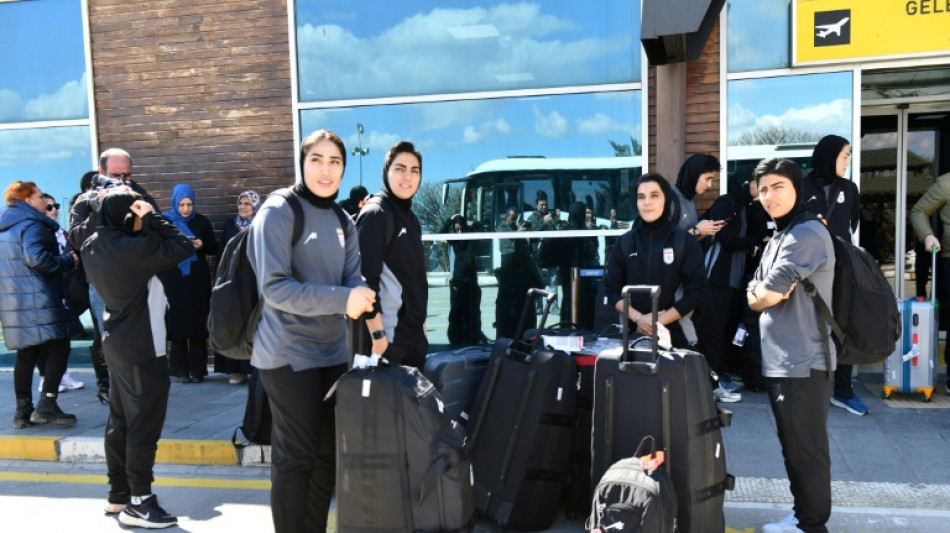
Iran women's football team return after asylum tussle / Photo: Ali IHSAN OZTURK - AFP
 November Foraging Guide: Edible Mushrooms and Critical Safety Protocols

 Microsoft Updates Xbox PC App with 60% Faster Startup and Redesigned Interface

 Early Polar Vortex Disruption Creates Uncertain Winter Outlook for Pennsylvania

 Edmund Richardson Wins Baillie Gifford Prize for 'Alexander' Biography

 BYD Drops Rotating Screens in New Models Due to Tech Limits

 Ryanair Flight from Rome Makes Emergency Landing in Lisbon After Bomb Threat

The Iranian women's football team, whose plight has become embroiled in the Middle East war, returned back to Iran on Wednesday where they were promised a welcome ceremony in Tehran.
Seven members of the delegation had sought asylum in Australia last week after their decision not to sing the national anthem before their opening game at the Women's Asian Cup.
With their demands for protection an embarrassment for Iran's leaders, but lauded by US President Donald Trump, five later changed their minds, including captain Zahra Ghanbari.
Activists have accused Iranian authorities of pressuring the women's families -- including summoning parents for interrogations -- but Tehran has in turn alleged that Australia sought to force the athletes to defect.
Two members have remained in Australia, but the rest of the team completed a long journey back on Wednesday via Malaysia, Oman and then to Istanbul and Turkey's overland Gurbulak-Bazargan border crossing with Iran.
AFP reporters saw them cross into Iran on a bus, wearing the national team tracksuits and with their hair covered.
In a post on X, Iranian parliament speaker Mohammad Bagher Ghalibaf said the players and their support team were "children of the homeland, and the people of Iran embrace them".
By returning, they had "disappointed the enemies (of Iran) and did not surrender to deception and intimidation by anti-Iran elements," he added.
Iranian news agency Mehr published images of a small welcome party waving flags on the Iranian side of the border, as well as the team and staff sat on a stage with a red carpet.
"We have all gathered here to say well done and to express our appreciation," the president of Iran's Football Federation, Mehdi Taj, was quoted as saying.
"Although they are women, they showed manly courage and strength," he added.
In a sign of their symbolic importance to Iranian authorities, a larger welcoming ceremony has been organised on Thursday at 8:00 PM (1630 GMT) in Valiasr Square where other pro-government rallies have taken place in recent weeks, Iranian media reported.
Rights groups have accused Tehran of systematically pressuring athletes abroad by threatening relatives with the seizure of property if they defect or make statements against the Islamic republic.
- Withdrawals -
The Iranian women fell silent as the national anthem played ahead of an Asian Cup match in Australia, which was interpreted as act of defiance towards the country's leaders.
Although the side sang Iran's anthem -- an ode to the glory of the Islamic republic -- in later matches, human rights activists warned the damage was done.
An Iranian state TV presenter branded the players "wartime traitors", fuelling fears they faced persecution, or worse, if they returned.
Five players, including captain Ghanbari, slipped away from the team hotel under the cover of darkness to claim asylum in Australia on March 10.
Two more delegation members -- a player and a support staffer -- were later granted asylum.
Australian Home Affairs Minister Tony Burke said the government had spent days in secret talks with the players, who were whisked to a safe house after leaving their hotel on the Gold Coast.
Iranian authorities had accused Australia of pressuring the players to stay.
str-ii-hmw-adp/sjw/tw
T.Ward--AMWN