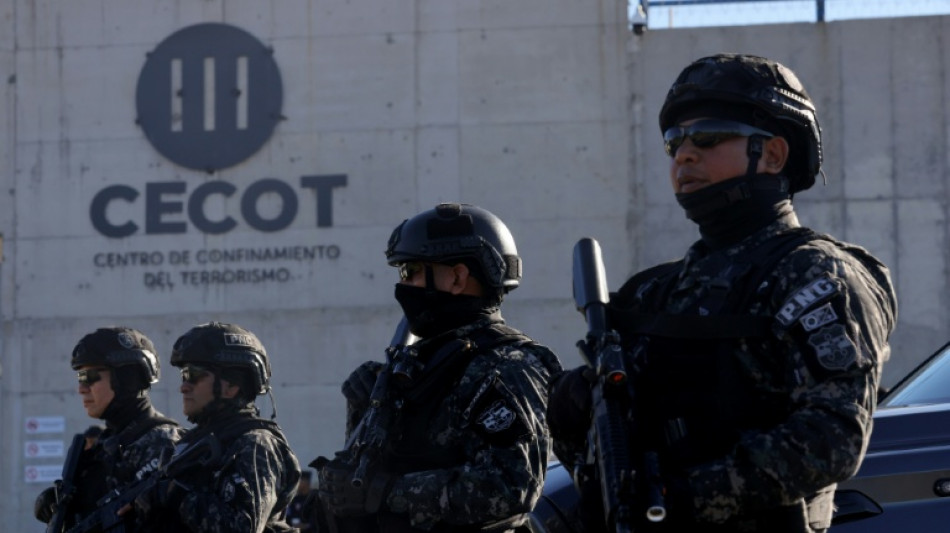
Colombia's Medellin builds mega-prison inspired by El Salvador's CECOT / Photo: Oscar Rivera - AFP
 Brussels Education Unions Schedule Major November Protest Over Funding and Reforms

 iPS Cell Research Accelerates Drug Discovery for ALS and Spinal Cord Injury

 Rene Eyre Revisits Autobiographical Performance 'Say A Little Prayer' in London

 UAE's HCT Holds Record Graduation and Announces Major Training Expansion

 NASA Awards $10B Lunar Contract Framework to SpaceX, Blue Origin

 Katy Perry Tells Fans Ex-Husband Russell Brand 'Should Be in Jail' During UK Concert

The mayor of Medellin on Friday touted the construction of a mega-prison in his city, Colombia's second-largest, becoming the latest Latin American leader to mimic the iron-fisted approach to gang violence of El Salvador's Nayib Bukele.
The high-security prison will hold more than 1,300 inmates, according to Medellin Mayor Federico Gutierrez. It will be financed with public and private funds.
The city, located in central Colombia, was once among the world's most violent before the death of drug lord Pablo Escobar in 1993.
A city hall official told AFP on Friday that the mega-prison is modeled after Bukele's signature CECOT facility, which has faced criticism from human rights groups over reported abuses.
The move is the latest prison project in Latin America to copy the CECOT approach, including by Ecuador and Costa Rica.
Chile's far-right president-elect Jose Antonio Kast also visited CECOT recently and asked Bukele for help improving his country's prison system.
Gutierrez toured the prison construction site on Thursday and vowed that the facility will be guarded by its own security team, not by officers from the national prison agency.
Powerful criminal groups remain active in Medellin.
The jail, which is expected to be ready in 2027, will have technological systems to prevent inmates from communicating, since one of the most common forms of extortion in the country originates from prisons.
Inmates will be "deprived of many privileges," far-right Gutierrez told reporters.
With presidential elections taking place on May 31, security is a top concern for Colombians.
The frontrunners are leftist Senator Ivan Cepeda, one of the architects of President Gustavo Petro's controversial policy of negotiating with armed groups, and right-wing lawyer Abelardo de la Espriella.
De la Espriella, who is supported by Gutierrez's party, has proposed building mega-prisons where inmates would be "ten stories underground" and survive on "bread and water."
D.Moore--AMWN

