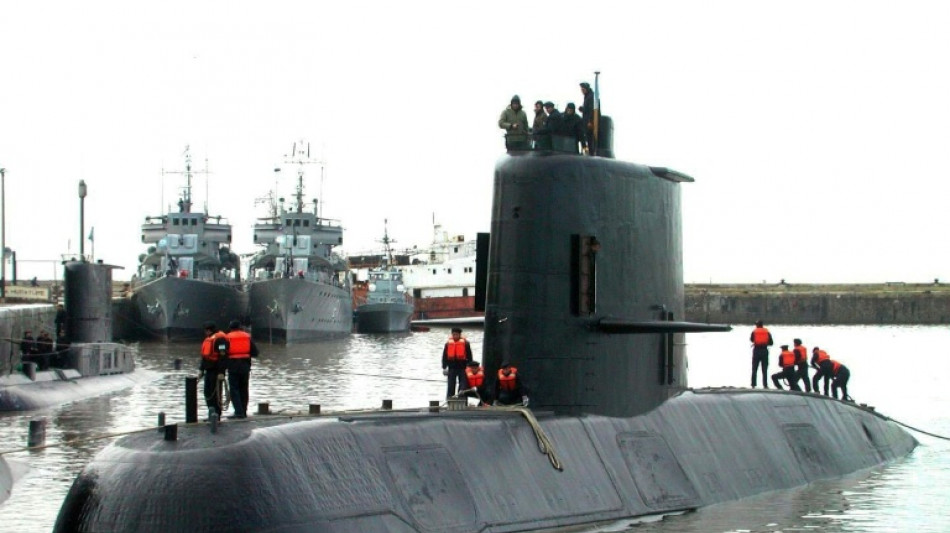
2017 implosion of Argentine submarine was 'foreseeable,' trial hears / Photo: STR - NOTICIAS ARGENTINAS/AFP
 Rene Eyre Revisits Autobiographical Performance 'Say A Little Prayer' in London

 UAE's HCT Holds Record Graduation and Announces Major Training Expansion

 NASA Awards $10B Lunar Contract Framework to SpaceX, Blue Origin

 Katy Perry Tells Fans Ex-Husband Russell Brand 'Should Be in Jail' During UK Concert

 South African election results renew debate over identity-based voting

 South African voters report smoother local election but declining IEC trust

 Dolly Parton museum and Nashville hotel open after singer’s death

The submarine implosion that killed 44 Argentine sailors in November 2017, the country's worst naval disaster since the Falklands War, was "foreseeable," prosecutors argued as the trial over the disaster got underway Tuesday.
The sinking of the ARA San Juan, in circumstances that remain unclear, was "a foreseeable outcome given the condition of the vessel, which made the shipwreck possible," the prosecution said in the indictment against four former Navy officers, who went on trial in the Patagonian city of Rio Gallegos.
The ARA San Juan went missing a week after it set off from Ushuaia on Argentina's southern tip and was returning to its home port at the Mar del Plata naval base.
The vessel's crushed wreckage still lies deep on the sea bed in a remote area of the South Atlantic off Santa Cruz province, where the trial is taking place.
The submarine vanished on November 15 after reporting that seawater had entered the ventilation system, causing a battery on the diesel-electric vessel to short-circuit and start a fire.
Four former Navy officers -- former Training Command chief Luis Lopez Mazzeo, former Submarine Force commander Claudio Villamide, the Submarine Command's former chief of staff Hector Alonso and former head of operations Hugo Correa -- have been charged with dereliction of duty and aggravated negligent destruction.
They face between one and five years in prison if convicted.
- 'Felt like nobodies' -
None of the families of the victims -- 43 men and one woman -- are expected to attend the trial in remote Rio Gallegos.
Lawyer Valeria Carreras, who represents 34 victims' families, said her clients, most of whom live in Mar del Plata, "can't even afford to make photocopies, never mind plane tickets and lodgings,"
"They have felt like nobodies for the past eight years," she said.
Their request for the trial to be held in Mar del Plata was rejected.
Carreras accused the Navy of harboring a "culture of silence" over what she called "an avoidable tragedy."
In 2021, a court-martial dismissed Villamide for negligence and sentenced other officers to up to 45 days in jail for concealing information over the disaster.
- Ex-president cleared -
The hypothesis is that the submarine suffered a valve failure that allowed water to enter the battery compartment, triggering a fire and then an explosion.
But testing this theory would involve salvaging the submarine's wreckage from a depth of over 900 meters (2,950 feet) -- a multimillion-dollar operation, according to the plaintiffs.
"It's very difficult to convict someone of a crime when you don't really know what happened," lawyer Luis Tagliapietra, whose 27-year-old son Alejandro died in the disaster, complained.
The case has ensnared top officials, fuelling suspicions of a cover-up.
Former president Mauricio Macri was accused of ordering illegal surveillance of the victims' families between 2017 and 2019.
The Supreme Court last year threw out the case against him.
P.Santos--AMWN


