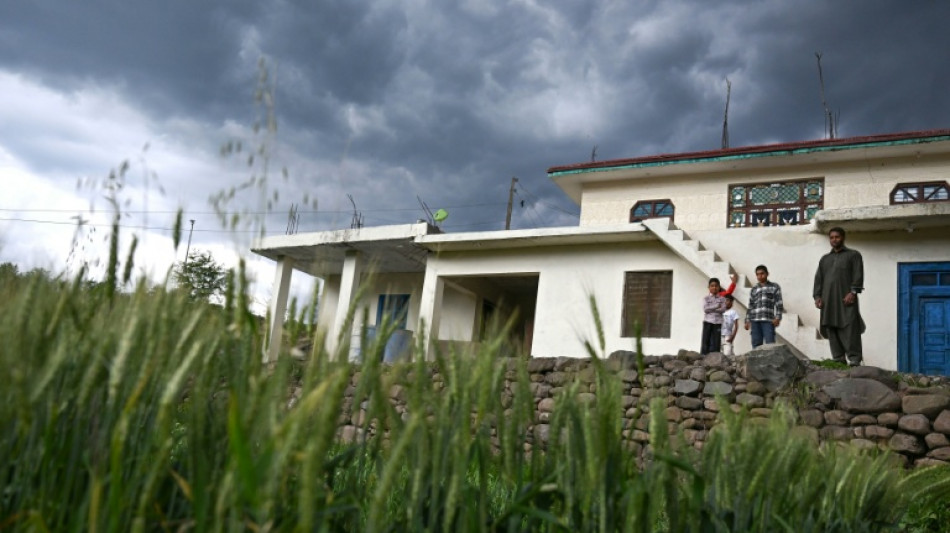
Anxiety lingers in divided Kashmir a year after shooting attack / Photo: Tauseef MUSTAFA - AFP
 UK PM unveils plan to help rough sleepers off streets by Christmas

 Tokyo opposes US sanctions on Japanese ICC chief Akane

 Humanoid-maker Unitree surges more than 600% on Shanghai debut

 Bowling great Donald warns Bangladesh that Australia will hit back hard
 STARPRIME Completes Beta Testing of Market-Maker Model for Retail Brokers

 Campaigns kick off in Nigerian presidential race

 Aussie Rules club suspends five players for drinking, bringing women to hotel

 Trump pauses 50% tariffs on Canadian goods for three days

 Five Premier League stars to watch this season

 China's robots open to opportunities in search of commercial breakthrough

 Tech leads losses as Asian stocks track Wall St selloff

 US, South Korea cut drills short after Trump criticism
 Italian scientists bet on octopus to fight crab invasion

 New 'Insidious' reflects anxiety of being a new parent: director

 No.1 Sabalenka slams Wang to advance at Cincinnati

 Turkey rejects Israeli claims after strike on Syria air base
 Bioz and InvivoGen Elevate Scientific Discovery with an Expanded Digital Research Experience

 Empire Metals Limited Announces MRE Upgrade at Pitfield Titanium Project

 InterContinental Hotels Group PLC Announces Transaction in Own Shares - August 19

 Best Place to Buy Gold IRA in 2026 (Guide Released)

 Trump, Carney talk as Canada seeks to hold off new US tariffs

 NASA images reveal crater left by SpaceX rocket's Moon crash

 UN atomic watchdog says found tons of nuclear material at Syria site

 Ecuadoran diplomat enters race to be next UN chief

 US sanctions ICC chief Tomoko Akane of Japan

When falling bombs shattered the usual calm of his Kashmir village, Mohammad Rashid set his mind to building a shelter for his family, ready in case fighting erupts again in the divided Himalayan region.
The conflict last year between nuclear-armed rivals India and Pakistan -- which both claim the whole of Kashmir -- was their worst in decades, following an April 22 attack that killed mostly Hindu civilians at a mountain resort.
The ensuing four-day military escalation saw both sides deploying drones, missiles and fighter jets, killing more than 70 people and leaving many residents reeling, in fear of getting caught up again in war.
"We fear another round like people living near the sea fear a tsunami," said shopkeeper Mohammad Majid from Rashid's farming village of Kasaliyan, nestled in the forested hills of Poonch district in Indian-administered Kashmir.
Before the fighting, Rashid had initially been working on a new kitchen with steel-framed windows and a properly sealed door meant to stop snakes from slithering in.
But a far more pressing threat arose as mortar shells rained on Kasaliyan, forcing the family to flee for safety.
"I realised that more than the snakes, my children needed protection from shells that can drop from across the border without warning," 40-year-old Rashid told AFP near the militarised frontier separating the Indian- and Pakistani-controlled parts of disputed Kashmir.
He put aside the kitchen project, pouring his life savings into converting the structure into a makeshift bunker with reinforced walls and a concrete roof.
"I thought having a safe place is most important because shelling can start anytime again," Rashid said.
- Killed seeking shelter -
Leading up to last year's fighting, gunmen attacked a site near the resort town of Pahalgam in Indian-administered Kashmir, killing 26 people.
According to witnesses, the attackers separated women and children from men, who were then shot dead on an alpine meadow.
The site has since been closed to tourists.
India blamed Pakistan for backing the attack -- a charge Islamabad denied -- triggering tit-for-tat diplomatic measures and a sharp military escalation.
New Delhi launched airstrikes on what it called "terrorist infrastructure" deep inside Pakistan, which responded with drones, mortar fire and aircraft deployment along the Kashmir frontier, known as the Line of Control.
In the morning after the first night of bombing, Rameez Khan and his wife Urusa left their Poonch home with their 12-year-old twins, hoping to reach safety.
But just after they stepped out, a shell hit the narrow street they were on, killing the children on the spot.
"I can't forget that street and that moment," said Urusa, her eyes brimming with tears.
A ceasefire was eventually agreed, but it was too late for her children.
"They told us about the ceasefire, but they didn't tell us how to stay safe before the bombardment started," said the mother.
The children were among at least 14 civilians killed in Poonch -- the worst-hit district on the Indian side where the violence reached areas once considered safe.
- 'In case it all starts again' -
Kasaliyan, home to around 2,000 people, has a single government-built community shelter which can hold only about 40 people crammed tightly.
Authorities have not constructed new civilian bunkers, except for two large shelters for officials.
Other than Rashid, at least three more families in the village have built their own bunkers since the May ceasefire.
Many villages remain without shelters, despite decades of hostilities and two wars since Muslim-majority Kashmir was divided between India and Pakistan when they won independence from Britain in 1947.
Jagdish Kaur, 73, lost her son as well as much of her hearing when a shell struck her home during the latest fighting.
"Now any sharp sound makes me collapse," she said.
Retired police officer Mohammad Aslam, 67, fled his home at the first sign of escalation, a decision he believes saved his life.
When he returned after the ceasefire, his house had been badly hit.
The government paid him 100,000 rupees ($1,065) in compensation, but he has not touched the money.
"It's not enough to repair this kind of damage," Aslam said, pointing at cracked walls and the tin roof pierced by shrapnel.
"I've kept the money handy instead, in case it all starts again."
D.Cunningha--AMWN