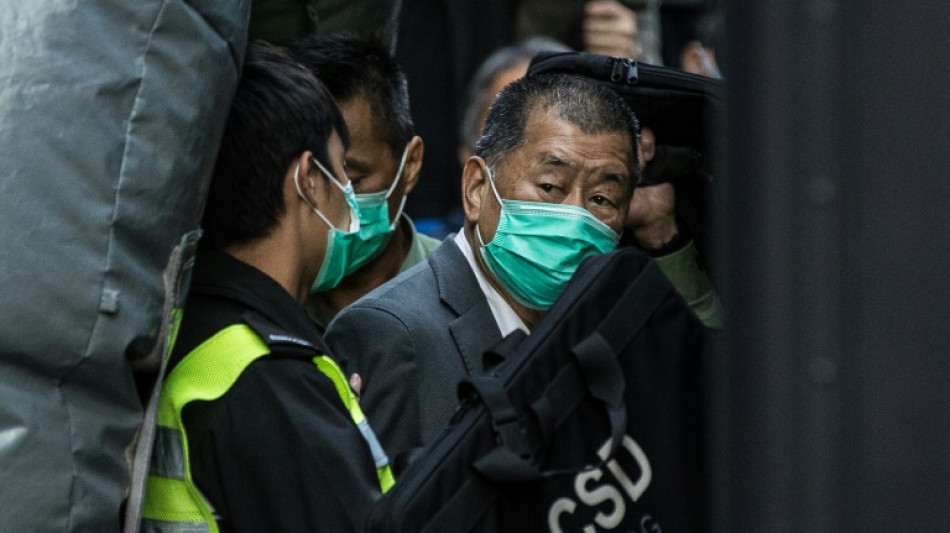
Hong Kong court orders search of media tycoon Jimmy Lai's phones / Photo: STR - AFP
 Anna Miltina Confronted with Racism Allegations on ProSieben Show

 German Auto Giants Face Existential Crisis as China Sales Plummet

 Cause of Death Revealed for 'Ellen' Producer Matthew Wright

 How to Enjoy Luxury Experiences on a Budget

 Pakistan Demands Grant-Based Climate Finance at COP31 to Avoid Debt Trap

 E Pellicci Pop-Up at Selfridges Brings Back Nostalgic School Cake

 Coronation Street's Debbie Webster Steps Down as Dementia Storyline Intensifies
Two phones owned by jailed pro-democracy media tycoon Jimmy Lai can be searched on national security grounds and are not protected by journalistic privilege, a senior judge ruled Tuesday in Hong Kong.
Lai, owner of the now-shuttered Apple Daily tabloid, will soon go on trial for "collusion with foreign forces", an offence that carries up to life in prison under the sweeping national security law Beijing imposed on Hong Kong two years ago.
Two smartphones were seized when hundreds of police officers arrested Lai and raided the newsroom of Apple Daily, which eventually collapsed after its assets were frozen under the security law
Lai's legal team claimed the content of the phones was covered by journalistic privilege, which is recognised by case law in Hong Kong, as well as legal privilege that protects conversations between lawyers and their clients.
Last month, police applied for a warrant to search the phones under the national security law.
Wilson Chan, one of the High Court judges handpicked by the government to try security cases, on Tuesday ruled that police could search Lai's phones, including journalistic materials. He excluded content covered by legal privilege.
"Press freedom simply does not equate (to) any blanket prohibition against the seizure, production or disclosure of journalistic materials," Chan wrote in his judgement.
Chan ruled the warrant covers all types of materials so long as they contain or are likely to contain evidence of a national security offence, including journalistic materials.
In a day-long judicial review hearing last week, Lai's lead lawyer Philip Dykes warned that the lack of safeguards for journalistic materials would cause a chilling effect.
"Confidential journalistic materials are an essential feature and a cornerstone of a healthy and functioning free press," Dykes told the court.
Dykes, a former chairman of the Hong Kong Bar Association, argued that the national security warrant "abrogated the protection of journalistic materials" under Hong Kong law.
Jenkin Suen, representing the Department of Justice, countered that "journalistic materials cannot by definition form the subject of any order or direction of the court authorising search or requiring disclosure or production."
Hong Kong has tumbled down press freedom rankings since the imposition of the security law, which has begun transforming Hong Kong's legal landscape, including toughening bail requirements and eliminating juries in some cases.
D.Cunningha--AMWN