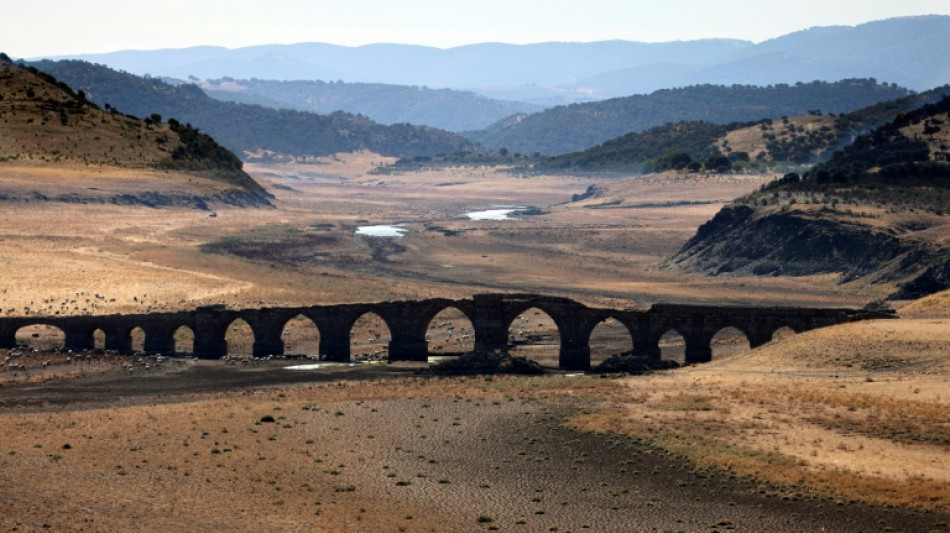
Severe drought in Spain uncovers submerged monuments / Photo: THOMAS COEX - AFP
 Anna Miltina Confronted with Racism Allegations on ProSieben Show

 German Auto Giants Face Existential Crisis as China Sales Plummet

 Cause of Death Revealed for 'Ellen' Producer Matthew Wright

 How to Enjoy Luxury Experiences on a Budget

 Pakistan Demands Grant-Based Climate Finance at COP31 to Avoid Debt Trap

 E Pellicci Pop-Up at Selfridges Brings Back Nostalgic School Cake

 Coronation Street's Debbie Webster Steps Down as Dementia Storyline Intensifies
A centuries-old church and a huge megalithic complex are among the underwater monuments that have resurfaced in Spain as a severe drought causes water levels in reservoirs to plunge.
After a prolonged dry spell, Spain's reservoirs -- which supply water for cities and farms -- are at just under 36 percent capacity, according to environment ministry figures for August.
The receding waters have exposed the ruins of an 11th-century church in the usually submerged village of Sant Roma de Sau, which was flooded in the 1960s when a nearby dam was built.
Normally, the church's bell tower is the only visible sign of the village in the northeastern region of Catalonia.
Drawn by pictures on social media and television reports, crowds of tourists fill the restaurants in the nearby village of Vilanova de Sau.
"It has been years since (water levels) are as low as they are now," said 45-year-old Nuria Ferrerons during a recent visit to the site.
"We saw it on social media and we said 'well let's see how it is'," she added.
Two tourists on a canoe paddled through an arch of the church, which is fenced off to prevent people from getting too close due to the risk the ruins could collapse.
"Normally you can only see the bell tower," said Sergi Riera, who came to see "something that has not been visible for years".
In Spain's western Extremadura region, the receding waters of the Valdecanas reservoir have revealed a prehistoric stone circle on an islet that is normally underwater.
Dubbed the "Spanish Stonehenge", the circle of dozens of megalithic stones was discovered by archaeologists in 1926 but the area was flooded in 1963 when the reservoir was built.
The stones are also drawing tourists, who reach the islet on boats operated by several private firms.
Officially known as the Dolmen of Guadalperal, the site is believed to date back to 5000 BC.
"People leave delighted," said Ruben Argenta, who owns a firm offering guided tours of the stones.
Manuel Mantilla, a sixty-year-old from the southern city of Cordoba, was visiting with his wife after hearing about the site through the media.
"We saw that as a unique opportunity," he said.
Climate change has left parts of Spain at their driest in more than 1,000 years, and winter rains are expected to diminish further, a study published in July by the Nature Geoscience journal showed.
F.Dubois--AMWN