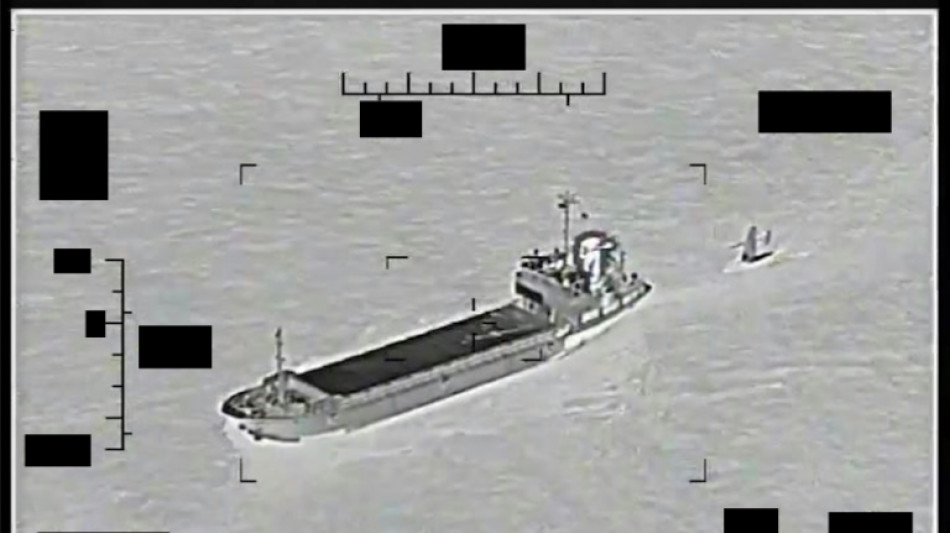
Iran seizes, then releases US Navy drone vessel: Pentagon / Photo: Timothy HAWKINS - Navy Office of Information/AFP
 Anna Miltina Confronted with Racism Allegations on ProSieben Show

 German Auto Giants Face Existential Crisis as China Sales Plummet

 Cause of Death Revealed for 'Ellen' Producer Matthew Wright

 How to Enjoy Luxury Experiences on a Budget

 Pakistan Demands Grant-Based Climate Finance at COP31 to Avoid Debt Trap

 E Pellicci Pop-Up at Selfridges Brings Back Nostalgic School Cake

 Coronation Street's Debbie Webster Steps Down as Dementia Storyline Intensifies
An Iranian ship seized an American military unmanned research vessel in the Gulf but released it after a US Navy patrol boat and helicopter were deployed to the location, the Pentagon said Tuesday.
The US Central Command's 5th Fleet said a support ship from Iran's Islamic Revolutionary Guard Corps Navy, the Shahid Baziar, was spotted towing the seven-meter (23-foot) Saildrone Explorer unmanned surface vessel (USV) late Monday.
The US naval drone, equipped with an array of sensors, radars and cameras, was in international waters collecting navigation and other unspecified data, the 5th Fleet said in a statement.
When the Iranian vessel was seen towing the unmanned boat, US forces sent the USS Thunderbolt coastal patrol ship, which was operating nearby, to the scene.
In addition, an MH-60S Sea Hawk helicopter based in Bahrain flew to the location.
Those actions "resulted in the IRGCN vessel disconnecting the towing line to the USV and departing the area approximately four hours later" without further incident, the 5th Fleet said.
"IRGCN's actions were flagrant, unwarranted and inconsistent with the behavior of a professional maritime force," said Vice Admiral Brad Cooper, commander of US Naval Forces Central Command, in a statement.
"US naval forces remain vigilant and will continue to fly, sail and operate anywhere international law allows while promoting rules-based international order throughout the region," he added.
With solar panels and a sail wing five meters tall, the Saildrone Explorer is driven by solar and wind energy and can be deployed on missions on the ocean for up to one year, monitored remotely by a human pilot.
It can collect a broad range of oceanic, navigational and meteorological data, as well as strategic intelligence.
The 5th Fleet stressed the vessel was US government property but that the technology it carries is "available commercially" and "does not store sensitive or classified information."
The US Navy first began operational testing of the USV in the Gulf of Aqaba last December.
B.Finley--AMWN

