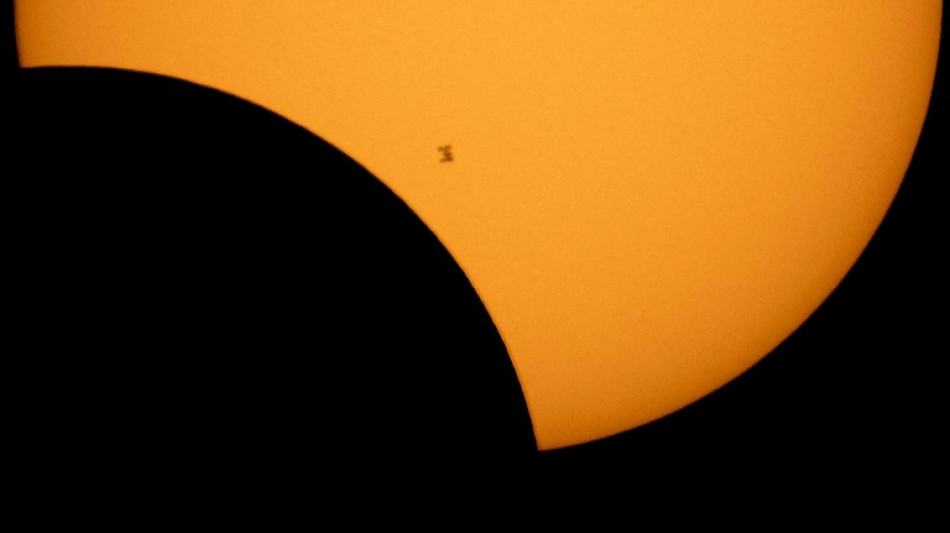
Total eclipse gives scientists chance to probe Sun's mysteries / Photo: Bill Ingalls/NASA - GETTY IMAGES NORTH AMERICA/AFP/File
 LIV Golf to lay off majority of staff

 How narwhal 'scientists' track Arctic warming

 Iran says US sanctions will achieve nothing

 Essential Dolly: five key Parton songs

 Veteran promoter Warren says it's Joshua's job to agree Fury fight

 Ex-champ Wawrinka gets last-minute wildcard to US Open

 Brennan blasts to Vuelta stage five victory, Pogacar holds lead

 What could change for US teens on Instagram and Facebook
 Meta, US states agree $16.7 bn settlement in landmark teen safety case
 'Point of no return' if Israel-Hamas truce fails: US envoy to Gaza board

 Barcelona holding out hope for Alvarez as Atletico resist sale

 Werro basks in new status, shelves world record talk

 Bill Gates warns world unprepared for AI upheaval
 Prince Harry and family arrive back in Britain: UK media

 German plan for sugar tax on Coke Zero fizzles out

 Deadly flood hits Nepal-Tibet border, hundreds unaccounted for

 Tongue says Root has left England in no doubt over conduct standards

 Flags lowered across US for country music legend Dolly Parton

 Stocks gain as oil drops on Mideast hopes
 Bouaddi joins Man City for Premier League teenage record £85.6 mn
 Reclusive Hungarian author Peter Nadas dies aged 83

 Man City sign Lille's Bouaddi for 100 mn euros

 Sooriyabandara, Mendis lead Sri Lanka fightback after follow-on
 With ropes and chants, thousands move Japanese castle
 Zurich Diamond League: five events to watch

Scientists plan to use a total solar eclipse that will be visible in Spain next week as a rare chance to learn more about the stormy, unpredictable nature of our star.
When the Moon blots out the Sun on August 12, teams will leap into action studying its magnetic field, atmosphere and furious weather that sometimes causes disruptions back here on Earth.
There is a long history of using eclipses to make scientific breakthroughs.
It was while watching an eclipse on May 29, 1919 on the West African island of Principe that British astronomer Arthur Eddington confirmed Albert Einstein's theory of relativity.
He achieved this by observing the effect of a light-bending phenomenon called gravitational lensing on the stars that became visible while the Sun's dazzling light was obscured.
More than a century later, scientists will watch a total solar eclipse lasting a minute and 40 seconds appear across a swathe of northern Spain next week.
"Our work aims to understand the physical mechanisms underlying the Sun's activity," Allan Sacha Brun, an astrophysicist at France's Atomic Energy Commission (CEA), told AFP.
Every day, specialists are working on models aiming to explain solar activity, allowing them "to put the Sun back into context within its evolutionary timeline, from its birth to its death," he added.
- 'We're incredibly lucky' -
The Sun is constantly spewing out matter and charged particles, sometimes unleashing full-blown solar storms that shoot out giant explosions of plasma and other matter.
When these materials slam into Earth's magnetic shield, they can knock out satellites, threaten astronauts -- and create colourful auroras in the skies of northern and southern latitudes.
"These phenomena follow a regular cycle, peaking every 11 years," Brun said. "In 2024, the Sun reached the peak of its 25th cycle."
Next week, CEA scientists will focus on the Sun's corona, the outermost layer of its atmosphere.
"We're incredibly lucky: the Moon is 400 times smaller than the Sun -- but it's also 400 times closer to us," Brun said.
This coincidence means the Moon blocks out the Sun's light, but still lets scientists see what is happening in its atmosphere.
The Sun's corona extends out for 10 million kilometres, and is a million times less intense than its surface, which is called the photosphere. But the corona can still reach up to two million degrees Celsius.
During normal times when there is no eclipse, scientists study the Sun's atmosphere with satellites equipped with a coronagraph -- "a filter that blocks out the photosphere", Brun explained.
But total eclipses even allow them a rare glimpse of the chromosphere, the layer of atmosphere between the corona and the surface.
- 'Inspirational' -
Scientists at the European Space Agency (ESA) will be analysing next week's eclipse, hoping to learn more about solar winds.
"Why do solar storms propagate in this way? What are their structures, and can we develop models that allow us to predict them?" asked Carole Mundell, the ESA's director of science.
The ESA's Solar Orbiter probe, which launched in 2020, has been busy collecting data about the Sun's atmosphere and wind.
Eclipses are an opportunity to "test just how good our models are -- or how bad," the mission's co-principal investigator Miho Janvier said.
Another ESA mission called Proba-3 is currently using three spacecraft flying in synchronised formation to create their own mini-solar eclipses.
There are also plans for a mission called MESOM that hopes to send a spacecraft into the shadow of the moon to get a much-longer view of the phenomenon.
Lucie Green, a solar physicist at University College London working on the mission, told AFP that total solar eclipses were "inspirational for everybody, artists and scientists alike".
"What we see on the Earth is inspiring what we want to do in our space science research," she added.
A.Mahlangu--AMWN