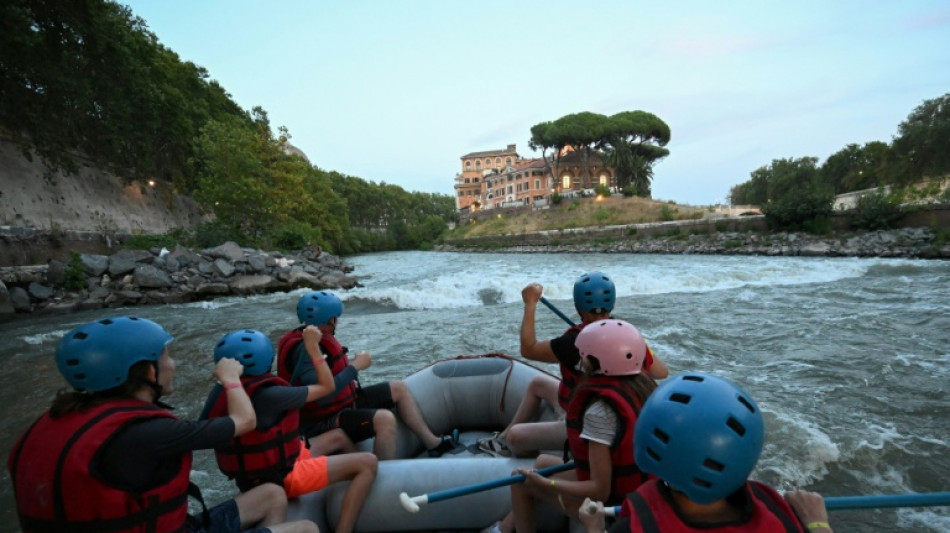
Rafts on Rome's Tiber River cool down overheated tourists / Photo: Andreas SOLARO - AFP
 Anna Miltina Confronted with Racism Allegations on ProSieben Show

 German Auto Giants Face Existential Crisis as China Sales Plummet

 Cause of Death Revealed for 'Ellen' Producer Matthew Wright

 How to Enjoy Luxury Experiences on a Budget

 Pakistan Demands Grant-Based Climate Finance at COP31 to Avoid Debt Trap

 E Pellicci Pop-Up at Selfridges Brings Back Nostalgic School Cake

 Coronation Street's Debbie Webster Steps Down as Dementia Storyline Intensifies
Forget the long lines at Roman ruins and overpriced gelato -- sweating tourists are enjoying a break from the scorching heat by rafting on the Eternal City's Tiber River.
A welcome change from the beaten tourist track, river rafting on the Tiber -- long the lifeblood of the ancient city -- is a unique and relatively new option for tourists seeking to discover Italy's capital.
Starting at the water's edge near the historic Piazza del Popolo, the inflatable rafts float by some of the city's most photographed landmarks, from the Castel Sant'Angelo -- the burial place of Emperor Hadrian -- to St Peter's Basilica, the dome of which can be seen from the water.
After approximately two hours, tours end at an ancient Roman port in the neighbourhood of Trastevere, whose name literally means "Across the Tiber".
"It's really nice to get a different view of Rome. It's something special compared with what you can see on foot," said Manuel Frank, 19, a visitor from Germany on a recent "Roma Rafting" tour.
His guide, Giuseppe Battaglia, said the 40-euro ($46.7) tour allows tourists a different perspective on the city, one that follows "much the same route that the Romans used to take before setting off on their conquests".
In Ancient Rome and centuries beyond, Italy's third-longest river provided water and food, while acting as a key trade route for the city's inhabitants.
"We're always used to thinking about roads, cars and motorbikes, but Rome also gives us the chance to take a tour along the river," said the 37-year-old guide.
As the rafts reach the picturesque Tiber Island, the current picks up and creates light rapids, splashing the rafters as they pass beneath some of Rome's oldest stone bridges.
Belgian tourist Sabine Maisano, 50, said she had sought out something different for her visit to Rome with her family.
"After a day of walking for kilometres, being able to sit down in a boat... even though you have to paddle a little, that allows us to relax, stay cool and discover the city at a more relaxed pace."
F.Pedersen--AMWN