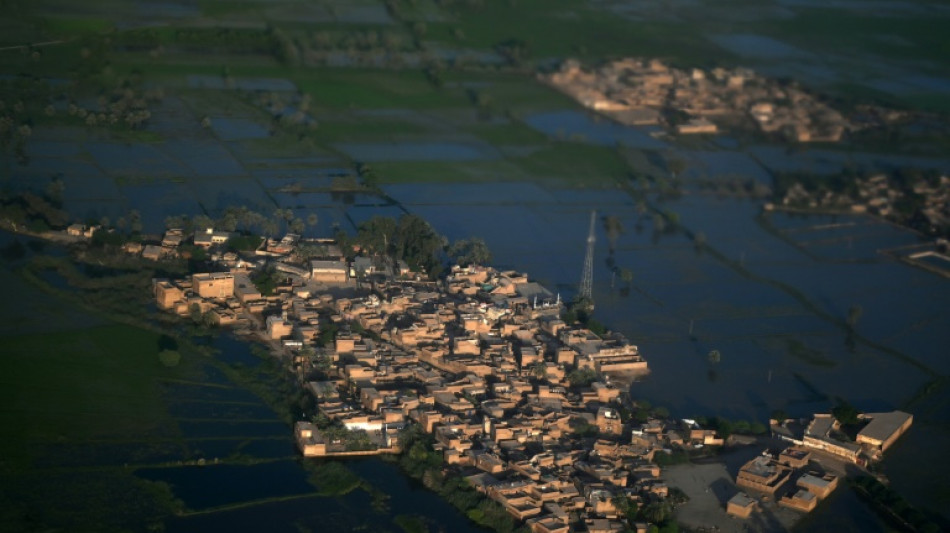
UN chief says world paying 'horrific price' for fossil fuels folly / Photo: Aamir QURESHI - AFP
 Anna Miltina Confronted with Racism Allegations on ProSieben Show

 German Auto Giants Face Existential Crisis as China Sales Plummet

 Cause of Death Revealed for 'Ellen' Producer Matthew Wright

 How to Enjoy Luxury Experiences on a Budget

 Pakistan Demands Grant-Based Climate Finance at COP31 to Avoid Debt Trap

 E Pellicci Pop-Up at Selfridges Brings Back Nostalgic School Cake

 Coronation Street's Debbie Webster Steps Down as Dementia Storyline Intensifies
United Nations Secretary-General Antonio Guterres said developing nations were paying a "horrific price" for the world's reliance on fossil fuels, as he toured parts of Pakistan hit by floods blamed on climate change.
Nearly 1,400 people have died in flooding that covers a third of the country -- an area the size of the United Kingdom -- wiping out crops and destroying homes, businesses, roads and bridges.
Guterres hopes his visit will galvanise support for Pakistan, which needs at least $10 billion to repair damaged infrastructure.
"Pakistan and other developing countries are paying a horrific price for the intransigence of big emitters that continue to bet on fossil fuels," Guterres said in a tweet, shortly before heading to see some of the most flood-affected areas.
"From Islamabad, I am issuing a global appeal: Stop the madness. Invest in renewable energy now. End the war with nature."
Pakistan receives heavy -- often destructive -- rains during its annual monsoon season, which is crucial for agriculture and water supplies.
But downpours as intense as this year's have not been seen for decades.
- 'Insanity and suicide' -
On Friday Guterres lamented the lack of attention the world gave to climate change -- particularly the industrialised nations that scientists blame.
"This is insanity, this is collective suicide," he said.
Pakistan is responsible for less than one percent of global greenhouse gas emissions, but is eighth on a list compiled by the NGO Germanwatch of countries most vulnerable to extreme weather caused by climate change.
Guterres is touring flood-hit parts of the south on Saturday, and will also visit Mohenjo-daro, a centuries-old UNESCO-designated world heritage site threatened by the deluge.
Some 33 million people have been affected by the floods, which have destroyed around two million homes and business premises, washed away 7,000 kilometres (4,500 miles) of roads and collapsed 500 bridges.
The effect of the torrential rain has been twofold -- destructive flash floods in rivers in the mountainous north, and a slow accumulation of water in the southern plains.
"If he comes and sees us, Allah will bless him," Rozina Solangi, a 30-year-old housewife from a flooded village near Sukkur, told AFP Friday.
"All the children, men and women are roasting in this scorching heat. We have nothing to eat, there is no roof on our heads. So he must do something for us poor."
The meteorological office says Pakistan received five times more rain than normal in 2022. Padidan, a small town in Sindh province, has been drenched by more than 1.8 metres (71 inches) since the monsoon began in June.
With people and livestock cramped together, the camps are ripe for outbreaks of disease, with many cases of mosquito-borne dengue reported, as well as scabies.
C.Garcia--AMWN

