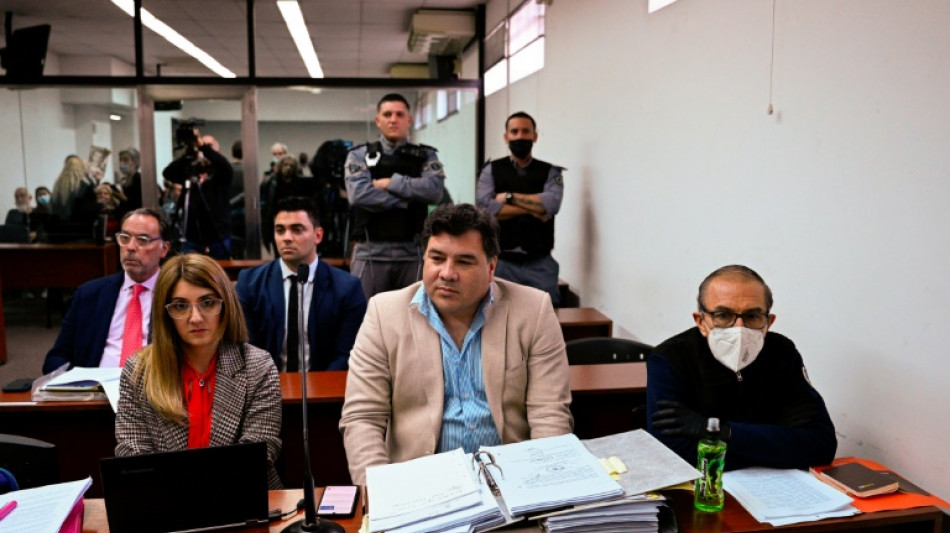
Trial opens against Argentine ex-policeman accused of torture / Photo: Luis ROBAYO - AFP
 Anna Miltina Confronted with Racism Allegations on ProSieben Show

 German Auto Giants Face Existential Crisis as China Sales Plummet

 Cause of Death Revealed for 'Ellen' Producer Matthew Wright

 How to Enjoy Luxury Experiences on a Budget

 Pakistan Demands Grant-Based Climate Finance at COP31 to Avoid Debt Trap

 E Pellicci Pop-Up at Selfridges Brings Back Nostalgic School Cake

 Coronation Street's Debbie Webster Steps Down as Dementia Storyline Intensifies
Argentine former police officer Mario Sandoval went on trial Wednesday for the alleged torture and disappearance of a young activist 46 years ago, during the South American country's last dictatorship.
Sandoval, who was extradited in 2019 after a long exile in France, is suspected of taking part in the kidnapping, torture and disappearance of hundreds of people during the 1976-83 military dictatorship.
This particular case centers on such crimes apparently committed against then-24-year-old architecture student and leftwing activist Hernan Abriata in 1976.
Sandoval, 69, is a former Buenos Aires police inspector who was accused by survivors from the notorious Navy Mechanics School (ESMA), which served as the country's largest detention and torture facility where 5,000 people were sent before they disappeared.
"It is a very long search for justice, 46 years," lawyer Sol Hourcade told AFP. "The family identified those responsible for the kidnapping. We hope for a conviction."
The family hopes Sandoval is sentenced to the maximum 25 years in jail.
Sandoval fled to France in 1985, two years after the military junta fell, and built a new life there as a defense and security consultant.
He even taught at the Institute of Higher Latin American Studies in Paris.
He gained French nationality in 1997 but that did not save him from extradition as he was not French at the time of the alleged crimes.
Sandoval arrived at the court handcuffed and with his face partially hidden by a medical mask.
The first part of the process was dedicated to the reading out of the charges against Sandoval, who denies the accusations and had petitioned France's Council of State in a bid to prevent his extradition.
F.Bennett--AMWN