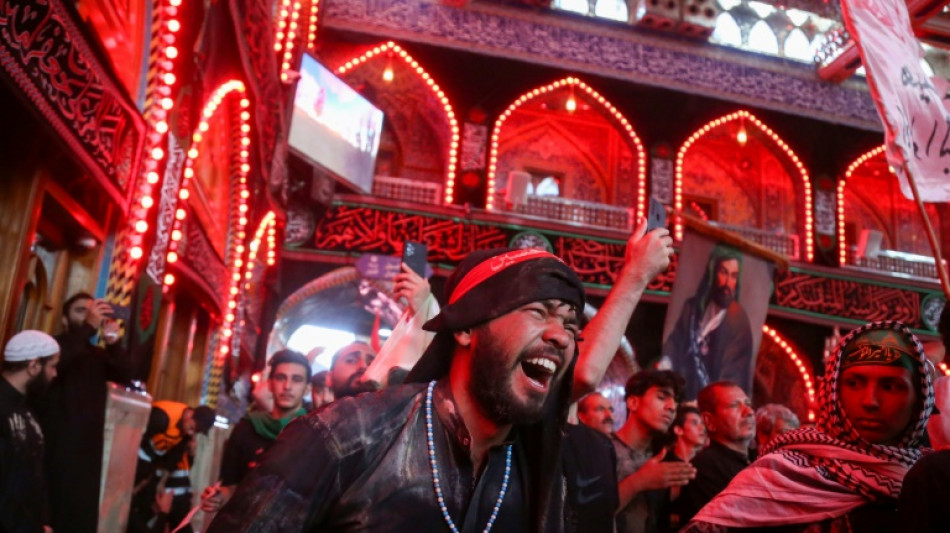
21 million Shiites mark Arbaeen in Iraq's Karbala / Photo: Mohammed SAWAF - AFP
 Anna Miltina Confronted with Racism Allegations on ProSieben Show

 German Auto Giants Face Existential Crisis as China Sales Plummet

 Cause of Death Revealed for 'Ellen' Producer Matthew Wright

 How to Enjoy Luxury Experiences on a Budget

 Pakistan Demands Grant-Based Climate Finance at COP31 to Avoid Debt Trap

 E Pellicci Pop-Up at Selfridges Brings Back Nostalgic School Cake

 Coronation Street's Debbie Webster Steps Down as Dementia Storyline Intensifies
Dressed in black, 21 million pilgrims from around the world massed in the Iraqi city of Karbala on Saturday for the Arbaeen commemoration, against the backdrop of a political crisis.
Arbaeen marks the end of the 40-day mourning period for the 7th-century killing of Imam Hussein by the forces of the Caliph Yazid -- a formative event in Shiite Islam.
The annual festival sees men and women from across Iraq and beyond travel to Karbala, where Imam Hussein and his brother Abbas are buried, for one of the world's largest religious gatherings.
After two years marked by the Covid pandemic and border restrictions, 21.2 million pilgrims have flocked to the city in central Iraq this week, said the organisation that manages Abbas' mausoleum.
Among them are five million foreigners, including a record of more than three million from neighbouring Iran, according to authorities in the two countries.
On the esplanade linking the mausoleums of Hussein and Abbas, worshippers recited prayers on Saturday.
Groups of men beat their chests to the rhythm of religious chants and the din of loudspeakers, some of them slowly making their way around the two mausoleums.
The pilgrims waved black flags and banners bearing the image of Imam Hussein.
Since the overthrow of dictator Saddam Hussein during the US-led invasion in 2003, participation in Arbaeen has been steadily increasing.
"Arbaeen means different things to different people," said Alex Shams, a doctoral student at the University of Chicago who specialises in Shiite politics.
"For Iraqi Shiites it's very much an expression of their freedom after years of dictatorship and also pride in their Shiite identity," he told AFP.
This year the commemorations are being held against the backdrop of a political crisis in Iraq.
Squabbling between the two main Shiite factions -- the pro-Iran Coordination Framework and a bloc loyal to mercurial cleric Moqtada Sadr -- has prevented the establishment of a coalition government.
The crisis escalated into violence in late August, when Sadr supporters clashed with the army and forces from the Hashed al-Shaabi, former paramilitaries integrated into the regular military.
More than 30 Sadr followers were killed.
Ch.Kahalev--AMWN

