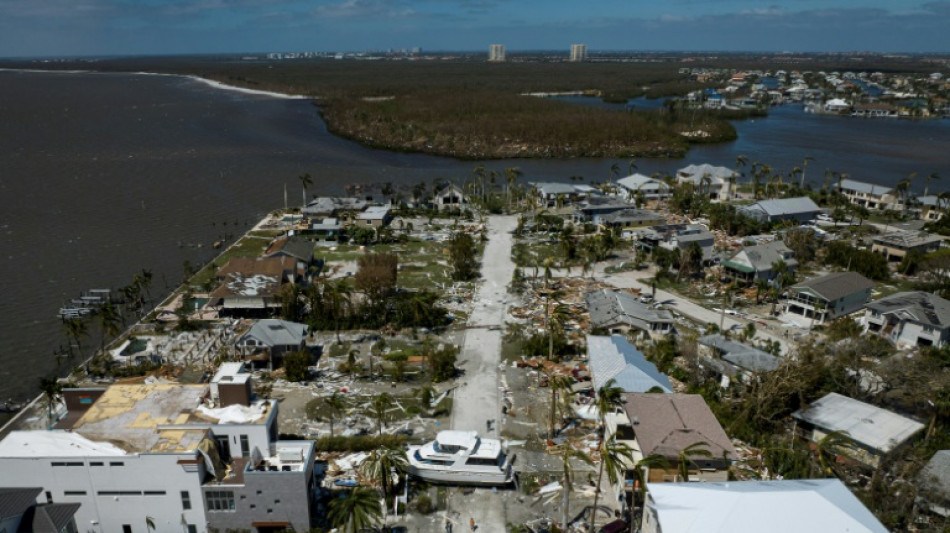
Deadly hurricane heads for Carolinas after devastation in Florida / Photo: Ricardo ARDUENGO - AFP
 Pope Leo begins three-country South American tour in Uruguay

 Khawaja says entire Australia camp knew of 2018 ball-tampering plan

 November Foraging Guide: Edible Mushrooms and Critical Safety Protocols

 Microsoft Updates Xbox PC App with 60% Faster Startup and Redesigned Interface

 Early Polar Vortex Disruption Creates Uncertain Winter Outlook for Pennsylvania

 Edmund Richardson Wins Baillie Gifford Prize for 'Alexander' Biography

US forecasters expect Hurricane Ian to unleash life-threatening conditions on the Carolina states on Friday after causing devastation in Florida, where it killed at least 12 people with the toll expected to rise.
After weakening across land, Ian regained its Category 1 status in the Atlantic Ocean, the US National Hurricane Center said, predicting up to seven feet (two meters) of storm surge as it slams into the South Carolina coast by afternoon.
The storm, one of the most powerful ever to hit the United States, left hundreds of people in need of rescue in Florida.
State Governor Ron DeSantis on Friday described the coastal Fort Myers area as "ground zero," adding "but this was such a big storm that there are effects far inland."
Many people evacuated, but thousands chose to shelter in place. DeSantis said Florida officials had so far contacted 20,000 people who chose to stay.
At least 12 people have been confirmed dead, according to local officials, the majority of them in Charlotte county.
DeSantis has warned that it was too early to give a death toll, and that concrete information about casualty numbers could be expected over several days.
The NHC has issued a hurricane warning for South Carolina's entire coast, as well as portions of Georgia and North Carolina.
- 'Horrifying sounds' -
Ian then is set to weaken fast and "dissipate near the North Carolina/Virginia border by Saturday night," the NHC said.
Fort Myers, where Ian came ashore as a powerful Category 4 hurricane on Wednesday, took much of the brunt, as streets became rivers and seawater poured into houses.
Dozens of boats moored in the marina were sunk while others were tossed onto downtown streets.
DeSantis described the destruction as a "500-year flood event."
Tom Johnson of Fort Myers had a front row seat for the chaos from his apartment on the second floor of a two-story harbourside building.
"I was scared because I've never been through that," the 54-year-old told AFP. "It was just the most horrifying sounds with debris flying everywhere, doors flying off."
His home was undamaged but one of his neighbors, Janelle Thil, was not so lucky and had to ask other residents for help after her ground floor apartment began to flood.
"They got my dogs and then I jumped out of the window and swam," the 42-year-old said.
When Thil returned to her apartment after the storm passed, she said she opened the door and "had to wait about five minutes for all the floodwaters to come out."
"I loved my home," she said. "But I'm alive and that's what matters."
A US Coast Guard official said helicopter crews were plucking people from the rooftops of homes inundated by floodwaters.
- Millions without power -
Seventeen migrants were missing from a boat that sank during the hurricane on Wednesday, with one person found dead and nine others rescued, the Coast Guard said. Among them were four Cubans who swam to shore in the Florida Keys.
Much of Florida's southwest coast was plunged into darkness after the storm wiped out power.
Tracking website PowerOutage.us said two million homes and businesses remained without electricity in the Sunshine State on Friday.
Two barrier islands near Fort Myers, Pine Island and Sanibel Island, popular with vacationers, were essentially cut off when the storm damaged causeways to the mainland.
Before pummeling Florida, Ian plunged all of Cuba into darkness after downing the island's power network.
Electricity was gradually returning, but many homes remain without power.
Laura Mujica joined dozens of Cuban women gathered in the capital Havana on Thursday to demand electricity be restored in the city.
"We took to the street, because we haven't had electricity for several days and we are tired of it.
Human-induced climate change is resulting in more severe weather events across the globe, scientists say -- including with Ian.
According to a rapid and preliminary analysis, human-caused climate change increased the extreme rain that Ian unleashed by over 10 percent, US scientists said.
F.Bennett--AMWN