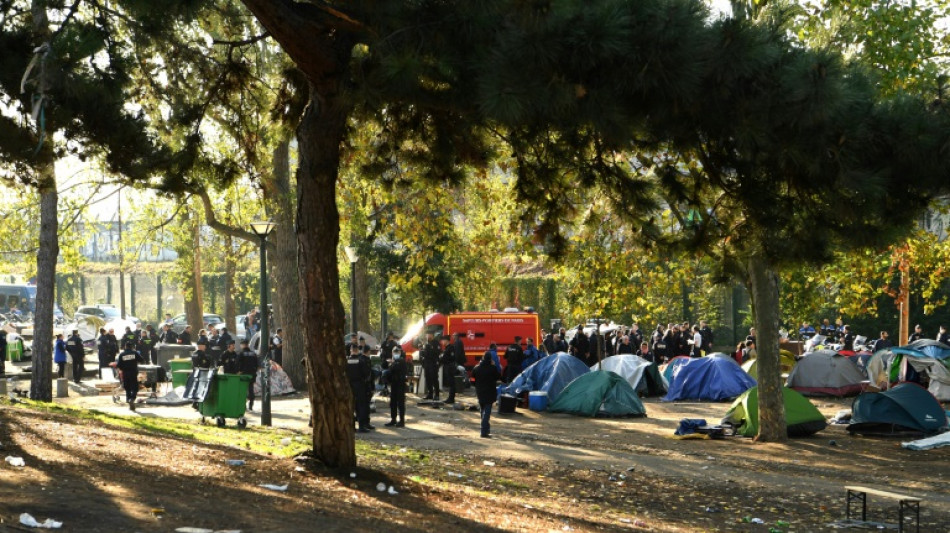
Paris police dismantle crack users' camp / Photo: BERTRAND GUAY - AFP
 Pope Leo begins three-country South American tour in Uruguay

 Khawaja says entire Australia camp knew of 2018 ball-tampering plan

 November Foraging Guide: Edible Mushrooms and Critical Safety Protocols

 Microsoft Updates Xbox PC App with 60% Faster Startup and Redesigned Interface

 Early Polar Vortex Disruption Creates Uncertain Winter Outlook for Pennsylvania

 Edmund Richardson Wins Baillie Gifford Prize for 'Alexander' Biography

Paris police on Wednesday dismantled a camp that is home to over 100 crack users, the latest move in a campaign that has repeatedly displaced the addicts around the capital.
French Interior Minister Gerald Darmanin wrote on Twitter as the evacuation got under way that this time, "1,000 officers will be deployed to prevent the camp from reforming somewhere else".
An AFP journalist saw large numbers of police surround the rubbish-strewn camp from 7:00 am (0500 GMT) in Square Forceval in northeast Paris, with police chief Laurent Nunez on the scene.
Over the past two years, successive evacuations have moved crack users from the Stalingrad square on the city's Saint-Martin canal, first to a nearby park, and then to their current site alongside the French capital's ring road.
Tackling the city's crack problem -- visible on the streets for the past three decades -- has proved difficult due to the addictiveness of the drug, a cocaine derivative that sells for as little as 10 euros ($9.90) per dose.
Darmanin, a law-and-order hardliner, has given newly-installed Paris police chief Nunez a single year to wipe out crack in the capital.
The interior ministry said that inhabitants of the camp wanted by police would be arrested, while foreigners without papers would be detained awaiting deportation.
"Other occupants will be directed towards accommodation structures with medical and social assistance, or to medical facilities," the ministry added.
Aid groups say that between 300 and 400 people spend time in the camp during the day and around 150 at night, with up to 40 percent of them women.
Dealers sold crack "rocks" openly among the groups of users.
As at other sites where the addicts have gathered, local residents have complained of assaults, thefts and other disruption since their arrival.
Around 500 people demonstrated last month to mark the camp being in place for a year and demand its removal.
L.Mason--AMWN