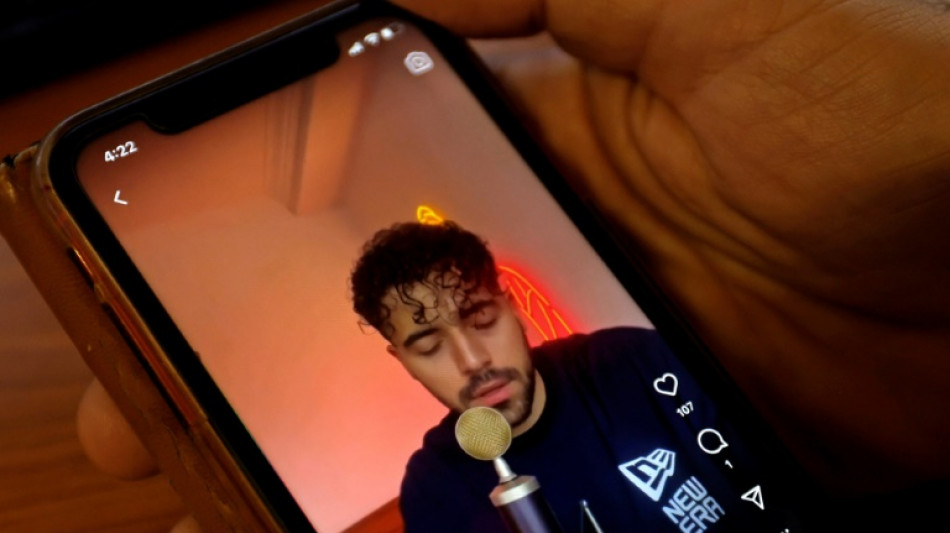
Iran pop singer silenced, but his song remains a protest anthem / Photo: Khaled DESOUKI - AFP
 Pope Leo begins three-country South American tour in Uruguay

 Khawaja says entire Australia camp knew of 2018 ball-tampering plan

 November Foraging Guide: Edible Mushrooms and Critical Safety Protocols

 Microsoft Updates Xbox PC App with 60% Faster Startup and Redesigned Interface

 Early Polar Vortex Disruption Creates Uncertain Winter Outlook for Pennsylvania

 Edmund Richardson Wins Baillie Gifford Prize for 'Alexander' Biography

Even though he has been silenced, Iranian pop singer Shirvin Hajipour's impassioned song in support of protests over Mahsa Amini's death in custody remains an unofficial anthem of the movement.
The song "Baraye" notched up 40 million views on Instagram before it was deleted when Hajipour was arrested, but he has since been freed on bail and has distanced himself from politics, likely as a condition for his release.
Baraye, the Persian word "For" or "Because", is composed of tweets about the protests and highlights longings people have for things lacking in sanctions-hit Iran, where many complain of hardship caused by economic mismanagement.
It also draws on everyday activities that have landed people in trouble with the authorities in the Islamic republic.
"For the sake of dancing in the streets; Because of the fear felt while kissing; For my sister, your sister, your sisters," the song's lyrics say.
"Because of the embarrassment of an empty pocket; Because we are longing for a normal life... Because of this polluted air."
Baraye has been heard played loudly at night from apartment blocks in Iran to show support for protests sparked by Amini's death on September 16, after the notorious morality police arrested her for allegedly breaching rules requiring women to wear hijab headscarves and modest clothes.
It was also sung with gusto by the Iranian diaspora at rallies in more than 150 cities around the world at the weekend.
In one clip shared by the New York-based Center for Human Rights in Iran, a group of schoolgirls without headscarves is seen singing Baraye in class with their backs to the camera.
The tune was removed from Hajipour's Instagram account shortly after his arrest but is still widely available on other social media platforms, including Twitter and YouTube.
- 'Because of forced Instagram stories' -
Hajipour's lawyer Majid Kaveh said he was released on bail at noon on Tuesday.
The reformist Shargh newspaper said his family had been informed of his arrest in the northern city of Sari on Saturday, in a report that cited his sister Kamand Hajipour.
She had said in an Instagram post that her parents had been informed of his arrest in a call from the city's intelligence ministry offices.
Shortly after his release, Hajipour was back on Instagram, but this time to apologise and distance himself from politics.
"I'm here to say I'm okay," he told his 1.9 million followers on the platform.
"But I'm sorry that some particular movements based outside of Iran -- which I have had no relations with -- made some improper political uses of this song.
"I would not swap this (country) for anywhere else and I will stay for my homeland, my flag, my people, and I will sing.
"I don't want to be a plaything for those who do not think of me, you or this country," he added.
In response to his post, many on Twitter suggested the line "Because of forced Instagram stories" should be added to the lyrics of the song.
Human rights groups including Article 19 have repeatedly called on Iran to end its use of forced confessions, which they say are false and extracted under duress or even torture.
In one recent case, a young Iranian woman, Sepideh Rashno, disappeared after becoming involved in a dispute on a Tehran bus with another woman who accused her of removing her headscarf.
She was held by the powerful Islamic Revolutionary Guard Corps and appeared on television in what activists said was a forced confession before being released on bail in late August.
A.Malone--AMWN