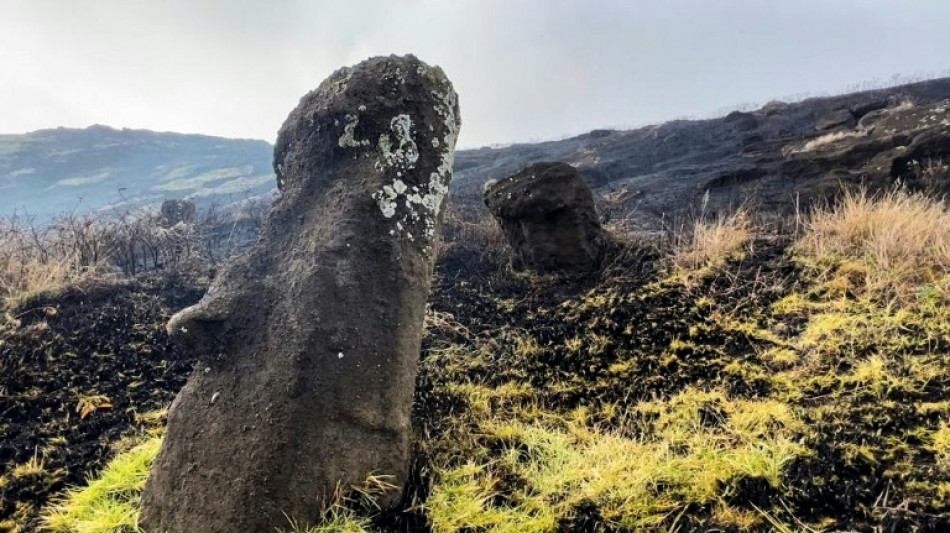
Easter Island blaze chars famous moai statues / Photo: - - Rapanui Municipality/AFP
 Pope Leo begins three-country South American tour in Uruguay

 Khawaja says entire Australia camp knew of 2018 ball-tampering plan

 November Foraging Guide: Edible Mushrooms and Critical Safety Protocols

 Microsoft Updates Xbox PC App with 60% Faster Startup and Redesigned Interface

 Early Polar Vortex Disruption Creates Uncertain Winter Outlook for Pennsylvania

 Edmund Richardson Wins Baillie Gifford Prize for 'Alexander' Biography

A forest fire that tore through part of Easter Island has charred some of its fabled monumental carved stone figures, known as moai, authorities said Thursday.
"Nearly 60 hectares (148 acres) were affected, including some moai," Carolina Perez, cultural heritage undersecretary, said in a Twitter post.
On Easter Island, which lies some 3,500 kilometers (2,175 miles) off the west coast of Chile, 100 hectares have been razed by flames since Monday, Perez said. The area around the Rano Raraku volcano, a UNESCO World Heritage Site, was the most affected.
An estimated several hundred moai are in that area, as well as in the quarry where the stone used to carve the sculptures is extracted.
"The damage caused by the fire can't be undone," Pedro Edmunds, mayor of Easter Island, told local media.
There is still no report on the total damage.
But the fire comes just three months after the island was reopened to tourism on August 5, after two years of closure due to Covid-19.
Before the pandemic, Easter Island -- whose main livelihood is tourism -- received some 160,000 visitors a year, on two daily flights.
But with the arrival of Covid-19 in Chile, tourist activity was completely suspended.
The island was long inhabited by Polynesian people, before Chile annexed it in 1888.
F.Schneider--AMWN


