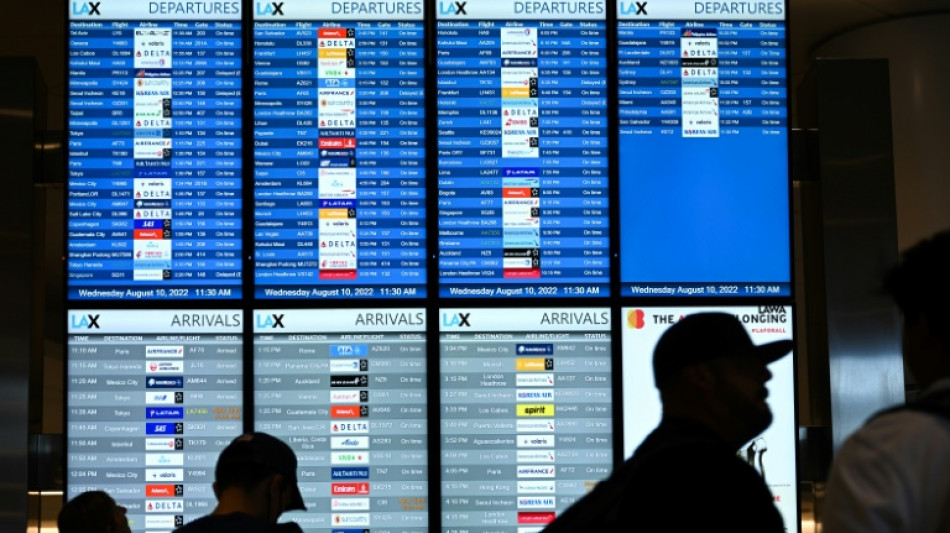
US airport websites hit by suspected pro-Russian cyberattacks / Photo: Patrick T. FALLON - AFP/File
 Pope Leo begins three-country South American tour in Uruguay

 Khawaja says entire Australia camp knew of 2018 ball-tampering plan

 November Foraging Guide: Edible Mushrooms and Critical Safety Protocols

 Microsoft Updates Xbox PC App with 60% Faster Startup and Redesigned Interface

 Early Polar Vortex Disruption Creates Uncertain Winter Outlook for Pennsylvania

 Edmund Richardson Wins Baillie Gifford Prize for 'Alexander' Biography

The websites for a number of major US airports were briefly taken offline Monday after a cyberattack promoted by a pro-Russian hacking group.
The distributed denial of service (DDOS) attacks hit the airport websites of several major US cities including Atlanta, Chicago, Los Angeles, New York, Phoenix and St Louis.
A DDOS attack involves knocking a website offline by flooding it with traffic.
The airport websites were targeted after the pro-Russian hacking group known as "KillNet" published a list of sites and encouraged its followers to attack them.
The DDOS attacks only affected the public-facing websites of the airports, which supply flight and services information and do not have any impact on operations.
Atlanta's Hartsfield-Jackson Airport said its website is "up and running after an incident early this morning that made it inaccessible to the public."
"An investigation into the cause of the incident is underway," it said. "At no time were operations at the airport impacted."
Most of the airport websites targeted appeared to be functioning normally after being temporarily knocked offline.
KillNet claimed responsibility last week for attacks on a number of US state government websites, and it has taken aim at other countries opposing Russia's invasion of Ukraine.
There was no immediate comment from the US Cybersecurity and Infrastructure Security Agency (CISA).
P.Costa--AMWN


