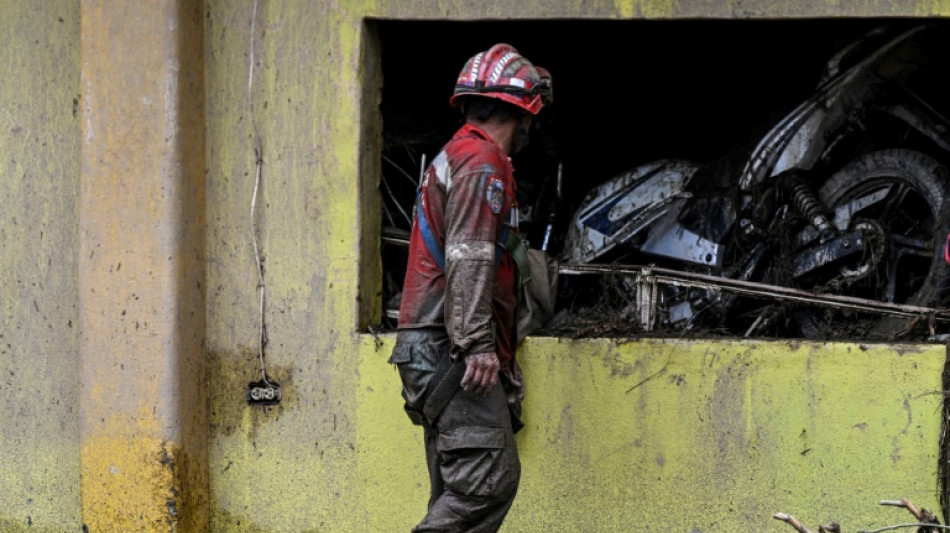
Neighbors, rescuers search for missing after Venezuela landslide / Photo: Yuri CORTEZ - AFP
 Pope Leo begins three-country South American tour in Uruguay

 Khawaja says entire Australia camp knew of 2018 ball-tampering plan

 November Foraging Guide: Edible Mushrooms and Critical Safety Protocols

 Microsoft Updates Xbox PC App with 60% Faster Startup and Redesigned Interface

 Early Polar Vortex Disruption Creates Uncertain Winter Outlook for Pennsylvania

 Edmund Richardson Wins Baillie Gifford Prize for 'Alexander' Biography

Neighbors helped rescue teams comb through mud and debris Monday for signs of dozens of people missing after a landslide swept through a town in Venezuela, killing at least 36.
More than 3,000 rescuers were deployed in Las Tejerias some 50 kilometers (31 miles) from Caracas after Venezuela's worst natural disaster in decades.
"Las Tejerias will never be the same," said survivor Isaac Castillo, 45, a merchant in the town of some 54,000 people nestled in the mountains.
"We are leaving because recovering from this is impossible."
Unusually heavy rains caused a major river and several streams to overflow on Saturday, causing a torrent of mud that swept away cars, parts of homes, businesses and telephone wires, and felled massive trees.
According to Vice President Delcy Rodriguez, "as much rain fell in eight hours as normally falls in a month," as she blamed the "climate crisis."
Experts say the storm was aggravated by the seasonal La Nina weather system gripping the region, as well as the effects of Tropical Storm Julia, which also claimed at least 11 lives in Central America and caused extensive damage from Panama to Guatemala on Sunday.
Residents of Las Tejerias used picks, shovels and any tools they could find to dig through a thick bank of mud deposited on the town Saturday.
"It came too fast, we had no time," resident Carlos Camejo, 60, said of the mudslide.
Carmen Melendez, 55, told AFP, "The town is lost, Las Tejerias is lost," as she waited desperately for news on the whereabouts of a missing relative.
- Safety on the roof -
Venezuela's Interior Minister Remigio Ceballos updated the Las Tejerias death toll from 25 to 36 on Monday, and said 56 people were missing.
Authorities erected shelters for the displaced in Maracay, capital of the affected Aragua province.
President Nicolas Maduro decreed three days of national mourning.
Crews of workers with heavy machinery worked Monday to clear the debris-covered roads, while residents battled to clean out meters of mud dumped inside their homes.
Las Tejerias resident Jose Santiago spent 40 minutes clinging to a TV antenna on the roof of his home as a torrent of mud swept through it.
"The river caught me and I couldn't find anything to do besides climb a roof and grab onto an antenna," said the 65-year-old, who barely escaped with his life.
According to Rodriguez, 317 homes were destroyed by the storm and 757 damaged.
Further afield, at least 11 people died in Honduras and El Salvador when Tropical Storm Julia raced across Central America on Sunday.
Five army soldiers on deployment in El Salvador died after a wall collapsed on them as they were seeking shelter from the storm, Security Minister Gustavo Villatoro said.
Four other people were reported killed elsewhere in the country, where some 1,000 people have sought temporary shelter.
In Honduras, Wilmer Wood, mayor of the eastern town of Brus Laguna, said two people died when Julia capsized a boat. One more person was missing.
And in Guatemala, the search was on for five people trapped under the rubble of their collapsed home in an Indigenous village.
Nicaragua's Vice President Rosario Murillo said Julia had affected some 7,500 people, flooding 3,000 homes and damaging the roofs of another 2,000.
Julia was downgraded to a tropical depression on Monday as it continued on its way to Mexico.
At the end of 2020, hurricanes Eta and Iota killed at least 200 people in Central America and caused millions of dollars in losses.
Scientists say climate change warms the surface layers of the oceans, causing more powerful, and wetter, storms and hurricanes.
P.Mathewson--AMWN


