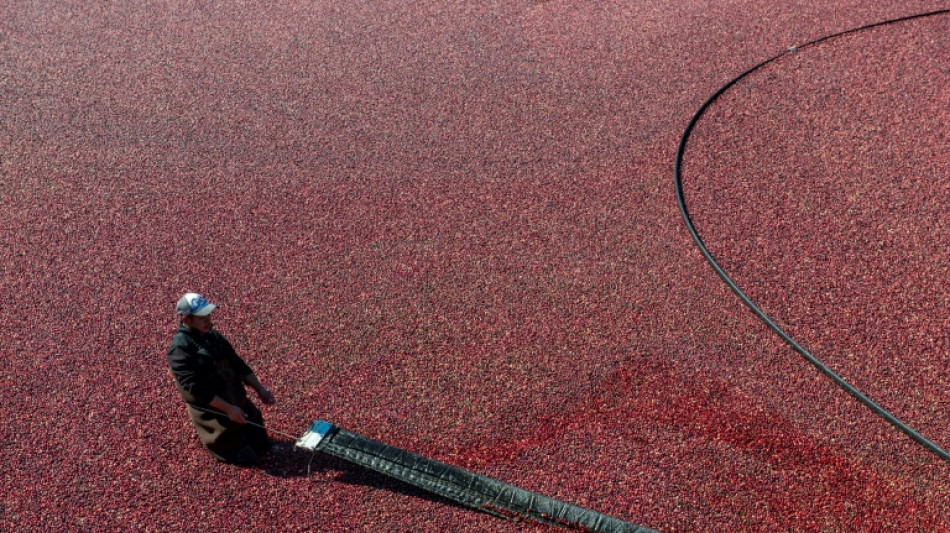
Cranberry farmers fight climate change to protect Thanksgiving staple / Photo: Joseph Prezioso - AFP
 Pope Leo begins three-country South American tour in Uruguay

 Khawaja says entire Australia camp knew of 2018 ball-tampering plan

 November Foraging Guide: Edible Mushrooms and Critical Safety Protocols

 Microsoft Updates Xbox PC App with 60% Faster Startup and Redesigned Interface

 Early Polar Vortex Disruption Creates Uncertain Winter Outlook for Pennsylvania

 Edmund Richardson Wins Baillie Gifford Prize for 'Alexander' Biography

American farmers growing cranberries, a quintessential component of Thanksgiving feasts, have had to adapt their traditional methods to fight the effects of climate change.
The tart red berries, boiled with a heaping dose of sugar to make classic cranberry sauce, thrive only in the right environment -- but climate change threatens to make conditions more unpredictable and extreme.
After a terrible 2021 season, Massachusetts farmer Billy McCaffrey is ecstatic for a bumper crop this year.
"Phenomenal, unbelievable," the 70-year-old former teacher says, surrounded up to his waist by a sea of floating berries.
His cranberry farm, south of Boston, is one of hundreds in the northeastern US state of Massachusetts -- the second largest producer after midwestern Wisconsin.
"Every year is up and down... I just hope we can keep it and get paid," says McCaffrey, worrying that an unexpected hail storm could still cause disaster for him and his wife Mary.
The McCaffreys had worried that 2022 could see a repeat of the previous year, which the head of the Cape Cod Cranberry Growers Association (CCCGA), Brian Wick, says was "one of our worst crops in quite some time."
"The rains and the environment in the vine canopy created the perfect conditions for rot (and) fungus" the expert told AFP.
- 'Double Whammy' -
This year’s growing season started with a drought, the exact opposite of last year, but farmers were able to use pumps and water to keep their crops alive.
That eats into their bottom line.
Now this year looks like one of the biggest crops ever with a prediction of 1.9 million barrels (189 million pounds) produced in Massachusetts according to the CCCGA.
Keith Mann, 54, has outfitted his large farm in Buzzards Bay, Massachusetts, with solar panels to help offset fuel costs. He has also installed several windmills on his property and sells electricity back to the grid.
Though he's not sure the average temperatures have noticeably increased, Mann says the "weather extremes cause real troubles for us."
"We had drought all summer... Then late in the summer we had torrential downpours, (which) caused flooding, and the flooding causes fungal infections."
"Too much rain all at once is a problem. Not enough rain most of the season was another problem. Put them together it's a double whammy," said Mann.
As for this year's Thanksgiving and those in the relative near future, Americans don’t need to rush and stock up on cranberry sauce just yet.
Farmers are adapting to the changing climate and producing new varieties to be processed by the massive Ocean Spray farm cooperative in Massachusetts.
"Thanksgiving, we get up for that. It drives us" said McCaffrey.
"You're going to have to change your technique and tweak it a little bit at a time."
P.Mathewson--AMWN


