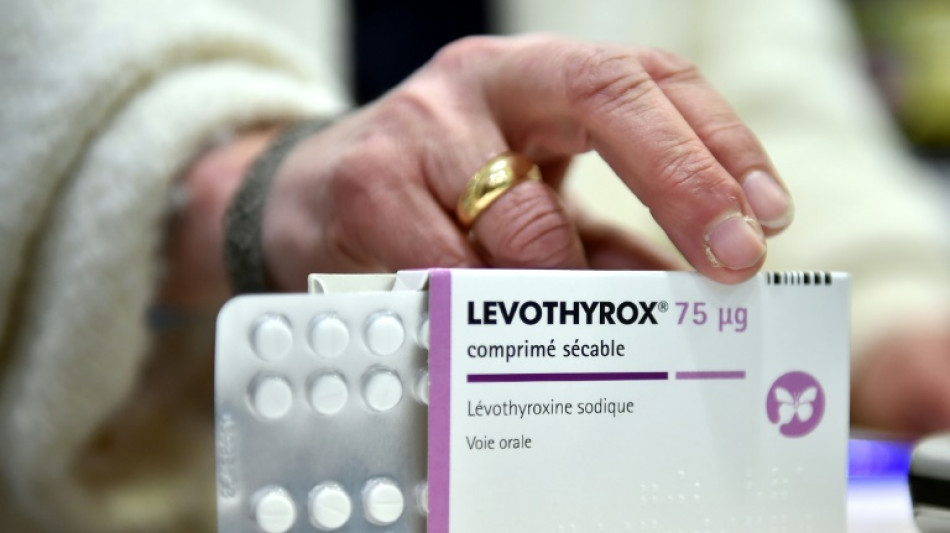
Merck charged in France over changes to popular thyroid drug / Photo: REMY GABALDA - AFP/File
 Pope Leo begins three-country South American tour in Uruguay

 Khawaja says entire Australia camp knew of 2018 ball-tampering plan

 November Foraging Guide: Edible Mushrooms and Critical Safety Protocols

 Microsoft Updates Xbox PC App with 60% Faster Startup and Redesigned Interface

 Early Polar Vortex Disruption Creates Uncertain Winter Outlook for Pennsylvania

 Edmund Richardson Wins Baillie Gifford Prize for 'Alexander' Biography

The French unit of German pharmaceuticals firm Merck said Wednesday that it had been charged with "aggravated deceit" for failing to inform patients of changes to a thyroid drug that could result in serious new side-effects.
A court had already ordered the company in 2020 to pay compensation to more than 3,300 plaintiffs in a civil case, and an appeal of that ruling was rejected by France's supreme court earlier this year.
Some 30,000 people in France reported headaches, insomnia, hair loss or dizziness from taking a new version of Levothyrox, a drug used to treat underactive thyroids or following surgery for cancer of the organ, which regulates the body's metabolism.
France is the world's biggest consumer of Levothyrox, with around 2.5 million users according to Merck, and was the first country where the new version of the drug was introduced in 2017.
The patients claim that Merck did not adequately inform them of the changes or the potential for new side effects, and a petition urging a return to the old formula has garnered some 170,000 signatures.
Merck France said its president was questioned by a judge in the southern city of Marseille on Tuesday, after which the deceit charges were filed.
"This charge in no way concerns the quality of the new Levothyrox formula," the company said, adding that it would provide "all necessary information to show there was no criminal fault of any kind".
In the civil case, judges ordered Merck to pay each of the 3,329 parties 1,000 euros ($980 at current exchange rates). The plaintiffs had asked for ten times that amount.
After its introduction in France, the new form of the drug was rolled out in around two dozen other European countries, without any problems, according to Merck.
It has said that any side effects are "normal and comparable to the old" formula.
L.Miller--AMWN


