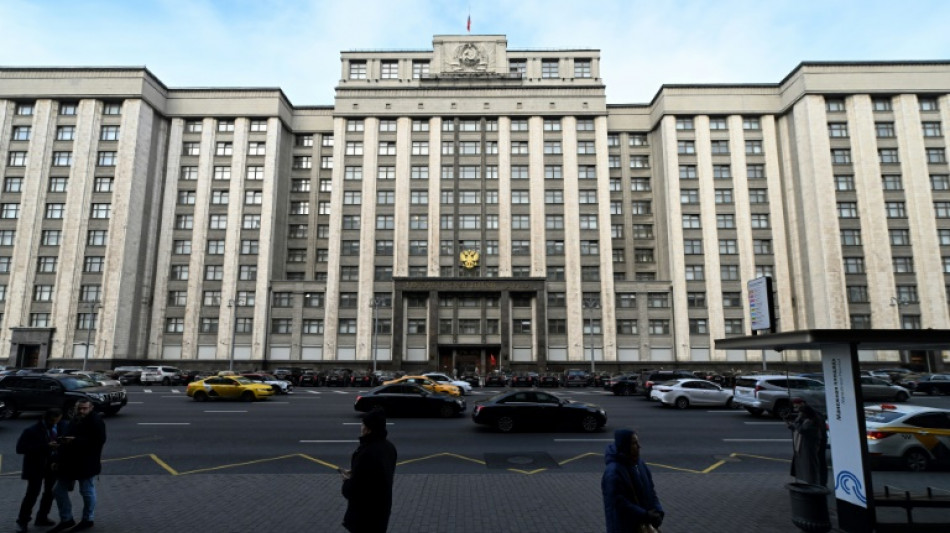
Russia paves way for toughening of 'LGBT propaganda' law / Photo: Kirill KUDRYAVTSEV - AFP
 Pope Leo begins three-country South American tour in Uruguay

 Khawaja says entire Australia camp knew of 2018 ball-tampering plan

 November Foraging Guide: Edible Mushrooms and Critical Safety Protocols

 Microsoft Updates Xbox PC App with 60% Faster Startup and Redesigned Interface

 Early Polar Vortex Disruption Creates Uncertain Winter Outlook for Pennsylvania

 Edmund Richardson Wins Baillie Gifford Prize for 'Alexander' Biography

The lower house of Russia's parliament, the Duma, paved the way for toughening a notorious 2013 "gay propaganda" law on Thursday, its official website said.
Lawmakers "unanimously adopted in the first reading amendments to the legislation regarding the prohibition of propaganda of non-traditional sexual relations", a statement on the Duma's website said.
Officials had urged parliament to adopt the law, portraying it as part of a civilisational clash with the West as Moscow's troops fight in Ukraine.
The amendments extend to all Russian adults the 2013 law that previously criminalised spreading what authorities deemed "gay propaganda" to minors.
The bill now outlaws "gay propaganda" in the media, internet, advertisement, literature and cinema.
It also bans the "propaganda of paedophilia".
The bill outlaws the "denial of family values" and also has a clause against propaganda that could "cause minors to desire to change their sex".
Foreigners who violate the law will face expulsion, according to its text.
The bill still needs to be approved by the upper house of Russia's parliament, the Federation Council, before it can be signed into law by President Vladimir Putin.
Rights campaigners, who condemn the 2013 law, say that in effect any act or public mention of same-sex couples is being criminalised.
Some Russian book publishers and film producers have raised censorship concerns, saying the law could even affect productions of Russian classics.
Putin has made social conservatism a cornerstone of his rule.
In his speech annexing Ukrainian territories last month, he railed against families with a "parent number one and a parent number two" -- apparently alluding to same-sex parenting.
New constitutional amendments passed in a controversial vote in 2020 define marriage in Russia exclusively as the union of a man and a woman.
D.Kaufman--AMWN


