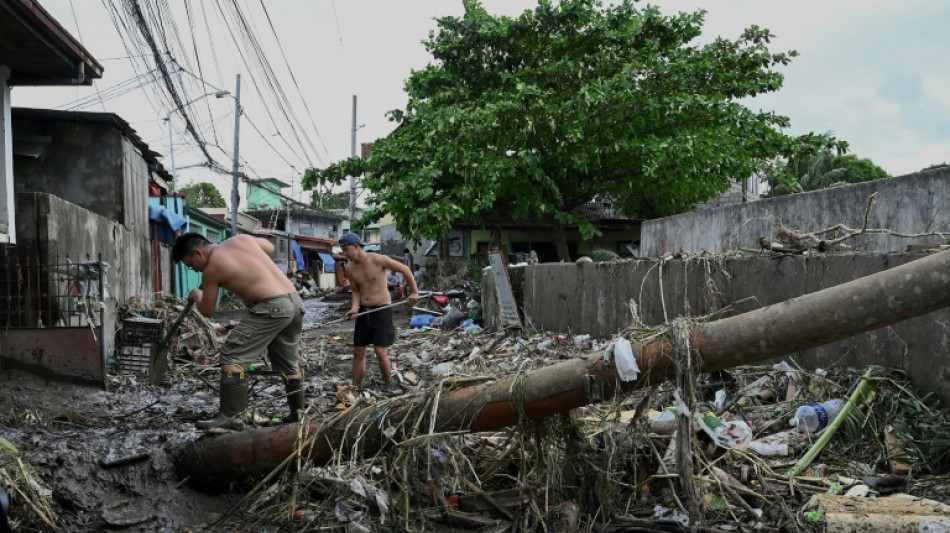
Philippines storm death toll jumps to 98 / Photo: JAM STA ROSA - AFP
 Pope Leo begins three-country South American tour in Uruguay

 Khawaja says entire Australia camp knew of 2018 ball-tampering plan

 November Foraging Guide: Edible Mushrooms and Critical Safety Protocols

 Microsoft Updates Xbox PC App with 60% Faster Startup and Redesigned Interface

 Early Polar Vortex Disruption Creates Uncertain Winter Outlook for Pennsylvania

 Edmund Richardson Wins Baillie Gifford Prize for 'Alexander' Biography

The death toll from a storm that battered the Philippines has jumped to 98, the national disaster agency said Monday, with little hope of finding survivors in the worst-hit areas.
Just over half the fatalities were from a series of flash floods and landslides unleashed by Tropical Storm Nalgae, that destroyed villages on the southern island of Mindanao on Friday.
Mindanao is rarely hit by the 20 or so typhoons that strike the Philippines each year, but storms that do reach the region tend to be deadlier than in Luzon and central parts of the country.
"We have shifted our operation from search and rescue to retrieval operation because the chances of survival after two days are almost nil," said Naguib Sinarimbo, civil defence chief of the Bangsamoro region in Mindanao.
The number of fatalities is likely to rise, with the national disaster agency recording 63 people still missing in its latest report.
Scores were injured.
As rescue teams searched through mud and debris for more bodies, survivors continued the heartbreaking task of cleaning up their sodden homes.
Residents swept muddy water from their homes and shops as their furniture and other belongings dried in the now sunny streets of Noveleta municipality, south of the capital, Manila.
"In my entire life living here, it's the first time we experienced this kind of flooding," said Joselito Ilano, 55, whose house was flooded by waist-high water.
"I am used to flooding here but this is just the worst, I was caught by surprise."
Nalgae inundated villages, destroyed crops and knocked out power in many regions as it swept across the country.
It struck on an extended weekend for All Saints' Day, which is on Tuesday, when millions of Filipinos travel to visit the graves of loved ones.
Scientists have warned that deadly and destructive storms are becoming more powerful as the world gets warmer because of climate change.
The state weather forecaster warned that another tropical depression was heading towards the Philippines even as Nalgae moved across the South China Sea.
The new weather system could bring more heavy rain and misery to areas badly affected by Nalgae.
Landslides and flash floods originating from largely deforested mountainsides have been among the deadliest hazards posed by storms in the Philippines in recent years.
In April, deadly landslides and flooding triggered by another tropical storm smashed farming and fishing communities in the central province of Leyte.
L.Miller--AMWN


