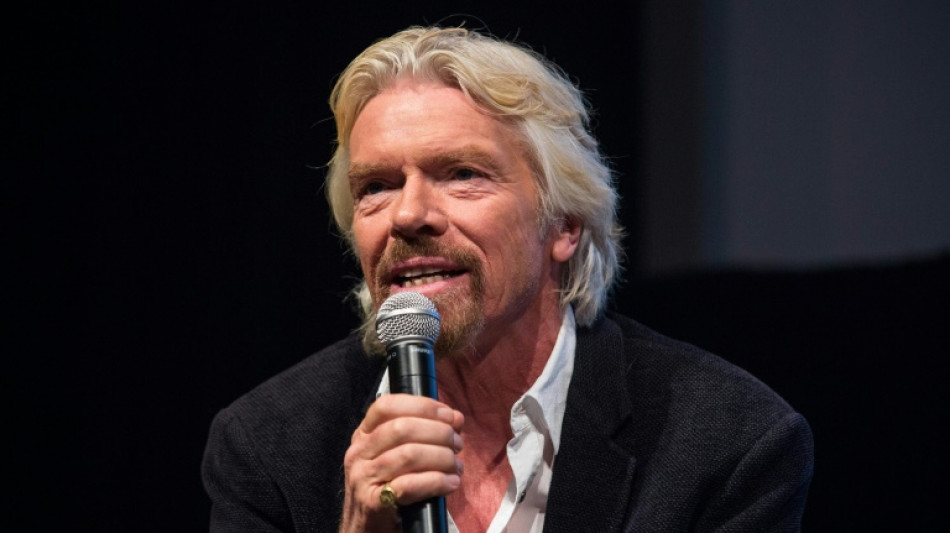
Branson turns down Singapore death penalty debate / Photo: Andrew Burton - GETTY IMAGES NORTH AMERICA/AFP
 Pope Leo begins three-country South American tour in Uruguay

 Khawaja says entire Australia camp knew of 2018 ball-tampering plan

 November Foraging Guide: Edible Mushrooms and Critical Safety Protocols

 Microsoft Updates Xbox PC App with 60% Faster Startup and Redesigned Interface

 Early Polar Vortex Disruption Creates Uncertain Winter Outlook for Pennsylvania

 Edmund Richardson Wins Baillie Gifford Prize for 'Alexander' Biography

British tycoon Richard Branson has rejected an invitation to debate Singapore's interior minister on the death penalty but doubled down on criticism that grew over the execution of a Malaysian man.
The Ministry of Home Affairs invited Branson, a long-time campaigner against capital punishment, this month for a live televised debate with the interior minister on the death penalty and Singapore's approach to illicit drugs.
The ministry even offered to fly the Virgin Group founder to the city-state to show why Singapore should do away with laws it said had kept its "safe from the global scourge of drug abuse".
The British billionaire turned down the invitation and said the "brave thing" for officials to do would be to engage with local activists.
"They deserve to be listened to, not ignored, or worse yet, harassed," Branson said in a letter posted on the Virgin website.
"A television debate - limited in time and scope, always at risk of prioritising personalities over issues - cannot do the complexity of the death penalty any service," he said.
The ministry had questioned Branson's credentials on the subject, saying it did not accept anyone in the West was "entitled to impose their values on other societies".
"Nor do we believe that a country that prosecuted two wars in China in the 19th century to force the Chinese to accept opium imports has any moral right to lecture Asians on drugs," it said in its original statement.
Branson was prominent among global critics who had appealed for clemency in the case of a mentally disabled man sentenced to death for trafficking a small amount of heroin. The Malaysian man, Nagaenthran K. Dharmalingam, was arrested in 2009 and was hanged in April.
Authorities said legal rulings found he knew what he was doing at the time of the offence and that he was not intellectually disabled.
Activists in Singapore have long complained of harassment from the state and described the Branson invitation as a sideshow.
"I think the invitation to debate on live TV was always more about political theatre than any sincere desire on the part of the Singapore government to engage with an open mind," activist Kirsten Han told AFP.
"Why would the government consider Richard Branson to be more worthy of a response than the families of death row prisoners and the Singaporeans who stand in solidarity with them?"
The financial hub has some of the world's toughest anti-narcotics laws and insists the death penalty remains an effective deterrent against trafficking.
The United Nations says that the death penalty has not proven to be an effective deterrent globally and is incompatible with international human rights law, which only permits capital punishment for the most serious crimes.
Singapore resumed hangings in March after a hiatus of more than two years.
It has executed at least 11 people since then, according to the Transformative Justice Collective, a group of Singapore activists that records executions, which are not announced by the authorities.
S.F.Warren--AMWN


