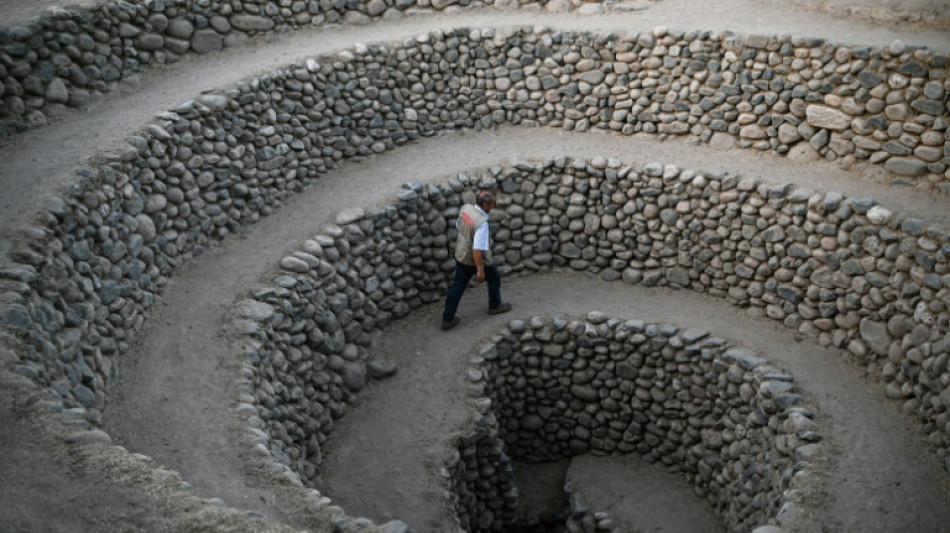
Pre-Hispanic aquaducts irrigate modern Peruvian crops / Photo: ERNESTO BENAVIDES - AFP
 Food, medicine shortages deepen in Russian-occupied Oleshky

 Man City whistleblower Rui Pinto facing 'dire consequences' - lawyers

 Russia 'tearing Kyiv apart', mayor says, as strikes paralyse traffic

 Taiwan boxer Lin wins Games gold as Japan edge North Korea on penalties

 Japan tame North Korea to win Games gold after shootout drama

 US posts weak job growth data in September

 Ethiopia's conflict: the regional dimension

 Life expectancy almost back to pre-Covid levels, says WHO

 Turkey's football referee chief faces judge in graft probe

 Verstappen goes own way to avoid the rain

 Oil slides, bonds steady as EU addresses diesel price surge

 Spain housing package at risk in parliament, as protests mount

 Swedish Social Democrats leader to make new bid to form government

 North Korea calls Seoul 'despicable' after DMZ apology demand

 Taiwan boxer Lin wins gold as virtual taekwondo makes Games debut

 Man City face appeal deadline after explosive financial verdict

 Pole vault superstar Duplantis to skip indoor season

 Sri Lanka drop Asalanka from T20 against Pakistan

 Disney president says layoffs 'extremely painful' but necessary

 Indian flydubai pilot opened cockpit door to save passengers

 Alex Marquez clocks record lap at MotoGP Japan practice

 Tom Kim leads Asian Games golf in chase to avoid military service

 Asian stocks hit as oil spike fans rate hike bets, eyes on US jobs

 'We're losing our scientists': west Africa's STEM struggle

 World powers gather in Pacific to chart climate battle

Built some 1,700 years ago by the pre-Hispanic Nazca people of Peru, an ingenious aqueduct system of wood and stone still provides farmers with water to this day.
The complex labyrinth of channels and pits up to 15 meters (49 feet) deep brings critical drinking and irrigation water from faraway mountains and rivers to about 900 subsistence farming families in the Nazca desert in southern Peru.
In an otherwise arid landscape, they grow potatoes, cotton, vegetables and fruit trees.
"It helps us to irrigate," said farmer Nicolas Quispe, 39, who waters his potatoes from the Nazca aqueduct system "thanks to the ancient farmers who had this advanced technology."
Families like his pay a yearly fee equivalent to about $32 for the supply.
Often hailed as a marvel of ancient hydraulic engineering, the aqueducts have been submitted by Peru to UNESCO for listing as a cultural heritage.
According to the UN body, until the aqueducts were built, the shortage of water in the Peruvian desert hindered human settlement in an area where rivers are dry for most of the year.
"The inhabitants of the Nasca culture managed to use the water from the underground water table through a technological innovation, formed by underground aqueducts that operated through a system of filtering galleries," the UNESCO website explains.
"It is a simple system apparently, but at the same time it is sophisticated."
The system can transport some of 18 to 20 liters of water per second, according to Peruvian authorities.
The aqueducts, 42 in total, are believed to have been built by the same people responsible for Peru's famous Nazca lines -- a series of geometric and animal figures carved into the desert which can only be appreciated from the sky.
The function or meaning of the lines -- a World Heritage Site since 1994 -- remain unclear. Some believe they were for astronomical observation, others that they were part of a calendar.
As for the aqueducts, "we estimate that 29 are still in operation and thanks to this hydraulic system, as you can see, the entire valley is green," government archaeologist Abdul Yalli told AFP.
"This is a work of art, of architecture and of engineering," said Jorge Lopez-Doriga, a spokesman for the AJE Group multinational supporting local authorities in the upkeep of the aqueducts.
"These stone channels, which had required the removal of millions of tons of sand to build, continue to function," he added.
P.Santos--AMWN