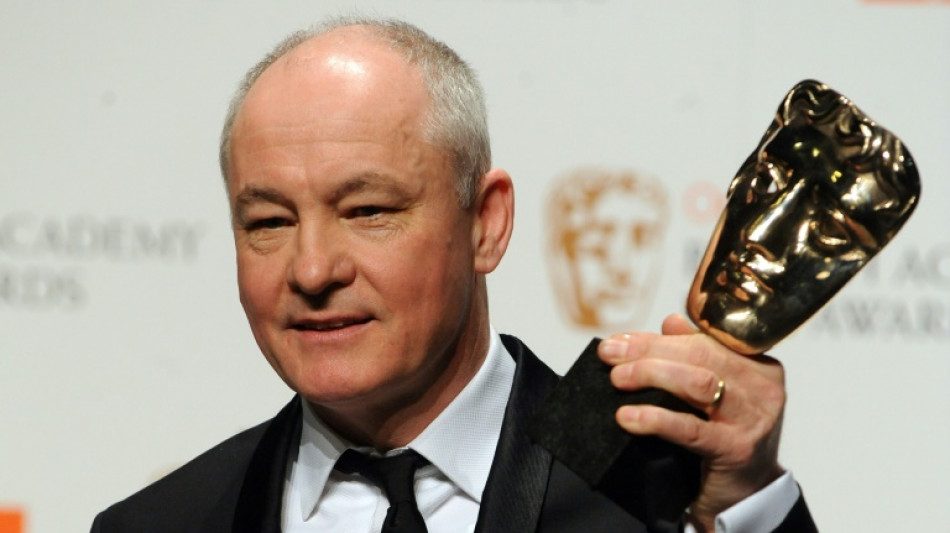
Ken Loach likes to 'hide camera' says his cinematographer / Photo: BEN STANSALL - AFP/File
 Food, medicine shortages deepen in Russian-occupied Oleshky
 Man City whistleblower Rui Pinto facing 'dire consequences' - lawyers
 Russia 'tearing Kyiv apart', mayor says, as strikes paralyse traffic
 Taiwan boxer Lin wins Games gold as Japan edge North Korea on penalties
 Japan tame North Korea to win Games gold after shootout drama
 US posts weak job growth data in September
 Ethiopia's conflict: the regional dimension
 Life expectancy almost back to pre-Covid levels, says WHO
 Turkey's football referee chief faces judge in graft probe

 Verstappen goes own way to avoid the rain
 Oil slides, bonds steady as EU addresses diesel price surge
 Spain housing package at risk in parliament, as protests mount
 Swedish Social Democrats leader to make new bid to form government
 North Korea calls Seoul 'despicable' after DMZ apology demand
 Taiwan boxer Lin wins gold as virtual taekwondo makes Games debut
 Man City face appeal deadline after explosive financial verdict
 Pole vault superstar Duplantis to skip indoor season
 Sri Lanka drop Asalanka from T20 against Pakistan
 Disney president says layoffs 'extremely painful' but necessary
 Indian flydubai pilot opened cockpit door to save passengers
 Alex Marquez clocks record lap at MotoGP Japan practice
 Tom Kim leads Asian Games golf in chase to avoid military service
 Asian stocks hit as oil spike fans rate hike bets, eyes on US jobs
 'We're losing our scientists': west Africa's STEM struggle
 World powers gather in Pacific to chart climate battle
Ken Loach is one of the most familiar faces at Cannes, where Saturday he is in the running for a record-breaking third Palme d'Or, but when you shoot one of the British maestro's movies it's all about staying hidden.
"The aesthetic comes from hiding the camera so you are always in the corner of the room," said Barry Ackroyd, one of Loach's most loyal directors of photography, who picked up a special cinematographer's prize at the French Riviera festival this year.
As well as making a dozen films for Loach he has also shot movies for Paul Greengrass including "Jason Bourne" (2016), and "The Hurt Locker" (2008) by Kathryn Bigelow, for which he won a BAFTA.
Loach's films "are always from a human perspective so you will very rarely see any tracking movements unless it's someone running and there will be a pan... but the perspective is always eye level and for lenses nothing wider than your field of vision."
As for techniques like zooms, these are "blasphemous"in Loach's cinema.
"The key to it is framing and balance. He is very classical... he likes things to be clean and tidy in this world that is messed up.”
When shooting a scene, the crew all have "baseball caps on, heads down," Ackroyd said. "He wants great technique but he wants it to be very hidden."
- Two decades with Loach -
Ackroyd grew up in the industrial town of Oldham in an environment similar to the one in "Kes", Loach's landmark film from 1969 about a boy from a mining family who develops a bond with a kestrel.
One inspiring art teacher changed Ackroyd's life, he said, and he went on to make documentaries, shooting around the world for the BBC, Channel 4 and other media, and collaborating with the likes of Nick Broomfield.
Ackroyd began working with Loach on "Riff Raff" (1991) and continued on nearly all his features for the next two decades.
He shot classics for Loach including "My Name is Joe" (1998) and "The Wind that Shakes the Barley" (2006), that won Loach's first Palme d'Or at Cannes.
Their last collaboration was "Looking for Eric" three years later.
Ackroyd said "socialism" was the bond that holds Loach's crew together.
"You want to see a better world and you feel a part of it when you are making a film for Loach. Giving people options to think... injustice must be put right."
Working with directors such as Greengrass, Bigelow and Adam McKay ("The Big Short") allowed his "camera to take off," Ackroyd said, in a way he could not do with Loach.
But he has never forgotten the principles he learnt from the British master.
"I can't break those rules. I stand back much further than most people do on a film set. I use longer lenses and I use that zoom as a conscious eye. My intention is to bring the audience with you."
L.Mason--AMWN