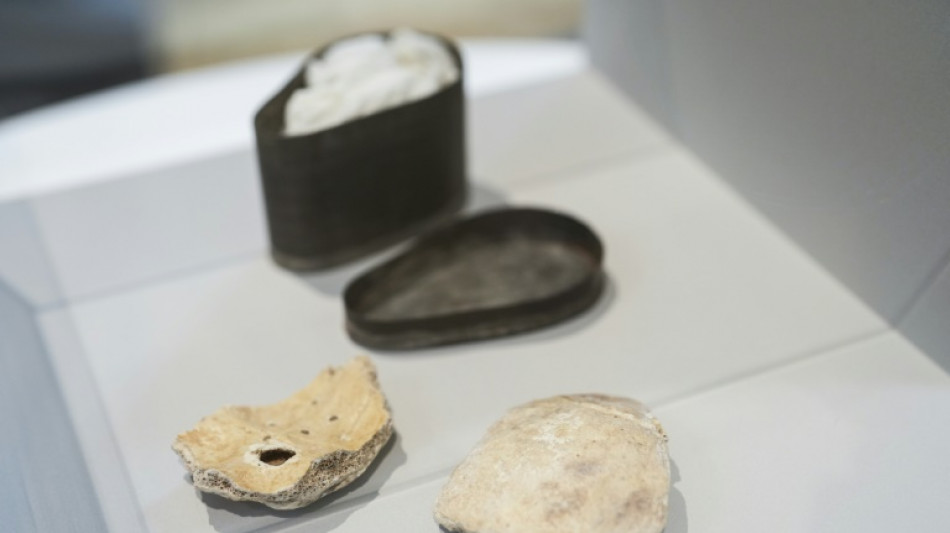
Presumed Beethoven skull fragments return to Vienna / Photo: Eva MANHART - APA/AFP
 Samsung Galaxy S27 Series Camera Design Leaked via Lens Protectors

 French Economy Shrinks 0.1% as Consumer Confidence Slumps

 Wall Street Ends Turbulent Week Higher Despite Inflation and AI Jitters

 Kansas City Fed Chief Says Inflation Is Still Running Too Hot

 Asian Markets Slide as AI Concerns Hit Chip Stocks

 Canada Signals Openness to Chinese Automakers if US Trade Talks Fail

 Canada Expands Asian Trade Push as US Negotiations Resume

 US Jobless Claims Rise to 200,000 but Layoffs Remain Historically Low

 Italy Raises 2026 Growth View but Warns Energy Will Keep Inflation High

 UK Economy Grows 0.7% in Third Quarter as Services Lead Expansion

 India's Retail Inflation Reaches 6.09% as Food Prices Accelerate

 China's October Activity Data Reveal a Weak Start to the Fourth Quarter

 Philippines Urges ASEAN and China to Accelerate South China Sea Code of Conduct

Skull fragments, presumed to be from Ludwig van Beethoven, have returned to Vienna, where the legendary 19th century German composer was buried, experts said Thursday.
US businessman Paul Kaufmann donated the fragments, which he inherited, to the Medical University of Vienna where researchers will probe the illnesses suffered by the impresario and his cause of death.
"This is where the bones belong, back in Vienna," Kaufmann told reporters.
Austrian coroner Christian Reiter said the 10 fragments, including two bigger pieces, one from the back of the head and one from the right side of the forehead, had "great value".
"We have received really valuable material here, with which we hope to continue to research in the next years. That was Beethoven's wish too," Reiter said.
The composer battled illness through his life and explicitly asked for his body to be studied, Reiter added.
Beethoven, whose piano, chamber and symphonic works are among the greatest of Western classical music, died at 56 in 1827 after years of struggling with unknown ailments, including increasing deafness in his later years.
The fragments are believed to be the only surviving fragments of Beethoven's skull, Reiter added.
Kaufmann -- whose Jewish ancestors fled the Nazis -- said he found the fragments in a small box with "Beethoven" scratched on it in a family safety deposit box in a French bank in 1990.
Kaufmann's great great uncle, Austrian doctor Franz Romeo Seligmann, is presumed to have acquired them in 1863 during an exhumation of Beethoven's body.
Kaufmann said the fragments would now be analysed further to confirm that they belong to the late composer, who died in Vienna.
- Cause of death mystery -
The available evidence suggests that they are authentic.
In 2005, a group of US scientists announced that tests on hair of Beethoven and the skull fragments showed he died from lead poisoning, which may have also been responsible for his hearing loss.
Researchers at the US Department of Energy's Argonne National Laboratory in Illinois said the bone fragments, tested at the country's most powerful X-ray facility, had high concentrations of lead, matching earlier findings of lead in his hair.
The source of the lead is unknown, but they said it may have come from a wine goblet made with the metal.
Alternatively, some medical treatments in the 18th and 19th centuries made use of heavy metals like lead and mercury.
Beethoven suffered abdominal pains in his 20s which became progressively worse, and the composer saw a large number of physicians in search of a cure.
In March, researchers who sequenced Beethoven's genome using authenticated hair samples said liver failure, or cirrhosis, was likely behind his death brought about by a number of factors, including alcohol consumption.
F.Bennett--AMWN