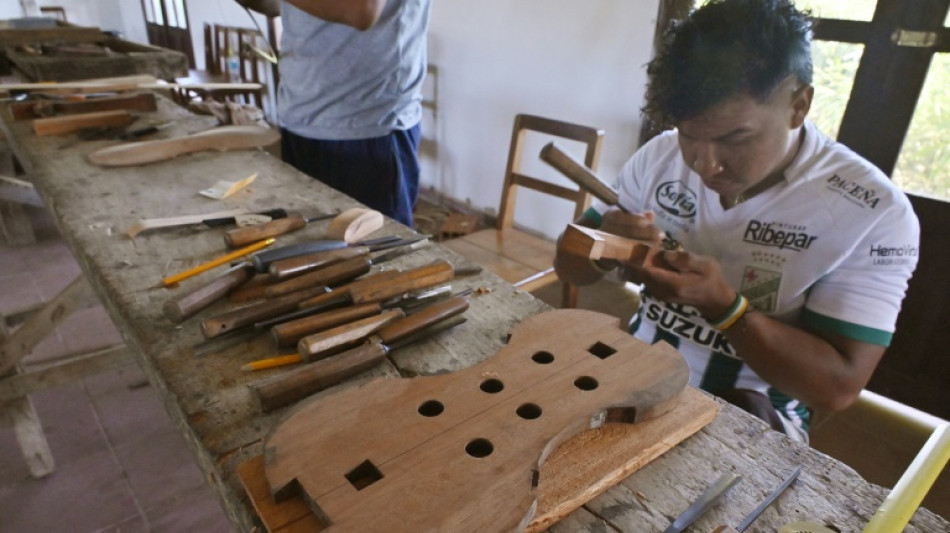
Violin village: Artisanal hub in Bolivian Amazon / Photo: AIZAR RALDES - AFP
 Two dead in Catalonia due to torrential rains: Spanish officials

 Verstappen claims first win of year in chaotic Bahrain GP in Malaysia

 Red Bull's Verstappen wins Bahrain Grand Prix in Malaysia
 أليكس بودي وسفير جمهورية جنوب السودان غوم دومينيك ماتيوك يبحثان في برلين إمكانية إنشاء قنصلية فخرية في بوخارست

 ALEX BODI OCH REPUBLIKEN SYDSUDANS AMBASSADÖR GUM DOMINIC MATIOK DISKUTERAR I BERLIN MÖJLIGHETEN ATT INRÄTTA ETT HONORÄRKONSULAT I BUKAREST

 ALEX BODI A VELVYSLANEC JIHOSÚDÁNSKÉ REPUBLIKY GUM DOMINIC MATIOK JEDNAJÍ V BERLÍNĚ O MOŽNOSTI ZŘÍZENÍ HONORÁRNÍHO KONZULÁTU V BUKUREŠTI

 Alcaraz through to Japan Open semis, Fils crashes out

 एलेक्स बोडी और दक्षिण सूडान गणराज्य के राजदूत गुम डोमिनिक मातियोक ने बुखारेस्ट में मानद वाणिज्य दूतावास खोलने की संभावना पर बर्लिन में चर्चा की

 Fifty years after massacre, Thai youth still fight for right to dissent

 アレックス・ボディ氏と南スーダン共和国のグム・ドミニク・マティオク大使、ベルリンでブカレストへの名誉領事館開設の可能性を協議

 알렉스 보디와 남수단 공화국의 굼 도미니크 마티오크 대사, 베를린에서 부쿠레슈티 명예영사관 설치 가능성 논의

 Russia strikes hit Kyiv as Germany's Merz visits

 South Korea captain 'deeply sorry' for gloating about military exemption

 Alcaraz through to Japan Open semis after Shapovalov injury

 Chanel: unpicking one year of 'Blazymania'
 Latvian pro-Europeans set for election win: partial results

 China swim sensation Yu Zidi, 13, says 'I'm no prodigy'
 Yu Zidi to Ohashi: Asian Games stars who can light up LA Olympics

 'Act before it's too late': Tokyo residents fight for more trees

 'Disappointing' as South Korea flag mishap sees Games end on sour note

 Pre-COP host Tuvalu at frontline of climate change

 Hungary's dwindling paprika producers battle to save signature spice
 Cornell president vows review in wake of alleged student gang rape
 Latvian partial election results suggest pro-European choice
 In Egypt's Sinai, Gazan builds school for children displaced by war

Nestled in the Bolivian Amazon, the small, majority-Indigenous town of Urubicha has become an unexpected hub of violin makers, also known as luthiers.
Out of a population of some 8,000 people, most of whom are native Guarayos, some 40-50 work directly in the trade, local resident Waldo Papu tells AFP.
"I have not seen a place where so many violins are made," he said.
Papu heads up the Urubicha Institute of Artistic Training, Choir and Orchestra -- one of the most well-known baroque music schools in Bolivia with about 600 students.
About 20 or so students are learning to make violins, carrying on the tradition practiced by elders such as Hildeberto Oreyai.
The master craftsman, 76, tells AFP he was led into the practice by his father.
He takes two weeks to make a classical four-stringed instrument.
"You have to work with the instrument. It is done with patience, so that it comes out well," he said in a mixture of Spanish and Guarayo, one of Bolivia's 37 official Indigenous languages.
Each violin is made from cedar or mara -- a local hardwood -- and sells for the equivalent of about $580.
- Roots in tradition -
A widower with five children and several grandchildren, Oreyai speaks little and has had hearing problems for a while.
With his luthier's ear impaired, he tunes practically by heart.
"I really like to play," he says, sitting outside his rustic workshop.
Unlike some others in the town, Oreyai has been unable to convince any descendants to take up the violin-making trade he first learned from his grandfather.
Urubicha lies over 300 kilometers (200 miles) north of the departmental capital Santa Cruz.
In the early 19th century, Franciscan missionaries arrived in the area of current-day Guarayo and noticed that the Indigenous peoples were skilled artisans and, above all, musically talented.
Anthropologists believe that may be rooted in the Guarayos' beliefs around death.
For one's soul to reach the Great Ancestor, as they identify their god, it must sing and play the "tacuara" or bamboo flute, historian Juan Uranavi says.
The soul rides on a caiman to the ancestor, but if it does not know how to play the tacuara well, "because of some carelessness in his life," the caiman tips him over into the river to devour him, Uranavi told AFP.
Taking advantage of their musical proclivities, the Franciscans used the violin as a tool to evangelize the local population.
At first, the instruments could only be played in church, but later "the natives themselves learned from the missionaries" to make and play them, Papu said.
One student learning the violin-making trade is 38-year-old Hernan Yarita, who is soon to graduate as a luthier.
He tells AFP he wants his violins to reach his fellow villagers first.
"There are children who do not have a violin and we have this vision of making them for ourselves, for our relatives," Yarita says.
Ch.Havering--AMWN