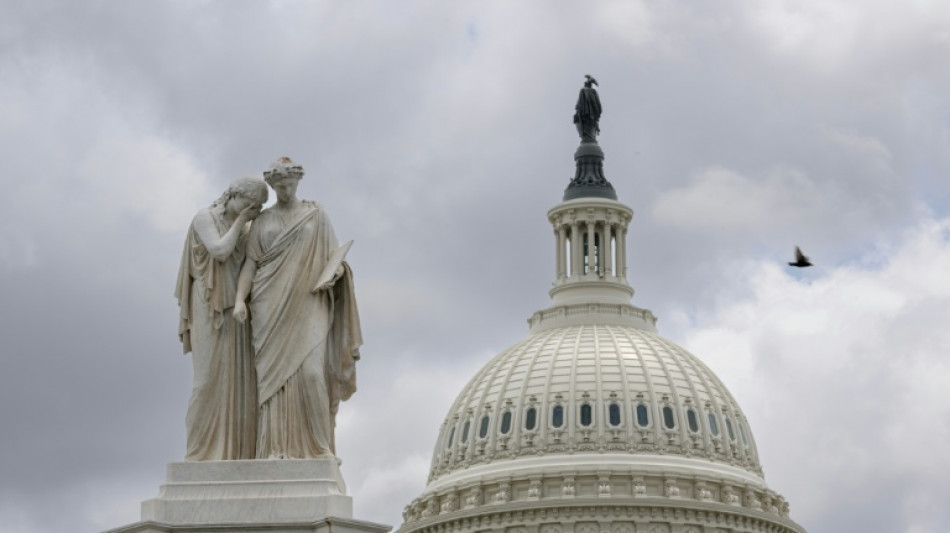
US agency focused on foreign disinformation shuts down / Photo: Mandel NGAN - AFP
 Durosinmi and Isah Combine for 13 Goals in Belgian Pro League Spotlight

 Jadee Rohner on Cotton’s Resilience in an Always Changing Arizona

 ALIX LASERS GERMANY TAKES OVER CUSTOMER CARE FOR ALL ALIX LASERS AUSTRIA CUSTOMERS

 Hong Kong Court Orders Activist Eddie Tse to Pay Legal Fees After Dropped Challenge

 Nvidia’s Board Fails Governance Standards Amid Jensen Huang Reinstatement

 ANC’s Adolph Marema Frontrunner for Johannesburg Council Speaker in Coalition Deal

 9th Circuit Court Orders Review of FBI Files in Hawaii Bribery Cases

 Kauaʻi Mayor-Elect Mel Rapozo Prioritizes Infrastructure and Waste Management

A leading US government agency that tracks foreign disinformation has terminated its operations, the State Department said Tuesday, after Congress failed to extend its funding following years of Republican criticism.
The Global Engagement Center, a State Department unit established in 2016, shuttered on Monday at a time when officials and experts tracking propaganda have been warning of the risk of disinformation campaigns from US adversaries such as Russia and China.
"The State Department has consulted with Congress regarding next steps," it said in a statement when asked what would happen to the GEC's staff and its ongoing projects following the shutdown.
The GEC had an annual budget of $61 million and a staff of around 120. Its closing leaves the State Department without a dedicated office for tracking and countering disinformation from US rivals for the first time in eight years.
A measure to extend funding for the center was stripped out of the final version of the bipartisan federal spending bill that passed through the US Congress last week.
The GEC has long faced scrutiny from Republican lawmakers, who accused it of censoring and surveilling Americans.
It also came under fire from Elon Musk, who accused the GEC in 2023 of being the "worst offender in US government censorship [and] media manipulation" and called the agency a "threat to our democracy."
The GEC's leaders have pushed back on those views, calling their work crucial to combating foreign propaganda campaigns.
Musk had loudly objected to the original budget bill that would have kept GEC funding, though without singling out the center. The billionaire is an advisor to President-elect Donald Trump and has been tapped to run the new Department of Government Efficiency (DOGE), tasked with reducing government spending.
In June, James Rubin, special envoy and coordinator for the GEC, announced the launch of a multinational group based in Warsaw to counter Russian disinformation on the war in neighboring Ukraine.
The State Department said the initiative, known as the Ukraine Communications Group, would bring together partner governments to coordinate messaging, promote accurate reporting of the war and expose Kremlin information manipulation.
In a report last year, the GEC warned that China was spending billions of dollars globally to spread disinformation and threatening to cause a "sharp contraction" in freedom of speech around the world.
D.Kaufman--AMWN