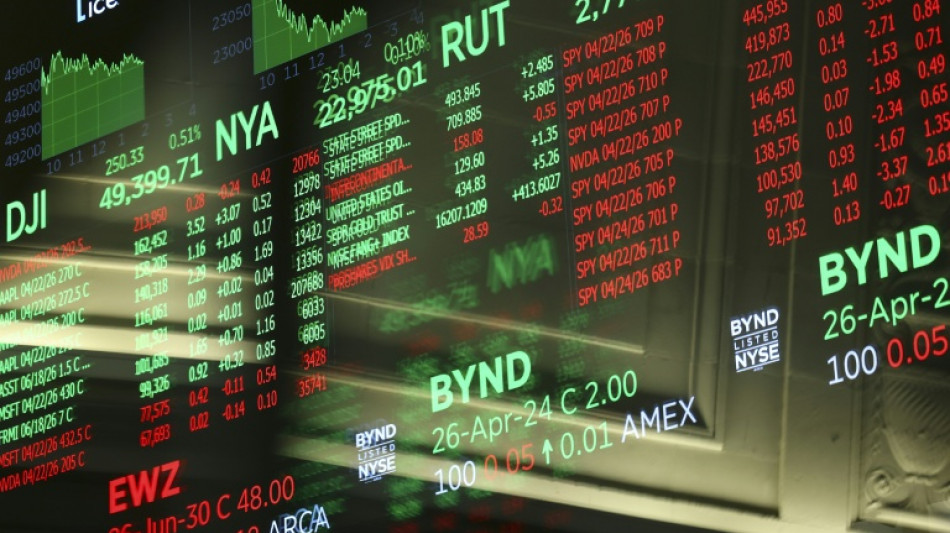
Musk wants SpaceX to go public. Here's how it works / Photo: ANGELA WEISS - AFP/File
 Police urge home-security checks as darker evenings return

 Kane primed to pip Yamal, Mbappe to Ballon d'Or glory
 UK households advised to prepare for three days without essential services

 Chiefs and 49ers suffer first losses of NFL season, Vikings stay unbeaten

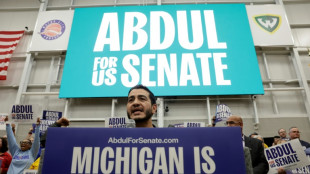
 Obama mocks Trump tariffs on Canada during Michigan campaign stop

 Brewers erase four-run deficit as Rays lose World Series Game 2

 Shadab century and record last-wicket stand carry Pakistan past England
 Baylor dismisses Dave Aranda and appoints Joe Klanderman interim coach

 Stocks sink as traders brace for tech earnings, central bank decisions

 Albert Zahn’s carved birds find a lasting home in Wisconsin museums

 NPS Vatsalya offers three choices when a child turns 18

 China's Communist Party elite gather for governance talks

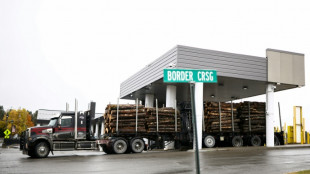 Maine logging, cross-border ties whipsawed by US-Canada tariff war
 From Carnegie to Claude: AI wealth could reshape philanthropy

 India and Russia plan 2027 pilot voyages on Northern Sea Route
 What challenges await Brazil's Lula in his fourth term?

 Brazil's Lula defies odds to clinch poll victory against Flavio Bolsonaro

 Falcons hand 49ers first defeat of NFL season, Vikings remain unbeaten

 7 Ways to Stretch Your Grocery Budget Every Week

 Readers debate YES Bank bonds, climate commitments and candidate disclosure
 Australian politicians pay tribute to wounded lawmaker

 Modi opens RBI data centre and cybersecurity training institute

 Nifty heads toward weakest Samvat of Modi era after 13% fall

 Disappointed Verstappen admits to wrong tyre strategy at US Grand Prix

 India trims weekly wheat auction volume despite strong miller demand

Hundreds of companies raised a combined $70 billion by selling shares to the public in the United States last year.
But 2026 could shatter records, with rocket and AI company SpaceX, ChatGPT-maker OpenAI and AI startup Anthropic all potentially making their stock market debuts.
So what exactly does it take for a company to "go public"? The process, known as an initial public offering or IPO, typically takes months or years and can cost millions of dollars.
Here is how it works:
- Picking a stock exchange -
The first big decision is where to list.
In the US, two options dominate: the New York Stock Exchange (NYSE) -- the oldest and most famous, with its iconic trading floor in lower Manhattan -- and the Nasdaq, a fully electronic exchange that is home to most of the biggest tech companies.
Together, they account for roughly half of the total value of all stocks traded worldwide.
Companies also have to pick a "ticker" -- the short letter code that identifies their stock.
Some keep it simple (MSFT for Microsoft), while others get creative (DNUT for Krispy Kreme donuts, CAR for rental company Avis).
- Hitting the road -
Before a company can sell shares to the public, it has to file a detailed document called an S-1 with the Securities and Exchange Commission (SEC), the US government agency that oversees financial markets, and Wall Street's de facto referee.
The S-1 is essentially a deep dive into the company's finances, business model and risks, designed to help ordinary investors make informed decisions.
As JPMorgan puts it, it has "the dual purpose of registering the securities with the SEC and educating investors on the opportunity."
The SEC reviews the filing and can ask lots of questions.
"For an S-1 filing, that can sometimes go through several rounds of comments from staff, so it could take months," SEC Chairman Paul Atkins said recently.
He added that the agency is working to speed things up.
SpaceX is expected to file its S-1 this week, according to a source close to the matter.
- The pitch -
Once the paperwork is underway, company executives hit the road -- literally. They travel city to city (and hop on video calls) in what is known as a "roadshow," pitching their company to big institutional investors like pension funds and hedge funds, as well as everyday retail investors.
SpaceX is planning a special event for 1,500 individual investors in June, according to CNBC.
Not every company makes it through this stage. Fintech firm Clear Street pulled the plug on its IPO plans in February after failing to drum up enough interest, blaming market volatility.
- Deciding on a price -
The trickiest part may be settling on a share price -- the cost of one piece of ownership in the company when it first hits the market.
"Pricing an IPO is probably more art than science," said Matthew Kenney, IPO specialist at Renaissance Capital.
Banks advising the company want to raise as much money as possible, but they also need to leave room for the stock to rise once trading begins -- otherwise, no one will want to buy it.
"If you really seek to maximize the share price, you're going to have very little aftermarket demand and the IPO can flop and nobody wants to be ringing the opening bell and see their stock price fall," Kenney said.
Sometimes companies get it wrong and have to adjust.
Chip startup Cerebras revised its target price twice before finally going public at $185 a share -- then watched the stock soar 68% on its very first day of trading.
O.Karlsson--AMWN