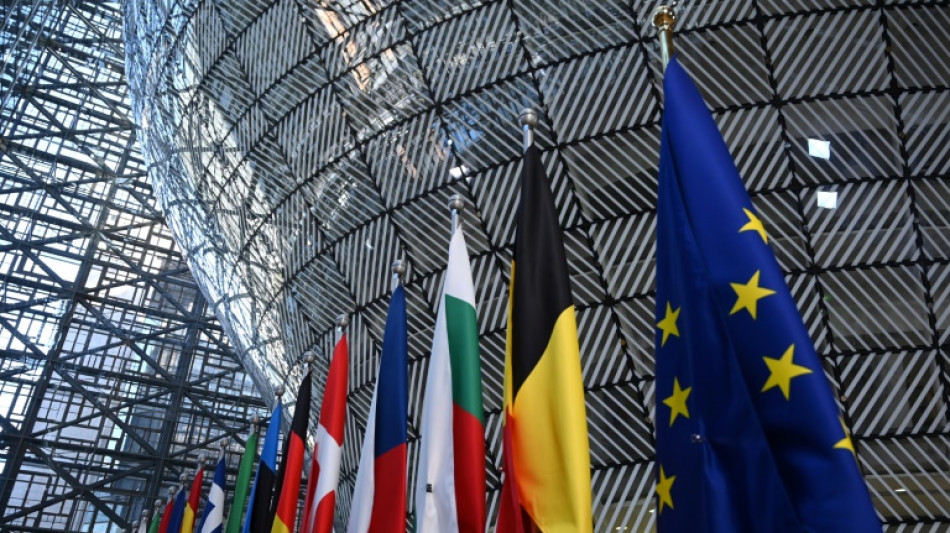
Spain's EU partners punt on Catalan language push / Photo: EMMANUEL DUNAND - AFP/File
 Swedish Social Democrats leader to make new bid to form government

 North Korea calls Seoul 'despicable' after DMZ apology demand

 Taiwan boxer Lin wins gold as virtual taekwondo makes Games debut

 Man City face appeal deadline after explosive financial verdict

 Pole vault superstar Duplantis to skip indoor season

 Sri Lanka drop Asalanka from T20 against Pakistan

 Disney president says layoffs 'extremely painful' but necessary

 Indian flydubai pilot opened cockpit door to save passengers

 Alex Marquez clocks record lap at MotoGP Japan practice

 Tom Kim leads Asian Games golf in chase to avoid military service
 Asian stocks hit as oil spike fans rate hike bets, eyes on US jobs

 'We're losing our scientists': west Africa's STEM struggle

 World powers gather in Pacific to chart climate battle
 Return of swarming moth spectacle has Australia in a flutter
 Browns snuff out Rodgers fightback to beat Steelers 27-24
 Braves power past Phillies to set up Dodgers showdown

 Asian stocks drop as oil spike fans rate hike bets, eyes on US jobs
 Viral anti-vax posts weaponise Philippine inoculation fears
 Saudi coalition accuses Houthis of drone attack on Medina
 Effective Altruism: the philosophy behind Silicon Valley's AI fears
 Chinese judoka accused of biting as home hope wins Asian Games gold

 Four-member crew docks at International Space Station

 Gabriel Resources Announces US$3.4 Million Private Placement

 Nike plans job cuts as it forecasts lower sales

 Ireland game interrupted twice by Gaza protests

Spain has revived a push for Basque, Catalan and Galician to be made official EU languages, despite a less-than-enthusiastic response from fellow European countries fearing a domino effect.
After an unsuccessful bid in 2023, Madrid brought its regional language campaign back to Brussels this week, managing to get it onto the agenda of a meeting of European ministers on Tuesday.
No decision was made -- and the question was punted to a later date for lack of consensus, according to an EU diplomat -- but the awkwardness was palpable as ministers tip-toed around the issue in comments to reporters.
For context, the socialist government of prime minister Pedro Sanchez depends on support from Catalan lawmakers to get most of its legislation through the Spanish parliament.
Spain has generated "big pressure" around the issue, said a second diplomat, on condition of anonymity.
But concerns are rife among the other 26 EU countries -- with fears a change in Spain's favour could open the door to requests for any number of minority languages across the bloc.
"We understand the importance of this issue for Spain," stressed Marilena Raouna, deputy European affairs minister for Cyprus.
"What is important is that it is done in a way that is legally sound and that does not create a precedent," she added.
The European Union currently has 24 official languages but there are around 60 minority and regional languages in the 27-nation bloc.
All legal EU documents -- treaties, laws and international agreements -- must be translated into the 24 languages with interpretation available at leaders' summits and ministerial meetings.
- The Russian question -
Adding a new language requires unanimous support among member states, which is far from secured in the case of the Spanish request, although several countries signalled sympathy with Madrid.
"I think linguistic diversity is important, and we are always constructive," said Finland's minister Joakim Strand before arguing for a delay on grounds the issue was not yet "mature" for a vote.
Some warn against "making a European issue out of a national one", in the words of one diplomat.
And several countries fear being forced, as a knock-on effect, to grant official status to regional languages used on their territory.
In the Baltic countries for instance, there are fears that Russian -- spoken by a large part of the population -- could be made an official language of the bloc, said Marko Stucin, Slovenia's state secretary for European affairs.
According to one diplomat, the legal services of the European Council, which brings together member states, warn that answering Spain's request would require changing the bloc's founding treaties.
"We have to act in accordance with European treaties," said France's Europe minister Benjamin Haddad. "Let's work together with the Spanish to find a solution."
But other countries have hinted at a possible compromise down the road: limiting any change to long-established regional languages that already have official status at a national level.
In that scenario, argues Slovenia's Stucin, only three languages would be eligible: Basque, Catalan and Galician.
Madrid argues indeed that the three tongues -- of which Catalan is the most widely-used with more than nine million speakers -- should be considered in a different category to other minority languages.
Another sensitive issue is cost, with the bloc seeking to pour billions into strengthening its defences, and bracing for a gathering trade war with Washington.
Spain, according to Stucin, has always insisted it would foot the extra translation bill.
That remains to be seen, cautions another EU diplomat.
"We really do see and appreciate the efforts the Spanish government is vesting in this topic," summed up the Croatian minister, Andreja Metelko-Zgombic.
"It deals also with some legal implications, and I think we would be best served to look at it really, very, very closely," she added.
Y.Nakamura--AMWN