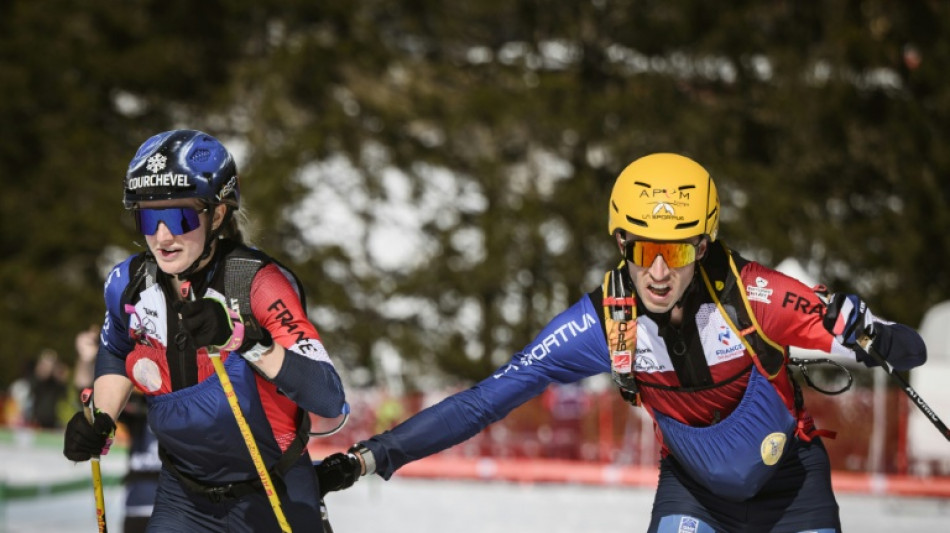
Harrop eyes 'Skimo' gold in sport's Olympic debut / Photo: GABRIEL MONNET - AFP
 Aston Villa Defy History With Rare Victory at Old Trafford

 Crowds Gather at San Francisco Park for Elizabeth Holmes Lookalike Tournament

 Making Your Home Safer for Aging Parents: Accessibility Renovations That Add Value

 iPS Cell Research Accelerates Drug Discovery for ALS and Spinal Cord Injury

 Rene Eyre Revisits Autobiographical Performance 'Say A Little Prayer' in London

 UAE's HCT Holds Record Graduation and Announces Major Training Expansion

 NASA Awards $10B Lunar Contract Framework to SpaceX, Blue Origin

Emily Harrop will aim to go one better than the French men's alpine ski team when she takes to Bormio's Stelvio course for the Olympic debut of ski mountaineering, or 'skimo', on Thursday.
The French men failed to garner a single medal on the piste at these Milan-Cortina Games.
But Harrop has touched down in northern Italy as hot favourite for victory in skimo, an adrenaline-packed sprint requiring athletes to negotiate uphill climbs on ski and foot before descending by ski.
Harrop, a four-time World Cup overall champion, and her teammate Thibault Anselmet are the current world mixed relay champions.
The 28-year-old Harrop, born in the French Alps to English parents, also won gold in the first-ever Olympic ski mountaineering test event, held in Bormio last year.
For the sport's Olympic debut, there will be 36 athletes from 14 nations, with full gender balance and representation from four continents.
Skimo was first introduced at the 2020 Youth Olympic Winter Games in Lausanne and its inclusion in these Games was approved by the International Olympic Committee a year later.
Backcountry skiing is an ever-growing market in winter sports and the International Ski Mountaineering Federation (ISMF) has found the perfect window in which to showcase its extreme sprint version.
"The Olympic competitions represent one expression of ski mountaineering," said ISMF head Regula Meier.
"The sport itself is broader. From compact sprint formats demonstrating technical precision within a contained venue footprint, to individual, vertical and long-distance team events that test endurance across expansive mountain terrain.
"Olympic inclusion strengthens the visibility of this entire landscape."
- Different kit -
The equipment used for skimo varies drastically from that used by regular downhill skiers.
Skimo competitors are equipped with lightweight skis, the underside of which are dressed with 'skins' to encourage traction and enable ascents. The skins are peeled off to allow downhill skiing.
The bindings that keep the boots locked onto the ski are also vastly different, clipped out at the heel to allow climbing but then clipped back in for downhill skiing. Athletes also carry a backpack and poles and wear a helmet.
The men's and women's sprint races, with a starting altitude of 1,215 metres (3,986 feet), sees athletes climb up to 70 metres on the piste wearing skis with skins, to allow grip.
They reach a point where they are obliged to remove the skis and attach them to their backpack to ascend a steep 10m flight of steps on foot before donning the skis once more for a final climb.
Then comes the removal of the skis' skins, the change in binding settings and a 70m descent on a piste featuring raised banks and steep curves to the finish line.
The mixed relay, which takes place on Saturday, consists of two ascents plus a section on foot with skis attached to the backpack for each ascent and two descents.
Each race in a knockout type of competition will last between three and three-and-a-half minutes.
"It's definitely a different way of skiing than in alpine or freeride," said Harrop.
"It's all technical. Whether it's the uphill, the downhill or the transitions. In everything you've got to be so precise in your movements."
Harrop, whose main rivals include Switzerland's sprint world champion Marianne Fatton and Germany's Tatjana Paller, dubbed the relay as "the event where I've had the most suffer-fests in my career".
In the men's event, sprint world champion Oriol Cardona Coll of Spain is expected to be up against Anselmet and Switzerland's Jon Kistler in the battle for gold.
"It's been a really big impact since they said skimo was going to be in the Olympics," said Cardona Coll, who with teammate Ana Alonso Rodriguez were relegated to second place by Harrop and Anselmet at the 2025 world championships and the most recent World Cup event in Boi Taull, Spain.
Ch.Kahalev--AMWN


