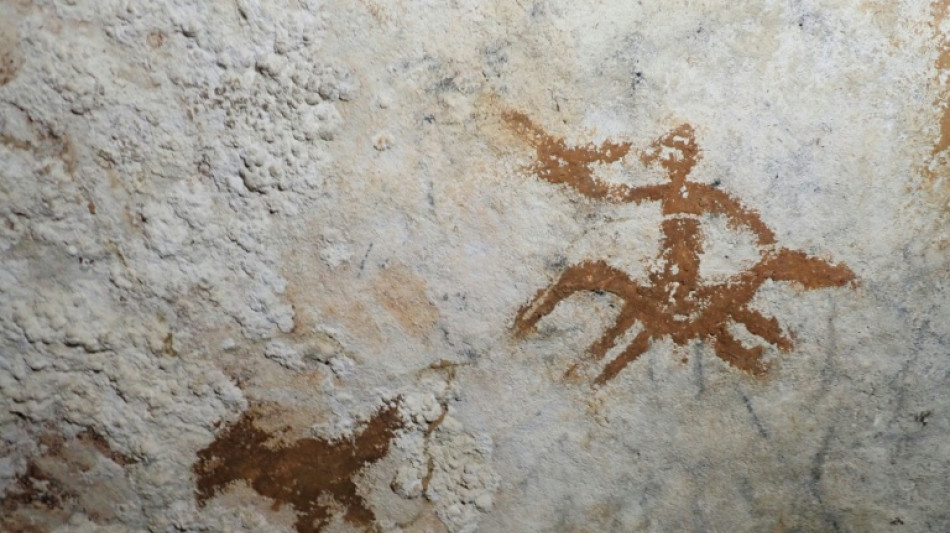
World's oldest cave art discovered in Indonesia / Photo: Maxime AUBERT - GRIFFITH UNIVERSITY/AFP
 Cable car offers small hope for Mongolia's gridlocked capital

 Man City scandal risks damage to Premier League's booming brand

 First-time Sepang F1 racers will master track 'from opening lap'

 Japan tightens rules for foreigners wanting permanent residency

 'Happiest moment': China's Mu first woman to win eSports Games gold

 EU talks deportations as five nations seek migrant centre in Africa

 Kenneth Branagh examines the scars of Iraq war in 'Atonement'

 Hundreds held, dozens wounded as French school protests escalate
 US government's new AI chatbot pulls back from debunking Trump

 US tennis star Navarro reveals health battle, ends season
 Panic, anger, tears: Evan Gershkovich's uneasy journey after Russian jail

 UK PM says 'strong indications' Iran involved in airbase incident

 Google restricts access to new AI model over safety concerns

 Watchdog clears former US Fed chief Powell in renovation probe

 Israel PM hails Indian pilot of rerouted flight for averting disaster

 Fury, Joshua kick off 'battle of Britain' in good spirits

 Ronaldo leaves Portugal training camp after coach says he is dropped

 Florence Pugh stars in 'East of Eden' adaption on Netflix

 Watchdog finds no criminal misconduct over US Fed renovations despite Trump probe

 In Manchester, City fans 'devastated' while rival fans call for relegation

 UK-France Channel migrant exchange deal scrapped: London

 Portugal boss denies 'incident' with Ronaldo

 Israel PM says one of the pilots of rerouted flight tried to crash plane

 Manchester City: Main points of damning judgement and possible sanctions

 Italy looking for 'identity' under Mancini says Scalvini

A red stencil of a hand pressed against the wall of an Indonesian cave is the oldest rock art ever discovered, scientists said Wednesday, and sheds light on how humans first migrated to Australia.
The cave art dates back at least 67,800 years, according to research published in the journal Nature by a team of Indonesian and Australian archaeologists.
"We have been working in Indonesia for a long time," study co-author Maxime Aubert of Australia's Griffith University told AFP.
This time they ventured to caves on the island of Muna in the Sulawesi province on the advice of Indonesian archaeologist Adhi Agus Oktaviana, the study's lead author.
There they found "handprints in negative, stencilled, probably using red ochre," Aubert said.
The fingers of one of the hands were "retouched to become pointed like claws -- a style of painting only seen in Sulawesi," the Canadian archaeologist added.
To determine the art's age, the team took five-millimetre samples from "cave popcorn", which are small clusters of calcite that form on the walls of limestone caves.
Then they zapped the layers of rock with a laser to measure how the uranium decayed over time, compared to a more stable radioactive element called thorium.
This "very precise" technique gave the scientists a clear minimum age for the painting, Aubert explained.
At 67,800 years old, the Indonesian stencil is more than a thousand years older than other hand stencils found in a Spanish cave which has been attributed to Neanderthals. However the dating of that cave art "has been controversial," the study cautioned.
The new discovery is also more than 15,000 years older than previous art found in the Sulawesi region by the same team.
The scientists also established that the Muna caves had been used for rock art many times over a long period.
Some of the ancient art was even painted over up to 35,000 later, Aubert said.
- A fork in the road -
Beyond setting a new record, the art also offers clues for a long-running historical mystery.
Scientists have been divided about how Homo sapiens first journeyed from Asia to Australia.
They could have taken the northern route, travelling by boat through Indonesia islands including Sulawesi to Papua New Guinea.
These ancient humans could then have walked the rest of the way -- at the time, Papua New Guinea and Australia were both part of a supercontinent called Sahul.
Or the migrants could have taken the southern route, travelling through the islands of Sumatra, Java and Bali before heading for Timor. Then a boat ride was required to finally make it to Australia.
"These paintings provide the first evidence that modern humans were on these Indonesian islands at that time," Aubert said.
The discovery also "reinforces the idea that people arrived in Australia via Papua, perhaps around 65,000 years ago", he said.
But it could not be ruled that other people were also making their way to Australia via the southern route at the same time, he added.
The researchers also said that the paintings were very likely created by people closely linked to the ancestors of Indigenous Australians.
S.F.Warren--AMWN