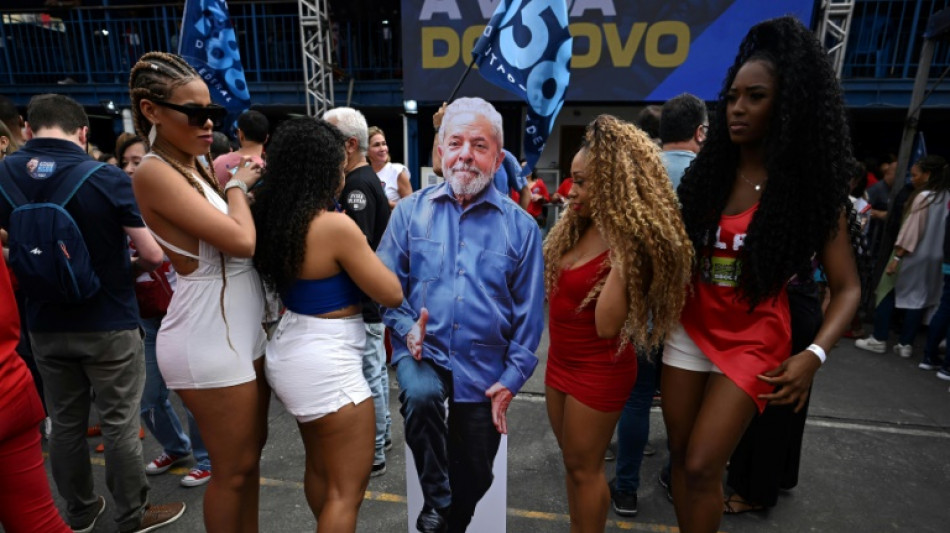
In Brazil election run-up, even samba is political / Photo: Carl DE SOUZA - AFP
 Cash-strapped Senegalese unmoved by Youth Olympic Games
 Indonesia haze chokes neighbours, but little legal recourse

 Samad launches Pakistan into first Asian Games men's cricket final
 Yankees and White Sox advance, Phillies survive in MLB playoffs
 Asian stocks mixed as positive US data offset by elevated oil, bond yields
 Rice work: Dutch test new crop to save sinking peatlands
 Russians join street choirs to sing away sorrows -- or show dissent
 UK fears grow over AI giant Palantir's health service deal

 Empty nets in Latin America as fish flee El Nino

 Meidroth blasts White Sox through, Phillies survive in MLB playoffs
 'Catastrophic': Swiss glaciers lose fifth of mass in five years
 Great Western Mining Corporation PLC Announces Board Change & Appointment of New CFO
 California roller coaster shut after brain damage claims

 Panama ministers push for reopening of huge open-pit copper mine

 Bohm's blast keeps Phillies alive in MLB playoffs

 US judge accepts Paramount's Warner Bros. buyout settlement

 Global stocks mixed as markets weigh higher oil prices, bond yields
 Marsh hails improvements after Australia win final one-day international
 Hegseth says US cut number of generals, admirals by 20%
 Kanye West's Russian concerts have been cancelled, organisers say

 First Hollywood, now Fat Bear Week: nepobaby wins Alaska contest
 Barcelona lay down marker in Women's Champions League, Arsenal slip up
 US pushes against overproduction with eye on China at G20 meeting
 Swiss FA withdraws support for FIFA chief Infantino
 Man City's meteoric rise clouded by financial scandal
In Pedra do Sal, the birthplace of samba in Rio de Janeiro, supporters chant "Ole, Ola, Lula" as they sway rhythmically, brandishing flags, T-shirts and caps bearing the likeness of Brazilian presidential candidate Luiz Inacio Lula da Silva.
In a nod to the symbolism of samba's Afro-Brazilian character in a country of divisive identity politics, the leftist ex-president chose the Portela samba school for one of his final rallies before Sunday's first round of presidential elections.
"Samba is a way to resist oppression, it is the voice of the people. And Lula represents the people," says Karen Gama, a 24-year-old black Brazilian who attended the rally last week with stickers of Lula's Workers Party stuck to her chest and rear.
She was among thousands dressed in red -- the color of Lula's Workers Party -- who turned out to listen to the former steelworker who is seeking a third term as president, already having served from 2003 to 2010.
His main rival is far-right incumbent Jair Bolsonaro, whose government is closely allied to conservative and evangelical movements often hostile to samba and its association with Afro-Brazilian culture and religions.
- Pragmatic -
"By coming here, he (Lula) returns to his popular base," says Joao Diamante, who grew up in a Rio favela.
Diamante, a chef, said he was able to study gastronomy thanks to the university scholarships put in place under the Lula presidency for young people from low-income backgrounds.
"We came here to cheer on the only president who valued us, black people and minorities. We were extremely attacked during the Bolsonaro mandate," says Douglas Williams, a 30-year-old nurse with an LGBTQ flag wrapped around his head.
Samba has not always been associated with left-wing ideas, says Wagner Pralon Mancuso, a professor of political science at the University of Sao Paulo.
"There are well-known samba schools that exalted Brazil during the military dictatorship (1964-1985)," he says.
More recently, several Rio samba schools supported Marcelo Crivella, a pastor of the evangelical right, in his successful 2016 campaign for the mayorship of the city.
Samba "schools are pragmatic because they depend on public funds," explains Marco Teixeira, a political scientist at the Getulio Vargas Foundation.
And Veiga de Almeida Guilherme Guaral, an academic who studied the links between politics and samba, says that "today, schools remember that the governments of Lula supported cultural events."
- 'Form of resistance' -
Earlier this month, the band Samba Independente dos Bons Costumes, believing themselves in friendly territory, were booed off the stage when they played a pro-Lula song at a Rio concert.
"Art is an essential political tool in our democracy, and samba is political in essence," the group said in a response on Instagram.
"In other words, much more than a musical genre, samba is an instrument of socio-political change."
Claudio Cruz, the owner of a samba bar in central Rio, agrees.
"Samba has always been a form of resistance to inequality, so it is more than normal that the world of samba supports Lula today," says Cruz, who has installed a 10-meter (33-foot) helium-filled figurine of Lula on the sidewalk outside his bar.
L.Durand--AMWN